
Vandaag of morgen in huis

Kwaliteit gegarandeerd

Welkomstaanbiedingen ontgrendelen: GRATIS bezorging | Tot 80% korting | Gratis 30 dagen JoyPlus-proefperiode
Download de app
A food processor can chop, slice, grate, mix, purée and sometimes even knead or blend. However, having a large number of functions does not automatically make it the right choice. An appliance that sits on your worktop every day should above all suit your portion sizes, available space and cooking style.
When buying a food processor, do not focus solely on wattage or the number of accessories. The most important differences are often found in the bowl, drive system, cleaning requirements and the accessories you will actually use.
A motor rated at 1300 watts sounds impressive, but it does not tell you how large the bowl is, how long the appliance can run continuously or which accessories are included. A compact mini chopper with a lower power rating may be perfectly adequate for onions, herbs and soft vegetables. For dough, hard vegetables or larger quantities, a more powerful model with a suitable bowl is more practical.
So, use the power rating as just one part of your comparison. Also check the maximum capacity, speed settings and instructions for using the pulse function.
The capacity stated on the packaging is not always the same as the amount you can process safely. For example, the Philips Avance HR7776/90 has a 3.4-litre bowl, but a maximum capacity of 2.4 litres for dry or liquid ingredients. The stated maximum amount for flour is 1000 grams.
A bowl that is too small means working in several batches. On the other hand, a bowl that is too large can be inconvenient for small portions. Look at the usable capacity and match it to your household.
A multifunctional food processor with lots of discs, blades and attachments can be useful, but only if you use them. Before buying, check whether the set suits your cooking routine:
A standalone electric mini chopper can sometimes make more sense than an elaborate food processor if you mainly chop small quantities.
For a small household, a compact food processor of around 0.5 to 1.3 litres is often sufficient. For families, models with approximately 2 to 3.4 litres are more practical, depending on the usable capacity. Also check the height beneath your kitchen cupboards and where you will store the accessories.
An appliance weighing 5 kg or more will generally remain more stable, but it is less convenient to store. A small model is more practical for everyday use, provided you do not want to prepare large portions at once.
A food processor rated at 300 to 450 watts is suitable for simple chopping tasks and soft ingredients. Models rated at 700 to 1000 watts offer more scope for hard vegetables, grating, mixing and some dough preparations. A higher stated power rating, such as 1300 watts, may be useful for more intensive use, but always follow the maximum operating time stated in the manual.
A pulse function helps you control the texture more precisely. Two speeds may be enough for a mini chopper; if you prepare a variety of dishes, you may benefit more from several settings or automatic programmes.
Check that the blades are made of stainless steel and that the bowl locks securely into place. A non-slip base helps keep the appliance steady. On models with a safety lock, the blade will only operate when the bowl and lid are positioned correctly.
Always unplug the appliance before cleaning it. Only handle sharp blades by the plastic centre section and check whether the components are dishwasher-safe. The product descriptions of various models mention dishwasher-safe accessories, but always consult the manual for the specific component.
When processing raw meat, thorough cleaning is particularly important. Do not use boiling liquids in a bowl or blender unless the product instructions specifically allow it.

Why it suits this profile: The 2.3-litre bowl and compact design are suitable for everyday preparations without taking up the space of a large appliance on your worktop. According to the product description, this model has an 800-watt motor, two speeds and a pulse function.
The specifications clearly state the bowl capacity and speed control, so you are less likely to pay for functions you do not need.
800 watts, 2.3-litre bowl, compact size, plus functions for chopping, mixing, slicing and grating.
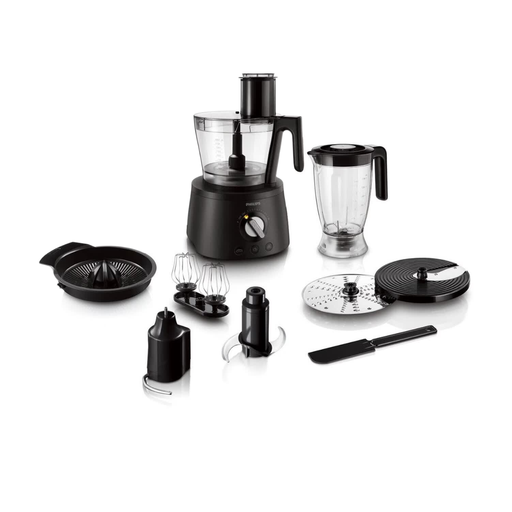
Why it suits this profile: This model is aimed at users who prepare a wide variety of dishes. According to the product description, it offers 1300 watts, 12 speeds plus pulse, a 3.4-litre bowl and multiple accessories.
The stated maximum quantities make it clear that the full bowl cannot always be used. This helps you plan your portions.
1300 watts, 3.4-litre bowl, 12 speeds plus pulse, and accessories for tasks including dough-making, whisking, juicing citrus fruit and slicing.

Why it suits this profile: The product description lists functions for chopping, blending, juicing and grinding. This makes the model an appealing option if you want one appliance for vegetables, sauces and certain meat preparations.
The 1.8-litre capacity is easy to manage and, according to the product description, the components are removable. However, check in advance which parts are dishwasher-safe.
750 watts, 1.8-litre capacity, blending and grinding functions, and removable components.

Why it suits this profile: Combining a food processor and blender suits users with limited space who still want to chop, grate, knead and make smoothies. The product details state 900 watts, 1.3 litres and seven speed levels.
You do not have to buy two separate appliances. However, check whether 1.3 litres is enough for your portions.
900 watts, seven speeds, blending function, 600 ml personal blender and direct serving via Express Serve.
We have put together a complete, up-to-date list of products that fully meet these strict selection criteria and the applicable European safety regulations.
Not always. A food processor is generally designed for chopping, slicing, grating and mixing. A stand mixer is often primarily intended for kneading, whisking and mixing in a mixing bowl. Some models combine both functions. Therefore, check the included accessories rather than relying on the product name alone.
Its lifespan depends on usage, maintenance and workload. Use a food processor within the stated maximum capacity and, when working with heavy ingredients, use short pulses if this is recommended in the manual. Allow the motor to cool down if the appliance becomes hot, and replace damaged blades or accessories only with compatible parts.
Electricity consumption depends on the power rating and how long the appliance is used. In theory, an 800-watt appliance uses 0.8 kilowatt-hours when running continuously for an hour, but chopping or slicing usually takes only a few minutes. Actual consumption therefore depends mainly on how often and for how long you use it.
