
Vandaag of morgen in huis

Kwaliteit gegarandeerd

Welkomstaanbiedingen ontgrendelen: GRATIS bezorging | Tot 80% korting | Gratis 30 dagen JoyPlus-proefperiode
Download de app
A food processor can take care of much of the preparation: chopping vegetables, grating cheese, kneading dough or blending ingredients. However, it is not wise to look only at the wattage or the number of accessories. A machine that appears to do everything on paper may be awkward in practice if the bowl is too small, parts are difficult to clean or accessories end up unused in a kitchen cupboard.
This guide helps home cooks, busy families and households with limited kitchen space choose a food processor that suits their everyday cooking.
A food processor with a powerful motor sounds appealing, but the power rating does not tell the whole story. A 1300-watt motor may be suitable for larger quantities or heavy dough, while a compact food processor with 650 or 700 watts may be sufficient for onions, herbs, cheese and vegetables.
Also consider:
A higher wattage is therefore no guarantee of better results. Look at the combination of power, capacity and features.
“More than twenty functions” can refer to different preparations using just a few accessories. So check whether the set actually includes an S-blade, reversible grating and slicing disc, dough hook, whisk or blender jug.
For anyone who regularly meal preps, chopping, slicing, grating and blending are particularly important. If you make bread dough, you will also need a suitable dough hook and sufficient bowl capacity. A food processor with accessories is only practical if they are easy to fit and store.
A food processor used every day often comes into contact with oil, dough, raw vegetables or meat. Parts that are difficult to reach can make the appliance less appealing to use. Check whether the removable parts can be taken off easily and whether they are dishwasher-safe.
Pay attention to the difference between dishwasher-safe parts and the motor base. The motor base must never be immersed in water or placed in the dishwasher. Sharp blades and grating discs must also be handled with care, including during cleaning.
The bowl capacity is not always the same as the maximum quantity you can process safely. For example, the Philips Avance HR7776/90 has a 3.4-litre bowl, but the stated maximum capacity for dry or liquid ingredients is 2.4 litres. The maximum stated amount of flour is 1000 grams.
For a household of one or two people, 0.9 to 1.5 litres may be sufficient. A family or anyone preparing several meals at once will benefit more from around 2 to 3 litres of usable capacity.
A simple food processor with one speed and a pulse function is straightforward and suitable for basic preparation. Multiple speeds offer greater control when working with soft fruit, hard vegetables, whipped cream or dough, for example.
According to the product specifications, the Philips Avance has 12 speeds, a pulse function and three one-touch programmes for dough, whipped cream and chopping. The Bosch MCM3200W has two speeds plus pulse and is designed for chopping, blending, slicing and grating.
Measure not only the worktop, but also the height of the appliance with the bowl and lid in place. A model may look compact, yet require considerable storage space because of its accessories.
For small kitchens, models with integrated cable storage or accessories that fit inside the bowl are convenient. A compact food processor is particularly useful if you can quickly get it out and do not have to dismantle it after every use.
A food processor with a blender can replace several appliances, but check the capacity and material of the blender jug. The Kenwood MultiPro OneTouch FDM73 has a 1.5-litre blender and a 3-litre bowl. According to the product description, it can weigh, mix, knead, purée, chop, grate, slice and crush ice, among other functions.
For mincing meat, a separate mincer attachment is important. The Monsga G100 is, for example, an electric meat mincer with three mincing discs, a sausage filler and kibbeh accessories. It is not a replacement for every food processor, but it may be suitable for users who mainly prepare mince and sausages.

Why it suits this profile: This model provides a straightforward foundation for everyday chopping, blending, slicing and grating without taking up too much space on the worktop.
The specifications clearly state a 2.3-litre bowl, 800 watts and two speeds plus pulse. This makes it clearer what you are buying than a general list of functions would.
800 watts; 2.3-litre bowl; suitable for chopping, blending, slicing and grating.
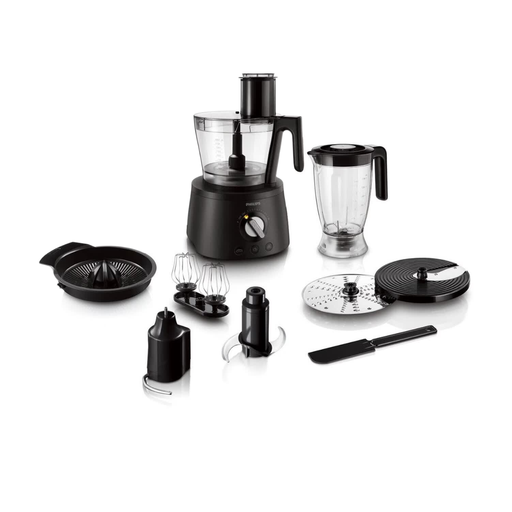
Why it suits this profile: The spacious bowl and extensive accessory set are ideal for households that want to prepare a variety of dishes with one multifunctional kitchen appliance.
The capacity is broken down into a 3.4-litre bowl, a maximum dry or liquid capacity of 2.4 litres and a maximum of 1000 grams of flour. The product information also states that the accessories are dishwasher-safe.
1300 watts; 12 speeds plus pulse; more than 30 listed functions; 3.4-litre bowl.
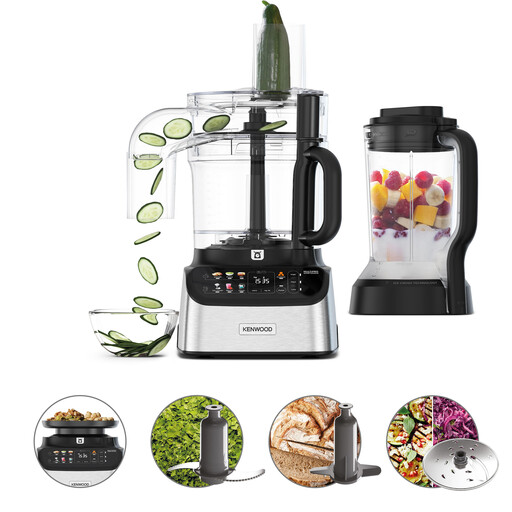
Why it suits this profile: This model combines a food processor with a blender, dough hook and integrated scales for users who prepare a wide range of dishes.
The key functions are linked to specific components: a 3-litre bowl, a 1.5-litre blender, slicing and grating discs, a dough hook and digital scales.
1000 watts; 3-litre bowl; 1.5-litre blender; automatic programmes and ice-crushing function according to the product description.
We have put together a complete, up-to-date list of products that fully meet these strict selection criteria and the applicable European safety regulations.
Always use the supplied pusher and never put your fingers or kitchen utensils into the feed tube while the appliance is running. Place the machine on a flat, dry surface and wait until the blades and discs have come to a complete stop before opening the lid.
Also follow the product manual. According to their safety information, some compact blenders may only be used for short cycles, with a cooling break between heavy preparations. Do not process boiling liquids in an appliance that is not designed for them.
Yes, particularly if you regularly prepare larger quantities of vegetables, herbs, cheese, sauces or dough. Choose a bowl that suits your portions and check the maximum working capacity. A model with a wide feed tube can speed up preparation because you will need to do less pre-cutting.
For basic tasks such as chopping, slicing and grating, around 600 to 800 watts may be sufficient. For heavy dough, larger quantities or more intensive use, a model with a higher stated power rating may be more practical. Always check the maximum capacity and operating time per cycle as well.
Electricity costs depend on the power rating and operating time. An 800-watt appliance running for ten minutes theoretically uses around 0.13 kWh. In practice, a food processor often runs for less time, for example in pulses. Cleaning, replacing accessories and the available warranty are therefore at least as relevant to the overall cost of ownership.
