
Vandaag of morgen in huis

Kwaliteit gegarandeerd

Welkomstaanbiedingen ontgrendelen: GRATIS bezorging | Tot 80% korting | Gratis 30 dagen JoyPlus-proefperiode
Download de app
A food processor can chop vegetables, mix ingredients, prepare dough, and sometimes even blend or grind. However, not every appliance is designed for the same purpose. A compact chopper is handy for small portions, while a multifunctional food processor requires more space and accessories.
The most common buying mistakes aren't usually due to a lack of power, but rather mismatched expectations. That's why it's essential to first consider what you'll actually be using the appliance for.
Packaging that boasts terms like “10-in-1” sounds versatile, but you should always check what's actually included. An appliance might be advertised as a blender and food processor, but the set may not include a suitable disc for grating or slicing.
Therefore, you should check:
A higher wattage doesn't automatically mean you can process larger quantities. The bowl capacity and the recommended maximum fill level are just as important. A compact 500 ml food processor is fine for small portions of onions, herbs or nuts, but less practical for a large family.
Note the difference between:
Sharp blades, lids, rubber seals and narrow openings can make cleaning a real chore. An appliance that's difficult to take apart after every use is more likely to stay in the cupboard.
Check beforehand whether:
For sauces, herbs and small quantities, a bowl of around 500 ml is often sufficient. If you regularly prepare vegetables or make multiple portions, you'll be better off with 1.3 to 2.1 litres. Remember to consider the available space on your worktop and in your kitchen cupboards.
A large bowl isn't always more convenient: with small quantities, ingredients can get stuck under the blade. A compact chopper might be more efficient in that case.
A stainless steel blade is standard for chopping and slicing. For a vegetable slicer, the shape and thickness of the slicing and grating discs are more important than the number of accessories on the box. Also, check if you need to pre-cut your ingredients.
For a meat grinder, different grinding plates are key. Fine, medium and coarse plates offer more control over the texture. According to the product description for the Monsga G100, three cutting plates are included. This is practical for things like mince, fillings and sausage making, but the safety instructions state that the parts must be washed by hand.
Two speeds and a pulse function provide enough control for most tasks. A pulse button helps you to chop onions or herbs briefly without making them too fine. With powerful appliances, pay attention to the recommended operating and rest times. The ochama food processor, for example, mentions short pulses and a maximum of 60 seconds of continuous blending per cycle, with a cool-down period for heavy loads.
Important: Do not use a food processor for boiling liquids unless the manual explicitly allows it. Steam pressure can force the lid off and cause burns. Always unplug the appliance from the socket before cleaning.

Why it's a good match: This model takes up little space and combines chopping, slicing and grating in a 1.3-litre bowl. This makes it ideal for daily meal prep without needing a large food processor on your worktop.
The functions are clearly defined: chopping, slicing, mixing and grating. The included Express Serve attachment can process ingredients directly into a bowl or pan.
650 W, one speed plus pulse function, cord storage and dishwasher-safe parts, according to the product description.
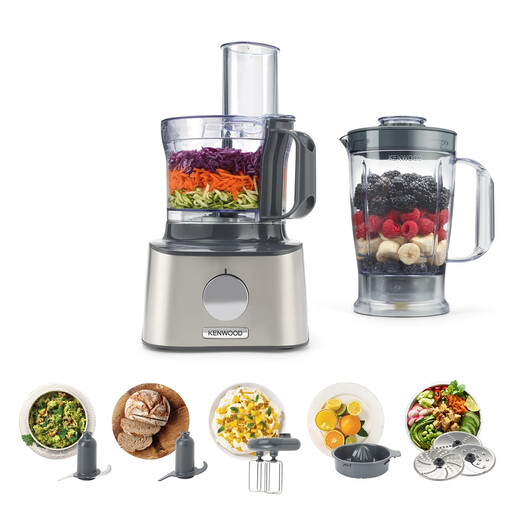
Why it's a good match: The 2.1-litre bowl and included blender jug offer plenty of capacity for families and home cooks who want to perform multiple tasks with a single base unit.
The functions are linked to the included accessories: chopping, slicing, grating, mixing, kneading, whisking and juicing. Be sure to check beforehand which parts you actually need.
800 W, 2.1-litre bowl, 1.2-litre blender capacity and dishwasher-safe accessories, according to the product specifications.
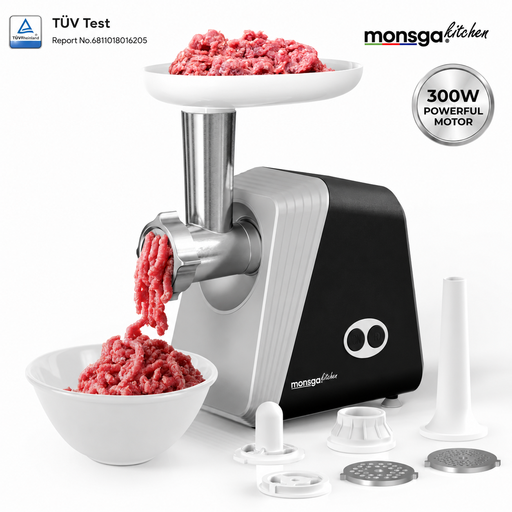
Why it's a good match: This appliance is aimed at those who want to grind meat at home and also make sausages, kibbeh or cookie dough with the included attachments.
The three grinding plates make the distinction between a general chopper and a device for specific meat preparations much clearer. The parts are not intended for the dishwasher.
300 W rated power, up to 1200 W maximum power, three cutting plates, reverse function and accessories for sausage and kibbeh, according to the product description.
We've put together a complete, up-to-date list of products that fully meet these strict selection criteria and comply with current European safety regulations.
Choose an electric chopper if you mainly process onions, herbs, garlic or small amounts of vegetables. A kitchen machine with a blender is more suitable if you also want to make smoothies, sauces, dough or larger portions. For just grating and slicing, a manual vegetable slicer can be cheaper and simpler.
A food processor for home use is most useful when you're preparing food several times a week. In that case, don't just look at the number of functions, but at the combination of bowl capacity, accessories, ease of cleaning and available storage space.
The lifespan depends on use, maintenance and how much you push it. Work in short pulses when recommended, let the motor cool down after heavy tasks, and don't force hard ingredients. Check the blades and discs regularly for damage. Many of the models in this selection come with a statutory warranty period of at least two years; always check the terms and conditions on the product page.
A food processor typically only uses electricity for a short time, so the running costs per use are usually low. The exact consumption depends on the power rating and how long the motor is running. An 800 W appliance running for one minute would theoretically use about 0.013 kWh. The purchase price, replacement accessories and cleaning are often more significant costs.
You can, but only if the manual and accessories permit it. For raw meat, it's best to use a dedicated meat grinder or bowl. Clean the blades, bowl and lid immediately after use with hot water and washing-up liquid. The motor base must not be submerged in water. Keep sharp parts out of the reach of children and hold blades by the plastic centre hub.
