
Vandaag of morgen in huis

Kwaliteit gegarandeerd

Welkomstaanbiedingen ontgrendelen: GRATIS bezorging | Tot 80% korting | Gratis 30 dagen JoyPlus-proefperiode
Download de app
A food processor can chop, slice, grate, mix, purée, knead and sometimes even blend. Yet not every appliance is suited to the same tasks. If you only look at the wattage or the number of accessories, you could end up with a large machine that’s awkward to store, or a compact chopper that can’t handle dough or larger quantities.
This buying guide will help you approach purchasing a food processor with a clear focus. The selection is based on verifiable specifications such as capacity, power, functions, dimensions, accessories and maintenance.
A powerful food processor sounds appealing, but the wattage doesn’t tell you how big the bowl is, which blades are included, or how long the appliance can run continuously. A 1,300-watt motor can be handy for larger quantities and dough, while a 650-watt model may be perfectly adequate for everyday chopping and grating.
Also pay attention to the instruction manual. Some models can only be used for short pulses, or need to cool down between heavy tasks.
A multifunctional food processor can perform many tasks, but check which accessories actually come in the box. For grating and slicing, you need specific discs. For dough, you need a dough hook or kneading blade. What’s more, a blender jug isn’t included as standard with every food processor.
Brand product descriptions can present functions broadly. So be sure to assess the included parts and the stated capacity.
Don’t just look at the dimensions of the motor base. A large bowl, blender jug and set of discs together take up a fair amount of cupboard space. For a small kitchen, a compact food processor with integrated storage, or a model that fits in a drawer, is often more practical than a larger machine with accessories you rarely use.
A 3.4-litre bowl doesn’t mean you can always process 3.4 litres of ingredients. Manufacturers sometimes list a separate maximum capacity for liquids, dry ingredients or flour. The Philips Avance HR7776/90, for example, has a 3.4-litre bowl, but the stated maximum capacity for dry or liquid ingredients is 2.4 litres. For flour, a maximum of 1,000 grams is given.
For one or two people, a bowl of 1.3 to 2.1 litres may be sufficient. If you often cook for several people, make dough, or process large batches of vegetables, a roomier model will serve you better.
An 800-watt food processor isn’t necessarily more suitable than a 650-watt model. Look at the combination of motor power, speeds and accessories:
The Kenwood MultiPro Compact+ FDM313 has, according to the product information, an 800-watt motor, two speeds and a pulse function. The Philips HR7776/90 offers 12 speeds, a pulse function and three automatic programmes for dough, whipped cream and chopping.
Check whether the parts are suitable for your recipes. A food processor with grating and slicing discs is handy for vegetables, cheese and potatoes. A food processor for dough needs a suitable kneading attachment and enough bowl space. A food processor with blender combines a mixing bowl with a separate jug, but generally takes up more room.
Pay attention to the materials. Stainless steel blades and discs are standard for slicing and grating. A glass jug or bowl is sturdy but heavier than plastic. For easy-to-clean food processors, dishwasher-safe, removable parts are practical. The motor base must not be submerged in water.

Why this fits: A practical choice for small households with limited worktop and cupboard space, who mainly want to chop, slice or grate vegetables.
The specifications state a 1.3-litre bowl and 650-watt power. The compact size means you won’t pay for a large system you don’t need.
According to the product description, this model features a reversible slicing and grating disc, dishwasher-safe parts and an Express Serve outlet.
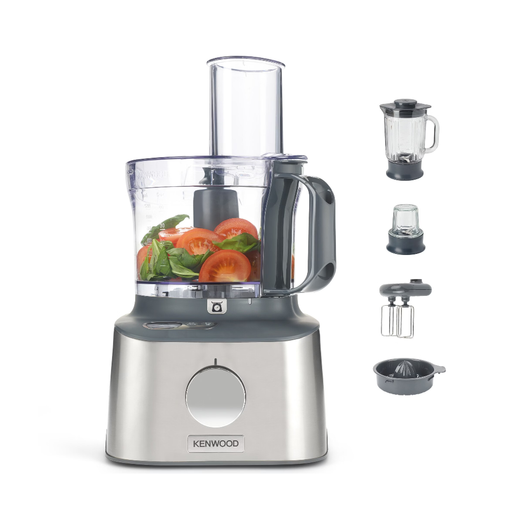
Why this fits: For home cooks who want to combine multiple functions without placing a large kitchen machine on the worktop.
The product information specifically mentions a 2.1-litre bowl, a 1.2-litre glass blender and a built-in scale. This makes the functions clearer than a general claim about lots of accessories.
According to the product description, you can chop, grate, slice, blend, knead, whisk and make juice with it. The stated power is 800 watts with two speeds and a pulse function.
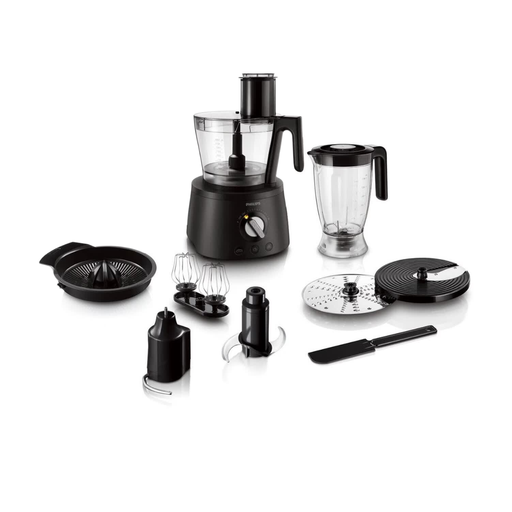
Why this fits: Suitable for households that often prepare larger portions, dough, whipped cream, sauces or sliced vegetables.
The product data lists separate limits for total bowl capacity, liquids and flour. This helps you assess the capacity more realistically.
According to the product description, this model features 1,300 watts, 12 speeds plus pulse, and accessories including a dough hook, citrus press, whisk and adjustable slicing disc.
Browse a current selection of food processors and compare capacity, materials, functions and accessories for your kitchen.
For one or two people, a bowl of around 1 to 2.1 litres is often practical. A smaller chopper of 500 to 900 millilitres suits herbs, onions, nuts, dips and small portions. Just check whether the stated capacity is the total or usable volume.
The lifespan depends on use, maintenance and following the instructions. Let the motor cool down after heavy tasks, don’t exceed the maximum fill level, and handle blades and discs with care. In the product data for the models mentioned, a statutory warranty of at least two years is typically stated. Your legal rights as a consumer remain applicable.
The stated wattage is the maximum electrical power, not necessarily the consumption during every task. A 1,300-watt appliance that runs for a few minutes may actually use less energy than a lighter model that has to work much longer. So choose the power based on your tasks, not just the highest number.
