
Vandaag of morgen in huis

Kwaliteit gegarandeerd

Welkomstaanbiedingen ontgrendelen: GRATIS bezorging | Tot 80% korting | Gratis 30 dagen JoyPlus-proefperiode
Download de app
A food processor can chop vegetables, mix ingredients, purée sauces and sometimes also slice, grate or grind. However, not every appliance is suitable for the same tasks. A compact electric chopper is handy for herbs and onions, while a multifunctional food processor offers more space and accessories for a family.
The product name does not always tell the full story. Pay particular attention to the practical specifications and avoid these common buying mistakes.
A higher wattage does not automatically mean that you can process larger quantities. A mini food processor with a 500 to 900 ml bowl is suitable for small portions, dips and herbs. For family meals, you will benefit more from a bowl of around 2 litres or larger.
Also check whether the manufacturer states a maximum fill level. The nominal capacity is not always the same as the amount you can process safely and evenly.
An appliance with a blender, meat grinder, vegetable slicer and several grating discs sounds versatile. In practice, accessories take up extra storage space and require more time to clean. Choose functions that fit your regular cooking routine.
For everyday chopping, a food chopper is often enough. If you also want to slice, grate, mix and purée, it is better to look at a compact kitchen machine or multifunctional food processor.
Sharp blades, a difficult-to-remove lid or components that are not easy to take apart can make an appliance less appealing after just a few weeks. Check the following in advance:
A glass bowl is less prone to retaining smells and discolouration than some plastic bowls, but it is heavier and can break if knocked hard or exposed to a sudden change in temperature.
For soft ingredients such as fruit, cooked vegetables and herbs, lower power is often sufficient. For nuts, raw vegetables or meat, power, blade design and pulse control are more important. A pulse function delivers short bursts, giving you greater control over the texture.
Also consider the number of speed settings. Two settings plus pulse generally offer more control than a single button, especially when you want to create both a fine purée and a coarser chop.
Think in terms of portions:
A food processor with a glass bowl is practical when you want to see the texture and limit smells. Do check whether the bowl and lid are heat-resistant. According to the product information for some models, these components are not suitable for boiling-hot ingredients or microwave use.
An appliance with slicing and grating discs can save time when preparing potatoes, carrots, cucumber and cheese. A separate meat grinder is more useful if you regularly mince meat or make sausages. A small bowl is handy for preparing baby food, but always process raw meat and prepared food separately and clean the components immediately afterwards.
Do not just look at the number of accessories, but also consider storage. A stackable design or integrated storage solution prevents loose discs and blades from disappearing into a kitchen drawer.
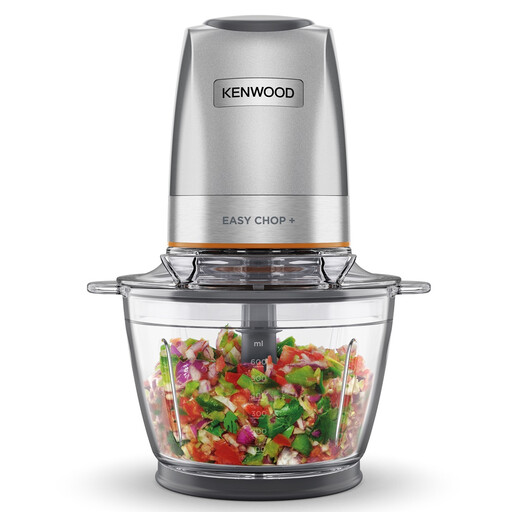
Why it suits this profile: This electric chopper has a 600 ml bowl and two speed settings. It is well suited to small everyday preparations without taking up the space of a large appliance on your worktop.
The glass bowl keeps the contents visible, while the two speed settings give you more control than a model with on/off operation only.
600 ml glass bowl, 500 W power, two speed settings and, according to the product information, a non-slip ring and dishwasher-safe removable components.
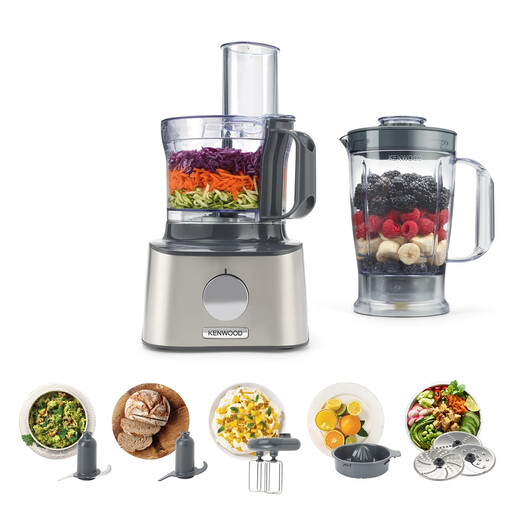
Why it suits this profile: This model is designed for households that want to carry out several preparation tasks with one kitchen machine, including chopping, slicing, grating, mixing and juicing.
The specifications clearly state the capacity and functions: a 2.1-litre bowl, two speed settings and separate accessories for different tasks.
800 W power, 2.1-litre bowl, 1.2-litre blender capacity and, according to the product information, dishwasher-safe accessories.
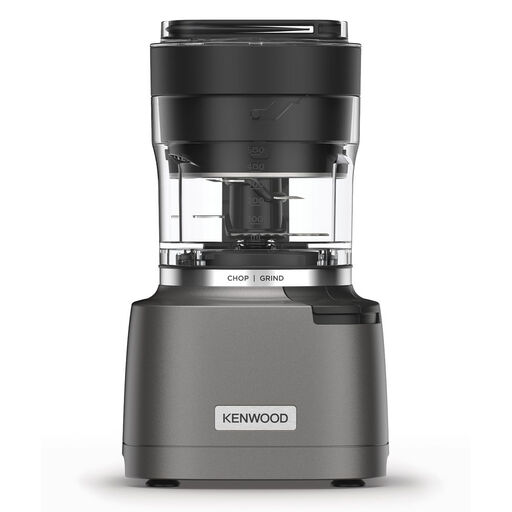
Why it suits this profile: This model combines a 500 ml chopping bowl with a separate grinding cup. This means you can process herbs, coffee or hard ingredients separately from vegetables, for example.
The two separate bowls help prevent flavours from mixing. According to the product information, the supplied components can be washed in the dishwasher.
800 W power, two speed settings, a Quadblade chopping system according to the product information, and a separate stainless steel grinding cup.
We have compiled a complete, up-to-date list of products that fully meet these strict selection criteria and the applicable European safety regulations.
Cut large ingredients into smaller pieces first. This puts less strain on the motor and produces more even results. With models that have a pulse function, use short intervals instead of running the appliance continuously for a long time. Always follow the maximum running time specified in the manual.
Also bear these points in mind:
Not always. A food processor is generally designed for chopping, slicing, grating, mixing and puréeing. A kitchen machine may also offer functions for kneading, whisking or juicing. So check the accessories rather than relying solely on the name on the packaging.
This depends on the quantity, hardness and blade design. For small portions, a 300 to 500 W model may be suitable according to the stated product specifications. For more frequent or heavier use, models around 750 to 800 W offer greater motor capacity. Always use short pulses and do not exceed the maximum fill level.
Electricity consumption per preparation is usually limited because you only use the appliance for a short time. Exact consumption depends on the wattage and running time. A 500 W model running for one minute theoretically uses around 0.008 kWh. The purchase price, ease of cleaning and available accessories therefore often have a greater impact on the overall user experience than the appliance’s brief electricity consumption.
