
Vandaag of morgen in huis

Kwaliteit gegarandeerd

Welkomstaanbiedingen ontgrendelen: GRATIS bezorging | Tot 80% korting | Gratis 30 dagen JoyPlus-proefperiode
Download de app
A food processor can take a lot of work off your hands, but not every model suits every kitchen. A home baker has different requirements from a family that mainly chops vegetables or makes smoothies. If you only look at wattage or the number of functions, you could end up with an appliance that takes up too much space, is difficult to clean or struggles with heavy dough.
Pay particular attention to these three common pitfalls:
For batter, whipped cream and light mixtures, an electric stand mixer with several speeds is usually sufficient. For bread, pizza or pasta dough, the combination of motor, drive system and dough hook is particularly important. A mixer for dough must also remain stable when the mixture becomes heavy.
Check the manual for:
Some models, for example, state that heavy yeast dough must not be kneaded for more than ten minutes at a time, followed by a cooling period. This is normal operating information, not an indication that the appliance can handle heavy work indefinitely.
A stainless steel bowl is practical for everyday use and generally does not absorb odours or colours from ingredients. Do not just look at whether it holds 5 or 6.5 litres; check the recommended fill quantity too. A 6-litre bowl is useful for family-sized portions, while a compact model is a better fit for a small kitchen or smaller preparations.
A splash guard helps when working with flour, batter and liquid ingredients. A tilt-head design makes it easier to change the whisk, beater or dough hook. Also check whether the bowl and accessories are dishwasher-safe. This does not always apply to every part.
A stand mixer is primarily designed for whisking, mixing and kneading. A multifunctional food processor can also chop, slice, blend or grind. Only choose additional functions if you will genuinely use them. A food processor with a meat grinder, for example, is interesting if you make burgers or sausages, while a blender attachment is useful for smoothies, sauces and purées.
Also consider the noise level. A quoted figure of 60 or 75 dB provides a useful point of comparison, but the experience depends on the surface, speed and ingredients. Non-slip feet or suction cups limit movement during mixing, but do not make an appliance completely silent.

Why it suits this profile: This model focuses on the essentials: mixing, whisking and kneading with a 5-litre bowl and ten speeds.
The product specifications state 400 W, a pulse function, and overload and overheating protection. This makes the power easier to assess than with models that only show a peak power rating.
5-litre stainless steel bowl, three standard accessories, tilt-head design and non-slip feet.
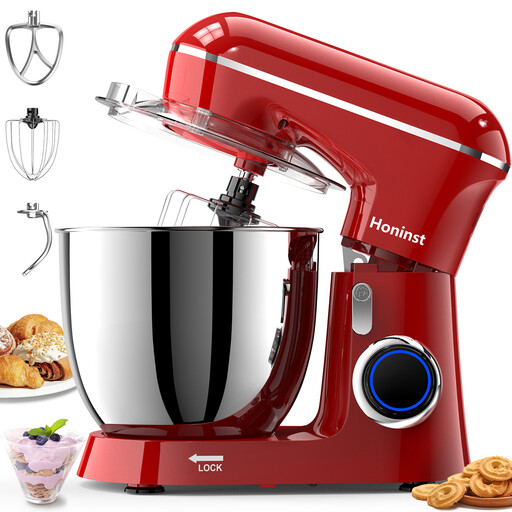
Why it suits this profile: Home bakers get a spacious bowl, ten speeds and a set for whisking, mixing and kneading.
The stated capacity, speed control and accessories are clearly specified. According to the product information, the model also comes with a splash guard and suction feet.
6.5 QT stainless steel bowl, tilt-head design, ten speeds and three included accessories.
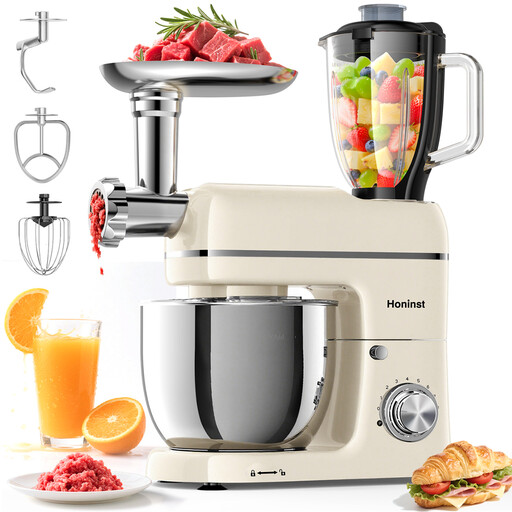
Why it suits this profile: This model combines a stand mixer with a blender and meat grinder for households looking to replace several appliances.
The functions are linked to specific accessories: a meat grinder for mince and a blender jug for smoothies, sauces and purées. Check beforehand that you will use these parts often enough.
1300 W maximum stated power, 6 QT bowl, eight speeds plus pulse function and a safety switch.

Why it suits this profile: This compact food processor can chop, slice, grate, knead and blend without the footprint of a large stand mixer.
The functions and capacity are clearly defined: a 1.3-litre bowl, seven settings and a separate personal blender. This helps prevent you from paying for accessories you do not need.
900 W maximum power, 1.3-litre bowl, six accessories and a 600 ml blender for individual portions.
Always place a food processor on a flat, dry surface. Lock the head and bowl in place before starting the motor. Add ingredients at a low speed where possible, then increase the speed gradually. Stop the machine completely before changing an accessory.
Keep the following points in mind:
We have put together a complete, up-to-date list of products that fully meet these strict selection criteria and the applicable European safety regulations.
Yes, a stand mixer with a dough hook can handle bread dough, provided you respect the maximum quantity and operating time. Start at a low speed and allow the motor to cool down when instructed to do so in the manual.
For a household with several people, 5 to 6.5 litres is practical for larger portions. If you mainly prepare sauces, vegetables or small quantities, a food processor of around 1 to 2 litres can save space and cleaning time.
Consumption depends on the power and operating time. A 1000 W appliance theoretically uses a maximum of 1 kWh in one hour, but in practice a food processor usually runs for less time and not continuously at maximum power. So consider the combination of wattage, preparation time and how frequently you use it.
