
Vandaag of morgen in huis

Kwaliteit gegarandeerd

Welkomstaanbiedingen ontgrendelen: GRATIS bezorging | Tot 80% korting | Gratis 30 dagen JoyPlus-proefperiode
Download de app
A food processor can take much of the chopping work off your hands: chopping vegetables, blending sauces, processing nuts or mincing meat. Yet many households buy an appliance that does not suit the way they cook. A compact electric chopper, for example, is handy for small portions but less suitable for a large family. A blender makes smoothies, but it does not automatically replace a food processor with grating and slicing discs.
As a Joybuy Product Recommendation Officer, I focus mainly on verifiable specifications. This helps you avoid paying primarily for a long list of accessories when the capacity, cleaning requirements or motor do not suit your everyday needs.
A higher wattage does not automatically mean that every ingredient will be processed more quickly or more effectively. Manufacturers sometimes state a maximum power rating, while the rated power is lower. The Monsga G100, for example, is listed as 300 W, with a maximum power of up to 1200 W. Always check which figure is given as the regular or rated power.
Also pay attention to the recommended operating time. Some appliances are designed for short pulses and need to cool down afterwards. The ochama blender, for example, is recommended for a maximum of one minute of continuous operation, followed by a two-minute wait when preparing heavy mixtures.
A 500 or 600 ml bowl is practical for herbs, pesto or a small amount of onion. For a family, several small batches are less efficient. A food processor with a 2.1 to 2.3-litre bowl provides more space for meal preparation, but also takes up more room on the worktop.
Also check whether the stated capacity refers to the bowl’s total capacity or its usable capacity. Do not fill a bowl to the brim, particularly when working with liquids or ingredients that expand during mixing.
A multifunctional food processor may come with blades, grating discs, a blender jug, a meat grinder and attachments for dough or sausages. However, every additional part requires storage and maintenance. Sharp blades and cutting discs must be washed carefully. The motor base must never be immersed in water.
Also check whether the accessories are dishwasher-safe. With some models, only the removable parts may be placed in the dishwasher; the motor housing must be cleaned with a lightly damp cloth.
For everyday chopping, blending and grating, the stated power of the selected models ranges between 350 and 800 W. A pulse function gives you greater control over the texture of ingredients such as onions, herbs and nuts. Two speeds are useful when processing both soft ingredients and firmer vegetables.
An electric chopper often works with a single push button. This is simple to use, but gives you fewer settings than a food processor with multiple speeds. For a blender, the quantity of liquid and maximum operating time are also more important than wattage alone.
A glass bowl is relatively resistant to odours and staining. Plastic is generally lighter. Stainless steel bowls are practical for raw ingredients and intensive use, but do not always allow you to see how finely the contents have been processed.
As a general guide:
A vegetable chopper is not the same as a meat grinder. A meat grinder uses an auger and grinding plates to process raw meat. A chopping blade cuts ingredients into smaller pieces but produces a different texture. If you also want to make sausages or kibbeh, check that the intended attachments are actually included.
Also look for a safety lock, stable non-slip feet and clear instructions. With any appliance fitted with sharp blades, unplug it before dismantling or cleaning, and do not touch the cutting edges directly.
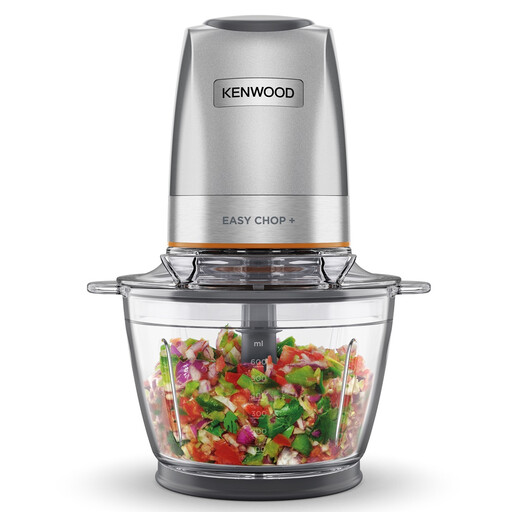
Why it suits this profile: The 600 ml capacity is manageable for smaller households and everyday portions of herbs, vegetables, sauces or ice.
The capacity and functions are clearly defined. You are not paying for a large set of accessories when you mainly want to chop.
500 W, two speeds, a 600 ml glass bowl and an ice-crushing function, according to the product information.
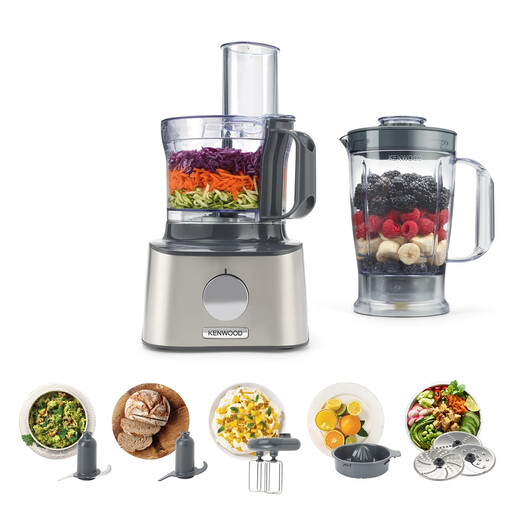
Why it suits this profile: This model is designed for cooks who want to carry out multiple preparations with one base unit, including chopping, grating, slicing, blending and juicing.
The key functions and capacities are clearly specified: a 2.1-litre bowl and a 1.2-litre blender capacity.
800 W, two programme settings, multiple accessories and dishwasher-safe removable parts according to the product description.
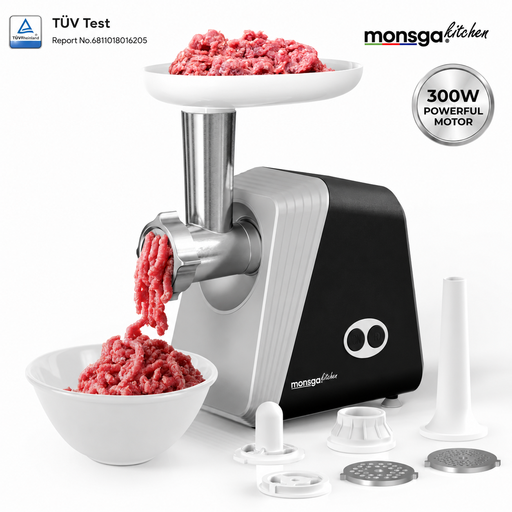
Why it suits this profile: A suitable choice for anyone who specifically wants to mince raw meat and prepare sausages or kibbeh at home.
This is not a general blender claim: the appliance comes with three grinding plates, a sausage filler and a kibbeh attachment.
Three textures using fine, medium and coarse grinding plates; the product information also mentions overload and overheating protection.
We have put together a complete, up-to-date list of products that fully meet these strict selection criteria and the applicable European safety regulations.
No. A blender is mainly designed for liquid preparations, smoothies, sauces and finely processing soft or liquid-rich ingredients. A food processor more often handles dry ingredients and, depending on the accessories, can also slice, grate, chop or knead. Some models combine both functions, but check the capacities of the individual bowls.
Its lifespan depends on the motor, materials, frequency of use and maintenance. Use short pulses when stated in the instructions, do not force hard ingredients and allow the motor to cool down between demanding batches. Wash the parts after use and only put them away once they are completely dry. In the European Union, many new consumer products are covered by a legal guarantee of at least two years; check the terms for the specific product and seller.
Power consumption is determined by the wattage and the length of time the motor runs. In theory, an 800 W appliance uses approximately 0.013 kWh after one minute of use. In practice, the actual power used during preparation also plays a part. More noticeable costs can include maintenance, replacement blades or accessories, and the time needed to clean the parts. A model that is easy to use and clean may therefore be more practical than a more sophisticated appliance that often remains unused in the cupboard.
