
Vandaag of morgen in huis

Kwaliteit gegarandeerd

Welkomstaanbiedingen ontgrendelen: GRATIS bezorging | Tot 80% korting | Gratis 30 dagen JoyPlus-proefperiode
Download de app
A food processor can be a useful assistant for baking and cooking, but not every appliance suits every kitchen. A compact hand mixer is ideal for cake batter and whipped cream, while a stand mixer with a mixing bowl is better suited to bread dough and larger quantities. If you mainly make smoothies, you are more likely to need a blender than a multifunctional food processor.
The biggest purchasing mistakes usually arise from three misconceptions:
A food processor is particularly useful if you regularly prepare a range of recipes. This could include mixing, whisking, kneading, chopping or grinding. However, be aware of the differences between these appliances:
Compare the rated power with the stated peak power. For example, the MONSGA SM100 is described as having 1000 watts of peak power and 600 watts of rated power. This distinction is important when you are looking for a powerful food processor for kneading and baking.
For heavy bread dough, power is not the only consideration. The manual may specify a maximum dough quantity and a rest period. When kneading, generally use a low to medium speed and do not exceed the maximum capacity. A motor that delivers a high amount of power for a short time is not automatically suitable for prolonged use at high speed.
Look at both the capacity and the recommended filling quantity. A stainless steel bowl is generally practical for everyday use and retains fewer odours than some plastic alternatives. Also check whether the bowl has a handle, whether it locks securely and whether the head can tilt.
A bowl of 5 litres or more can be useful for a family or larger baking batches. If you mainly make one cake or a small amount of whipped cream, you may have enough capacity with a hand mixer and a 3-litre bowl.
Check whether the set includes a whisk, flat beater and dough hook. For a food processor, slicing and grating discs are more important. Also look for:
A CE marking indicates that, according to the manufacturer, the product complies with relevant European product requirements. It does not mean that the appliance is suitable for every task. Therefore, also read the safety instructions and check the warranty and returns conditions.
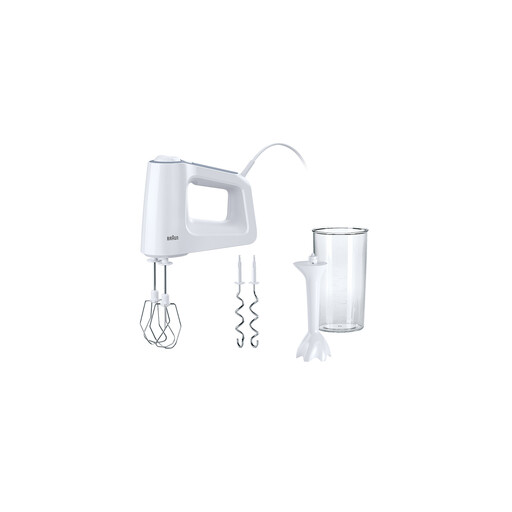
Why it suits this profile: This hand mixer is suitable for anyone who mainly makes cake batter, cream and light bakes, and does not want a large appliance taking up space on the worktop.
The controls offer several speeds, from low to turbo, and the accessories can be changed at the press of a button. This means you do not buy an elaborate system when all you need is a hand mixer.
Ergonomic non-slip handle and SmartMix technology according to the product description; suitable for everyday light baking.
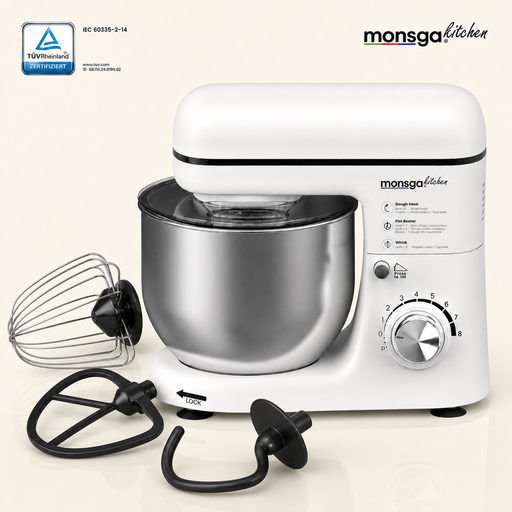
Why it suits this profile: Home bakers who regularly prepare bread, biscuits, cakes or whipped cream can benefit from a fixed food mixer with a spacious stainless steel mixing bowl.
The specifications state 600 watts of rated power alongside 1000 watts of peak power, and recommend a usable capacity of 5 litres in a 6-litre bowl. This makes the limits clearer than quoting a high wattage alone.
8 speeds, tilting head, dough hook, whisk, flat beater and splash guard. According to the product information, several accessories are dishwasher-safe.

Why it suits this profile: For anyone who chops lots of vegetables, slices or grinds ingredients, or prepares small portions, a food processor is more practical than a traditional stand mixer.
The set focuses on specific functions such as chopping, blending, juicing and grinding. The parts are removable; before buying, check the manual to see which components are dishwasher-safe.
750 watts of power, a 1.8-litre bowl and included functions for chopping, blending, grating and shredding.

Why it suits this profile: This blender is ideal for households that regularly make smoothies, sauces or mixed drinks for several people.
The working capacity is listed separately: 1.5 litres within a 2-litre jug. The blades are also removable for cleaning, so the larger capacity does not have to come at the expense of easy maintenance.
1000 watts, 3 speeds plus pulse function, removable blades and dishwasher-safe detachable parts according to the product information.
We have put together a complete, up-to-date list of products that fully meet these strict selection criteria and the applicable European safety regulations.
A stand mixer with a dough hook may be suitable for bread dough, but always check the maximum dough capacity and recommended usage time. Use a low or medium speed and allow the appliance to cool down when instructed to do so in the manual.
The lifespan depends on the materials, motor load, maintenance and frequency of use. An appliance will generally last longer if you do not overfill the bowl, lock the accessories in place correctly and do not run the motor for longer continuously than specified. Also check whether replacement accessories and parts are available.
Electricity consumption depends on the power rating and usage time. A 1000-watt appliance theoretically uses a maximum of 1 kWh in one hour, but food processors usually run for shorter periods and not continuously at full power. Consider your own usage pattern and do not choose a higher power rating than you need.
A hand mixer usually has fewer parts and is therefore quicker to tidy away. A food processor may have more accessories, but offers extra convenience when preparing larger quantities. Check which parts are dishwasher-safe for each model, and clean the blades, dough hooks and bowls immediately after use.
