
Vandaag of morgen in huis

Kwaliteit gegarandeerd

Welkomstaanbiedingen ontgrendelen: GRATIS bezorging | Tot 80% korting | Gratis 30 dagen JoyPlus-proefperiode
Download de app
A food processor can make cooking and baking easier, but not every model is suitable for the same tasks. A food processor is useful for chopping, grating and slicing, while a stand mixer is primarily designed for whisking, mixing and kneading. If you only look at the wattage or number of accessories, you could end up buying an appliance that proves too small, too noisy or too limited in everyday use.
Pay particular attention to these three common pitfalls:
First, consider which preparations you make most often.
A kitchen mixer or stand mixer with a mixing bowl is ideal if you regularly make cake batter, whipped cream, biscuit dough or bread dough. A planetary mixing action can distribute ingredients more evenly throughout the bowl. For heavy dough, always check the recommended quantity and use the low or medium speed when instructed in the manual.
A food processor is more practical for everyday cooking. With the right disc or blade, you can chop, grate and slice vegetables. Some models can also mix, knead, whisk or make juice. This type of multifunctional food processor often takes up less space than several separate appliances.
A model with a blender, meat grinder and mixing bowl may be appealing to families who want to prepare different recipes using a single motor unit. If so, pay extra attention to how the accessories are attached and how much storage space they require.
The stated wattage is a technical specification, not a guarantee of a particular result. A 450-watt food processor may be sufficient for normal baking, while a model with a higher stated peak power may not be able to process heavy dough continuously.
Therefore, check:
For example, the AUCMA stand mixer lists 450 watts of power, six speeds and a pulse function. According to the product information, this model should not run continuously for more than six minutes without a break. This type of information is more important than simply seeing a high number on the packaging.
A food processor with a 5- or 6-litre mixing bowl provides space for larger portions, but the amount of flour, dough or batter can vary from one recipe to another. The Monsga SM100 lists a capacity of 6 litres and a recommended capacity of 5 litres. Use the recommended figure as your starting point and prevent ingredients from spilling over the rim during mixing.
For a food processor, the total bowl capacity is likewise not the same as the usable quantity. The Kenwood MultiPro Compact FDM301 has a 2.1-litre bowl and a blender capacity of 1.2 litres. This is compact for everyday use, but less suitable if you often prepare very large quantities in one go.
A food processor with accessories is only versatile if the attachments suit your recipes. For baking, a whisk, beater and dough hook are usually the essentials. For cooking, a chopping blade, slicing discs and grater are more useful. A blender jug or meat grinder can provide extra functions, but also makes the appliance bulkier.
Also check:
Noise levels also deserve attention. The Monsga SM100 states a noise level below 75 dB, while AUCMA gives a range of 68 to 72 dB within one metre. These figures are only directly comparable if they were measured under the same conditions.
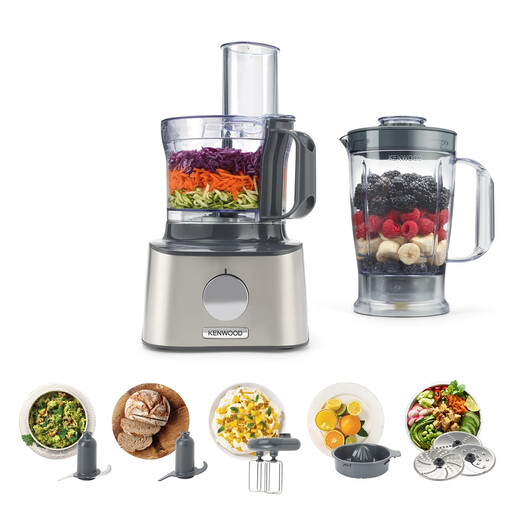
Why it suits this profile: This compact model combines chopping, slicing, grating, mixing, kneading, whisking and juicing in one base unit. The bowl has a capacity of 2.1 litres and takes up relatively little space.
The functions are clearly linked to the included accessories. This means you do not need to buy several separate appliances for basic tasks.
800 watts, two speeds, a 2.1-litre bowl and dishwasher-safe accessories according to the product information.

Why it suits this profile: This stand mixer is aimed at home bakers who want a spacious bowl and multiple speeds for batter, cream and dough. The manufacturer states a peak power of 1000 watts and a rated power of 600 watts.
The product information distinguishes between the maximum capacity of 6 litres and the recommended capacity of 5 litres. This helps when planning larger baking recipes.
8 speeds, a stainless-steel bowl, tilt-head design, splash guard and dishwasher-safe accessories according to the product description.
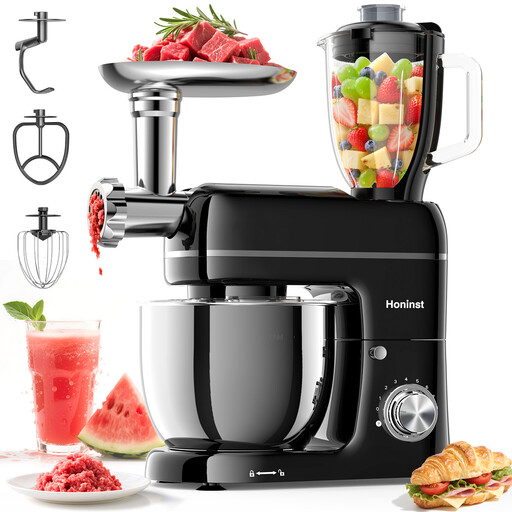
Why it suits this profile: According to the product description, this model combines a stand mixer with blender and meat grinder accessories. It is aimed at households that want to prepare smoothies, sauces and mince as well as baked goods.
The product information highlights the safety lock, tilt-head design and overheating warning. Before buying, however, check the exact accessory list and permitted quantities.
Maximum stated power of 1300 watts, 6 QT stainless-steel bowl, 8 speeds plus pulse function and multiple attachments.
We have put together a complete, up-to-date list of products that fully meet these strict selection criteria and the applicable European safety regulations.
That depends on the motor, dough hook, bowl and recommended dough capacity. Choose a stand mixer with a sturdy housing and use the low speed for heavy dough when specified in the manual. Do not exceed the recommended quantity; a large mixing bowl does not mean that you can knead a large quantity of bread dough.
Consumption is determined by the power and operating time. An 800-watt appliance running for ten minutes theoretically uses around 0.13 kWh. In practice, a motor does not always operate continuously at maximum power. Consider your own usage: short preparations such as chopping or whisking generally have a limited operating time.
Its lifespan depends on build quality, maintenance, workload and frequency of use. Clean the accessories according to the manual, allow the motor to cool down after heavy use and regularly check the cable, locks and attachments. In the EU, the products mentioned are covered by the statutory minimum two-year guarantee; additional rights may apply under the relevant national regulations.
