Who is a food processor for making breadcrumbs suitable for?

Family cook preparing portions

You want to process bread for a meal and are mainly concerned with usable bowl capacity and how many batches you’ll need. Magimix distinguishes between total capacity and processing capacity for the CS 3200 XL; Kenwood also gives a dry working capacity alongside the bowl capacity.

Cook who wants to control the crumb texture

You want to make fine or coarser breadcrumbs, so you’re looking at the chopping blade, portion size and whether you can use short pulses. Magimix shares its own recipe using a metal blade; Kenwood lists pulse control for the FDP22.130RD.

Cook with limited cupboard space

You make smaller quantities and are weighing up a compact appliance and easy cleaning against the capacity of a larger food processor. Cuisinart lists a 900 ml bowl and dishwasher-safe parts for the Mini Prep Pro; always check which parts of the version you choose can go in the dishwasher.

What should you look for when buying?

Full-size food processor

Choose this if: you regularly want to chop or slice bread and other ingredients for family meals, and have room for the bowl and accessories.

Consider: a larger stated bowl capacity doesn’t guarantee a larger working portion. Accessories also take up space and need maintaining.

Compact food processor or chopper

Choose this if: you make smaller portions, have limited cupboard space and don’t mind working in several batches if needed.

Consider: check the working capacity and whether a chopping blade is included; a compact model won’t necessarily be suitable for every slicing or kneading task.

No new electrical appliance

Choose this if: making breadcrumbs is your only task and you want to check first whether you already have a suitable tool.

Consider: you won’t get the convenience or any additional chopping and slicing functions a food processor may offer.

What to consider What to look for when buying Who is this important for?
Usable capacity Compare the working capacity and portion guidance with the amount of bread you want to process; don’t treat the total bowl capacity as the working amount. For example, Magimix lists a total capacity of 2,6 l and a processing capacity of 1 l for the CS 3200 XL. For a family meal, I want to know how much bread will actually fit in the bowl per batch, so I can work out how many batches I’ll need. Capacity is the top priority for around 36% of consumers.
Crumb texture Check that a suitable chopping blade is included and that the controls allow pulsing. In its own recipe, Magimix recommends processing around half a baguette at a time for finer breadcrumbs; follow the manual for other appliances. If I want fine or coarser crumbs, I want to be able to tailor the process to the recipe. Around 29% of consumers focus mainly on the texture they want.
Cleaning and storage Check whether each part is dishwasher-safe and whether the bowl and accessories will fit in the cupboard space you have available. If I don’t use an appliance every day, I want it to be easy to clean and put away afterwards. Maintenance and storage space are the main considerations for around 21% of consumers.
Cost and other uses Check which chopping and slicing accessories are actually included and whether you’ll use those functions. Wattage alone doesn’t show how well an appliance makes breadcrumbs. If I want to use the appliance for other tasks too, I compare the included functions with what I really need. Around 14% of consumers weigh up cost and versatility first.

Common buying mistakes

  • Assuming the total bowl capacity is the amount of bread it can process per batch

    The stated capacity and usable working capacity can differ. So a nominal capacity in litres doesn’t automatically tell you how much bread you can process at once.

    Compare the dry working capacity and portion guidance with the amount you plan to process, and follow the manual for your chosen model.

  • Choosing an appliance without checking that it comes with a suitable chopping blade

    A large bowl or a kneading function doesn’t prove that the model can chop bread.

    Check the accessories included with the exact version and whether the manufacturer says the supplied blade can be used to chop bread.

  • Expecting a compact chopper to have unlimited capacity

    A smaller working capacity may mean you need to process the bread in several batches.

    Compare the chopping bowl’s working capacity with your portion; a feed-through slicer, if included, doesn’t change the chopping bowl’s capacity.

Brands to consider

Bosch

MultiTalent food processors are worth considering if you’re looking at other chopping and slicing tasks as well as making breadcrumbs.

  • Bosch lists a 2,3 l bowl, two speed settings and a pulse function for the MCM3501M.
  • The bowl capacity doesn’t confirm how much bread will fit per batch. This information doesn’t establish how well this model makes breadcrumbs; also check which accessories are included.

Kenwood

The MultiPro Go FDP22.130RD is a compact food processor with a chopping blade, for anyone considering smaller portions.

  • Kenwood lists a 1,3 l bowl, a dry working capacity of 0,75 l and pulse control.
  • The dry working capacity may mean processing several batches. The product specifications aren’t a measured test of its breadcrumb-making performance.

Magimix

The CS 3200 XL is a larger food processor for anyone who wants to combine making breadcrumbs with other food preparation tasks.

  • Magimix lists a total capacity of 2,6 l, a processing capacity of 1 l and three bowls. Magimix also publishes its own breadcrumb recipe using a metal blade.
  • The recipe isn’t an independent comparison; the appliance and its accessories need storage space.

Cuisinart

The Mini Prep Pro ECH4E is a compact chopper for anyone who wants to make smaller quantities.

  • Cuisinart lists a 900 ml bowl, pulse buttons and chopping and grinding functions.
  • The stated bowl capacity doesn’t tell you how much bread can be processed per batch; before buying, check which version you’ll receive and which separate parts are dishwasher-safe.

Products at Joybuy

This selection includes food processors and choppers for chopping bread, from models with larger bowls to more compact options. For each product, check its usable capacity, the chopping blades included and the guidance for the portion you want to process.

ochama Food Processor 750W, 1.8L

ochama Food Processor 750W, 1.8L

A food processor to consider if you want to chop bread and have other chopping or slicing tasks in mind too; check that the included parts suit the way you plan to use it.

The product title lists 750W and 1.8L. The product information recommends using short pulses and cutting larger ingredients into 2 cm pieces first.

View product

Bear Electric Food Chopper QSJ-D03Q1, 2 glass bowls of 2L and 0.6L, 300W

Bear Electric Food Chopper QSJ-D03Q1, 2L/0.6L, 300W

A chopper to consider for chopping tasks; compare the bowl capacities with the amount of bread you want to process per batch.

The product title lists two glass bowls of 2L and 0.6L, and a power rating of 300W.

View product

IAGREEA MS-25JM08 Electric Food Chopper, 350W, three bowls

IAGREEA MS-25JM08 Electric Food Chopper, 350W

A chopper to consider if you want to compare which bowl best suits your portion; check the manual for its working capacity with bread.

The product title lists three bowls of 2.5L, 2.2L and 1.8L, and a power rating of 350W. The product information recommends pulses of up to 30 seconds per cycle and cutting larger ingredients into 2 cm pieces first.

View product
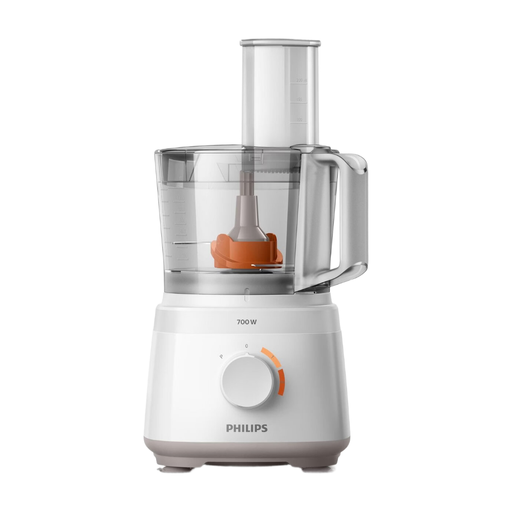
Philips Daily Collection Food Processor HR7320/00, 1.5 L, 700 W

Philips Daily Collection Food Processor HR7320/00, 1.5 L, 700 W

A compact food processor to consider for chopping tasks; check which parts and accessories are supplied with this version.

The product title lists a 1.5 L bowl and a power rating of 700 W.

View product

Bear Chopper QSJ-D03W5, 2L, 300W, 2 speeds

Bear Chopper QSJ-D03W5, 2L, 300W

A chopper to consider for chopping bread; check that its working capacity suits the quantity you want to prepare for a meal.

The product title lists a 2L bowl, a power rating of 300W and two speeds. The product information recommends short pulses, no more than 30 seconds of continuous use, and cutting larger ingredients into 2 cm cubes first.

View product

Frequently asked questions

Do I need a food processor or a stand mixer with a dough hook to make breadcrumbs?

For chopping bread finely, a food processor with a chopping blade is the obvious choice. The Consumentenbond describes food processors as being for tasks including chopping, while stand mixers are mainly for mixing, whisking and prolonged kneading; check that a chopping blade is included with the version you choose.

How can I make fine breadcrumbs without overfilling the bowl?

In one of its own recipes, Magimix recommends using slices of stale bread and processing around half a baguette at a time for a finer result. This is a Magimix recipe, not a universal maximum portion size for other models; follow your appliance’s manual.

What safety information should I check for a food processor used in the Netherlands?

The Dutch government states that electrical appliances placed on the market in the EU must meet the applicable safety requirements and carry the required CE marking. Check the marking and product information for the version you actually receive; a statement on a sales page doesn’t in itself verify the appliance delivered.

Do I need to pay for an extended warranty to have a statutory guarantee?

No. ACM ConsuWijzer explains that you have a statutory guarantee as well as any seller’s guarantee; with normal use, a product should last as long as you could reasonably expect. Consider paid-for extended cover separately, based on what it offers in addition to your statutory rights.

Can I always return a food processor bought online without giving a reason?

For an online consumer purchase, you generally have a statutory cooling-off period of up to 14 days after delivery, according to ACM ConsuWijzer. Exceptions may apply, so check the terms for the product. This is separate from your rights if a product is faulty, damaged or inaccurately described.
