
Home baker making dough from scratch
You want to make your own dough for almond pastries. The recipe determines what type of dough you’ll be making and how much the machine needs to handle.


With ready-made puff pastry, you don’t need to make dough in a machine. A food processor is mainly useful if you also want to make your own dough or filling, and chop or slice ingredients. If you’re making dough from scratch, check the recipe, the suitable attachment and the maximum dough capacity for the exact model. For regular or extended kneading of heavy dough, the Dutch Consumers’ Association recommends a stand mixer with a dough hook instead.
You want to make your own dough for almond pastries. The recipe determines what type of dough you’ll be making and how much the machine needs to handle.
You mainly want to assemble pastries using shop-bought puff pastry and work out whether you actually need a machine to prepare the dough.
You want to use the machine for more than the occasional dough-making task, such as chopping or slicing ingredients. So you’ll also want to consider its attachments, storage and cleaning.
Start with the recipe. Then decide whether you need a dough attachment and whether the machine can handle the whole batch.
| What to consider | What to look for when buying | Who is this important for? |
|---|---|---|
| Suitability for your dough | Check whether the recipe calls for homemade dough and whether the exact model comes with a suitable dough attachment. | If I’m making my own dough, I want to know whether the attachment suits my recipe. Around 31% of consumers in this decision-making context prioritise a machine’s suitability for dough. |
| Amount per batch | Compare the total weight of the dough in your recipe with the maximum amount specified for that model. Bowl capacity is not the same as dough capacity. | If I want to process the full recipe in one go, it needs to be within the stated dough limit. This is a deciding factor for around 25% of consumers in this decision-making context. |
| Other kitchen tasks | Check which chopping and slicing attachments come with the exact model, and whether its size and cleaning requirements suit your kitchen. | If I also want to use the machine for chopping or slicing, those features matter alongside dough preparation. Around 25% of consumers in this decision-making context prioritise versatility. |
| Do you need a machine? | First work out whether you’ll be making your own dough and whether you’ll actually use the other functions. | If I’m using ready-made puff pastry and don’t need the machine for anything else, I want to avoid buying an appliance for a task I don’t need to do. Around 19% of consumers in this decision-making context want to avoid an unnecessary purchase. |
You can also make almond pastries with shop-bought puff pastry, so making your own dough isn’t always necessary.
Choose your recipe first, and only buy a machine if you want to make your own dough or use its other functions.
Bosch lists a 2.3 l bowl and a maximum dough capacity of 0.8 kg for the MCM3531M. These figures refer to different things.
Weigh the full batch of dough in your recipe and compare it with the dough limit specified for the exact model.
The Dutch Consumers’ Association describes a food processor as mainly suitable for briefly kneading light dough. A stand mixer is generally better suited to kneading.
Check the type of dough, the attachment and the instruction manual. If you regularly knead heavy dough, consider a stand mixer with a dough hook.
A Joybuy listing for the Kenwood FDP23.380GR states that it has seven speed settings; Kenwood lists one speed plus pulse for the FDP23.380GR.
Check the model code and specifications for the exact version before relying on a product listing.
The MultiTalent 3 MCM3531M is sold with a dough tool and a stated maximum dough capacity.
According to Magimix, the CS 3200 XL combines a dough blade with bowls and attachments for other types of preparation.
Braun describes the PurEase FP3132BK as coming with a dough attachment and other food preparation attachments.
Kenwood offers both the compact MultiPro Go Blend FDP23.380GR and the separate MultiPro XL Weigh+ FDM72.990SS.
This selection includes food processors for a range of kitchen tasks, as well as stand mixers and dough makers for kneading homemade dough.
 No image available
The product description lists dough hooks for making dough.
The title lists a 4.5 l stainless steel bowl, 1300 W, six speeds and a pulse function.
 No image available
The product description mentions dough preparation as well as chopping, slicing and grating. Check which attachment comes with this version.
The title lists 800 W and a 2.3 l bowl. No maximum dough weight is given here.
 No image available
The title and product description mention a dough hook for kneading.
The title lists a 5 l bowl, 10 speeds and 400 W; the description also mentions a pulse function.
 No image available
The title and product description mention automatic kneading and proving, for anyone who wants a dough maker to handle those steps.
The title lists a maximum dough batch of 2.5 kg.
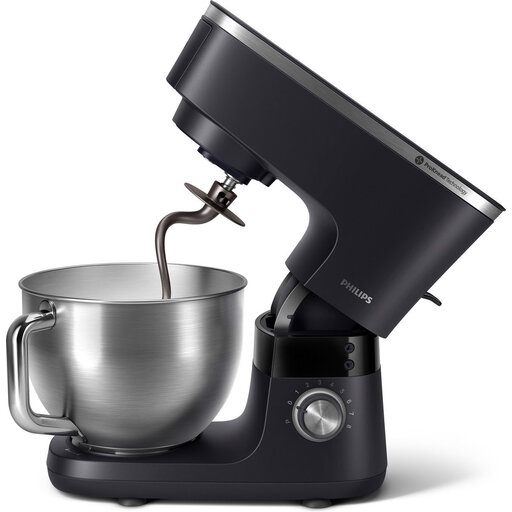 No image available
The product description lists a dough hook for kneading. The title also mentions a blender and mincer attachment.
The title lists a 5.5 l bowl and 8 speeds.
No, it depends on the recipe and the machine. You don’t need to make dough for shop-bought puff pastry. For homemade dough, check that the exact model has a suitable attachment and can handle the amount you need. For extended kneading of heavy dough, the Dutch Consumers’ Association recommends a stand mixer instead.
Follow the instructions for your exact model and make smaller batches if necessary. Kenwood specifies a maximum of 1 kg of dough, a maximum running time of 60 seconds and a 15-minute cooling period between batches only for the FDM72.990SS. Don’t treat these figures as a general rule.
Keep anything that needs to stay chilled in a cool bag. The Netherlands Nutrition Centre advises throwing away food that normally belongs in the fridge if it has been kept unrefrigerated for more than two hours. Check whether your recipe and filling need to be kept chilled.
Electrical products are subject to the relevant EU product legislation. CE marking is only compulsory for product categories covered by harmonised rules that require it. Parts that come into contact with food must meet the applicable requirements for food contact materials. According to the Dutch government, there is no fixed statutory guarantee period in the Netherlands; if a product is faulty, the seller must deal with the statutory guarantee.