
Vandaag of morgen in huis

Kwaliteit gegarandeerd

Welkomstaanbiedingen ontgrendelen: GRATIS bezorging | Tot 80% korting | Gratis 30 dagen JoyPlus-proefperiode
Download de app
A food mixer and blender may look like similar appliances at first glance, but they are designed for different tasks. A kitchen mixer or stand mixer is particularly suitable for dough, batter, whipped cream and egg whites. A blender, on the other hand, processes fruit, vegetables, sauces, shakes and smoothies.
Choosing the right appliance means you do not pay for features you are unlikely to use. Pay particular attention to three common pitfalls: a high wattage that says little about actual performance, a large bowl whose full capacity cannot be used and accessories that are difficult to clean or unsuitable for your recipes.
A powerful blender with a high wattage may seem appealing, but wattage does not tell the whole story. The blade design, transmission, programme duration and filling quantity also affect the result. With a kitchen mixer, the motor type and speed under a low load also play a role.
Use wattage as just one point of comparison. Also consider:
A 6-litre mixing bowl does not mean you can fill it completely with dough or batter. Ingredients need room to mix properly and must not come into contact with the drive mechanism or splash guard. Always check the recommended maximum quantity in the manual.
A 5 to 6-litre bowl can be practical for a family. If you usually make small portions, a compact kitchen mixer may be more suitable. A large bowl also takes up more space on the worktop.
A multifunctional food mixer with accessories can combine a food processor, dough mixer and blender. This may save space, but every additional component needs to be stored, fitted and cleaned.
Check whether the accessories:
According to the brands’ product information, some parts are dishwasher-safe, while motor housings must never be submerged in water. Always follow the instructions for the specific appliance.
For regular baking, three accessories are important:
A mixer for baking with multiple speeds gives you greater control. Start heavy dough on a low setting. Some models have a maximum continuous operating time, for example, a few minutes with heavy dough. Allow the appliance to cool afterwards to help prevent thermal overload.
A blender for the whole family usually has a larger jug and a motor base for preparing several portions at once. According to the product information, the Philips HR3020/20 has a 2-litre jug with a recommended working capacity of 1.5 litres, a 1000-watt motor, three speeds and a pulse setting.
A portable blender is more convenient for a single serving at the office, on the go or after exercising. The trade-off is a smaller capacity, and not every model is suitable for hard or frozen ingredients. Also check whether the cup has a leak-proof seal and how the battery is charged.
Look for a stainless-steel mixing bowl, a sturdy base and non-slip feet. Suction cups can help limit movement during kneading, but always place the appliance on a flat, dry worktop.
With a blender, a securely locked jug, a tight-fitting lid and careful handling of sharp blades are important. Do not process hot liquids unless the manual explicitly permits this. For battery-powered appliances, also use the charging cable supplied and do not charge the appliance in a damp environment.

Why it suits this profile: This compact smoothie blender is designed for simple 500 ml portions and takes up very little space on the worktop.
The specifications are straightforward: 250 watts, one speed and a 500 ml cup. You are not paying for a large number of programmes you will not use.
500 ml Tritan cup, drinking lid, stainless-steel blades and dishwasher-safe removable parts.

Why it suits this profile: This food mixer is designed for baking, with 3D planetary mixing action and a fixed set of baking accessories.
The stated usage limits are specific: a maximum of 1.7 kg of dough and 2.4 kg of batter. This helps you plan portions more realistically.
700 watts, 3.8-litre bowl, whisk, beater and dough hook; according to the product information, the accessories are dishwasher-safe.
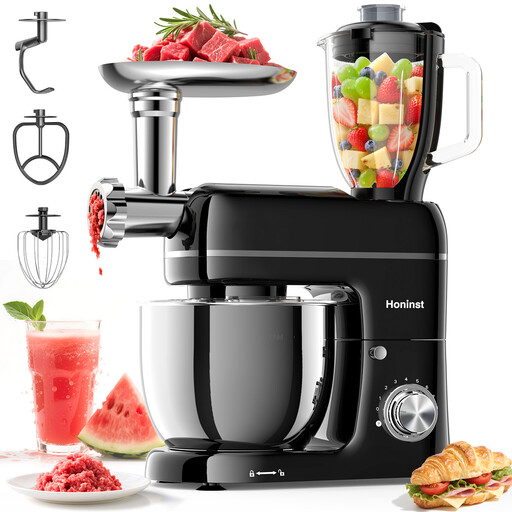
Why it suits this profile: This model combines a kitchen mixer with a meat grinder and blender attachment for users who want to prepare several types of food with one base appliance.
The product information lists a safety lock and overheating protection. However, bear in mind that several accessories need to be fitted, stored and cleaned.
1300 watts maximum power, a 6 QT stainless-steel bowl, eight speeds plus a pulse function, and blender and meat grinder attachments.

Why it suits this profile: The large jug is practical when you want to prepare several smoothies, sauces or soups at once.
The recommended working capacity of 1.5 litres makes it clear that the 2-litre jug should not be filled completely.
1000 watts, three speeds plus pulse, removable blades and a manual cleaning function.
We have put together a complete, up-to-date list of products that fully meet these strict selection criteria and the applicable European safety regulations.
A food processor is mainly designed for slicing, chopping, grating and sometimes mixing. A kitchen mixer uses a whisk, beater or dough hook for batter, whipped cream and dough. A blender uses blades and is better suited to liquid preparations such as smoothies and sauces.
The lifespan depends on usage, maintenance and load. Never use more ingredients than permitted, keep the ventilation clear and allow the appliance to cool down when instructed to do so in the manual. Before buying, also check the statutory guarantee and the availability of original accessories.
Energy consumption depends on the power and operating time. A 1000-watt blender running for one minute uses less energy than a lower-powered model that has to run for much longer. Only use the pulse function when necessary, and switch the appliance off and unplug it after use.
