
Vandaag of morgen in huis

Kwaliteit gegarandeerd

Welkomstaanbiedingen ontgrendelen: GRATIS bezorging | Tot 80% korting | Gratis 30 dagen JoyPlus-proefperiode
Download de app
A food mixer with a mixing bowl can make preparing bread dough, cake batter, whipped cream and egg whites much easier. However, a high power rating or a bowl holding several litres is not automatically the right choice. Some specifications can be unclear, accessories may not be included and a machine can take up more space than expected.
That is why it is worth paying particular attention to three common pitfalls before buying a stand mixer or electric mixer.
A high wattage sounds appealing, but on its own it does not tell you how much torque the motor delivers while kneading. The motor type, overheating protection and maximum operating time are also important. A dough mixer for heavy bread dough should also be used at a low speed and not loaded beyond its maximum capacity.
Pay attention to the difference between peak power and rated power. Some models mainly list their highest power output, while their continuous power is lower. Check the manual and the recommended maximum dough quantity before buying.
A 5- or 6-litre mixing bowl may seem spacious, but you usually should not fill it completely. The Kenwood Go, for example, specifies a maximum dough quantity of 1.4 kg, despite having a 4-litre bowl. The Monsga SM100 has a 6-litre bowl, but lists a recommended usable capacity of 5 litres.
For a household that regularly makes large quantities of bread dough, a spacious bowl is practical. For small batches of cake batter or whipped cream, a very large bowl can actually be less efficient at mixing.
A multifunctional food mixer may have extra connections for a blender, mincer or other accessories. Check whether these parts are actually included in the box or available separately. A mixer with a whisk and beater is sufficient for many home bakers; extra functions are mainly useful when you will genuinely use them.
A more compact food mixer is often sufficient for cakes, pancake batter and whipped cream. If you regularly make wholemeal bread, pizza dough or brioche, you should look at:
A manufacturer’s claim about quiet operation or a powerful motor should be read as a statement made by the brand. According to Honinst’s product information, for example, a particular model has a motor with a maximum output of 1300 watts; this does not automatically mean that every type of dough can be processed at high speed for a long time.
A mixer with a stainless-steel bowl is generally practical for everyday use, as stainless steel is durable and easy to clean. Also check whether the bowl has a handle, whether it is dishwasher-safe and whether a splash guard is included.
For two to four people, around 4 to 5 litres is often sufficient. Families making several loaves or large quantities of batter may prefer to look at bowls holding 5.5 to 7 litres. Do consider the dimensions, though: a large stand mixer must not only fit on the worktop, but also be able to sit beneath wall cabinets when the head is raised.
A good food mixer for baking should include at least a whisk, flat beater and dough hook. The whisk is designed for whipped cream and egg whites, the beater for cake batter and the dough hook for yeast dough.
More speeds give you greater control, but they are not the only criterion. A pulse function can be useful for short bursts of mixing. Non-slip feet, suction cups and a tilt-head lock help keep the machine stable. Also check whether accessories are easy to change and whether the casing may only be cleaned with a damp cloth.

Why it suits this profile: A compact stand mixer with a whisk, beater and dough hook for cakes, batters and lighter doughs.
The product information specifies a 3.8-litre bowl and a maximum dough quantity of 1.7 kg. This makes the operating limits clearer than simply displaying a high wattage on the packaging.
3D Planetary Mixing Technology, non-slip feet and dishwasher-safe accessories according to the product description.
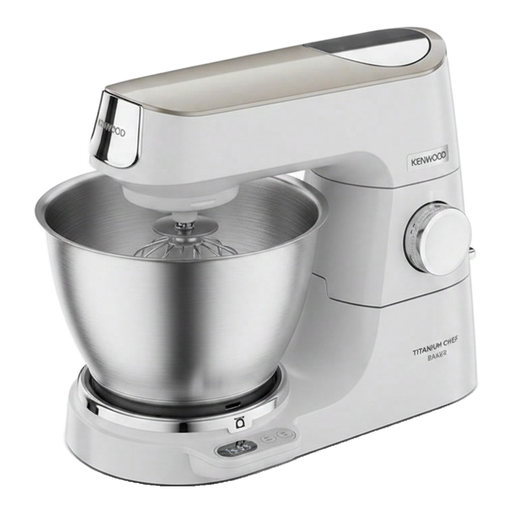
Why it suits this profile: Designed for home bakers who bake frequently and appreciate extra convenience.
The built-in scales reduce the need to weigh ingredients separately. The product details also list a 5-litre stainless-steel bowl and variable speed with a pulse function.
1200 watts, dough hook, whisk, K-beater and a LightLift head according to the product specifications.

Why it suits this profile: The spacious bowl and built-in scales are well suited to families and bakers who prepare larger batches.
The product information specifies a 7-litre bowl and automatic speed control. However, always check the maximum permitted quantity in the manual.
1200 watts, integrated scales and a stainless-steel casing according to the listed product specifications.

Why it suits this profile: A 5-litre food mixer with essential accessories for cakes, bread, pizza and everyday batters.
The specifications list 400 watts, 10 speeds, a pulse function and protection against overloading and overheating.
Stainless-steel bowl, dough hook, whisk, beater and non-slip suction cups according to the product description.
We have put together a complete, up-to-date list of products that fully meet these strict selection criteria and the applicable European safety regulations.
For smaller households and cake batter, a bowl of around 4 litres is often sufficient. For families or several loaves at a time, 5 to 7 litres is more practical. Always look at the usable capacity and maximum dough quantity, rather than just the number of litres stated on the box.
Its lifespan depends on the materials, maintenance, frequency of use and load. Use a dough hook at a low to medium speed, do not exceed the maximum quantity and allow the motor to cool down as instructed in the manual. Clean the accessories immediately after use and never immerse the motor housing in water.
Electricity consumption depends on the power rating and how long the mixer is used. In theory, a 1000-watt machine running for ten minutes uses around 0.17 kWh. In practice, a mixer often runs for less time and not continuously at maximum power. For energy costs, long kneading programmes and large quantities are the most relevant factors.
