
Vandaag of morgen in huis

Kwaliteit gegarandeerd

Welkomstaanbiedingen ontgrendelen: GRATIS bezorging | Tot 80% korting | Gratis 30 dagen JoyPlus-proefperiode
Download de app
A food mixer with a mixing bowl can knead bread dough, whip cream and mix batter while you prepare other ingredients. However, a high wattage or a 6-litre bowl is not automatically enough for your kitchen. If you only look at the advertising, you could end up with a noisy appliance, a bowl that is difficult to clean or a mixer that needs to cool down quickly when handling heavy dough.
In this buying guide, prepared by the Joybuy Product Recommendation Officer, we look at the key differences between a stand mixer, food mixer and electric mixer. The selection is based on verifiable product specifications and practical usage scenarios.
A high stated power rating sounds appealing, but it does not tell you everything about performance during kneading. Manufacturers may use different types of power ratings, such as peak power or rated power. The transmission, motor control and maximum dough capacity also play a part.
A mixer for bread dough should therefore offer more than just a high wattage. Check whether the manufacturer states a maximum dough quantity and whether overheating protection is included.
A 5-litre or 6-litre food mixer does not always have room for the maximum quantity of ingredients. The bowl should not be filled to the rim, particularly when working with yeast dough, which can expand during kneading.
Pay attention to the difference between total bowl capacity and recommended fill quantity. A 6-litre bowl may be suitable for family-sized portions, but the right amount of bread dough depends on the motor, the attachment and the brand’s instructions.
A mixer with a dough hook, whisk and beater is more versatile than a model with just one attachment. However, the included parts vary from product to product. A splash guard, additional blender jug or meat grinder can be useful, but they also take up storage space.
Also check which parts are dishwasher-safe. With some models, the bowl and whisk can go in the dishwasher, while the dough hook or beater must be washed by hand.
A stainless-steel mixing bowl is durable, rust-resistant and suitable for cold and hot ingredients within the limits stated in the instructions. Also consider the shape of the bowl: a wide bowl can be useful for small quantities, while a deep bowl may help to reduce splashing.
For a household that regularly makes bread, pizza, cake and whipped cream, a capacity of around 5 to 6 litres is often a sensible choice. If you usually make smaller quantities, a more compact bowl may be more practical and take up less worktop space.
A food mixer with multiple speeds gives you greater control. A low setting is useful for combining dry ingredients or starting dough. Higher settings are better suited to whipping egg whites or cream, depending on the instructions.
With a planetary mixing action, the attachment moves around the bowl while also rotating on its own axis. According to the product specifications from various brands, this is designed to mix ingredients more evenly. In practice, the result also depends on the quantity, the recipe and the attachment selected.
A heavy metal housing, non-slip feet or suction cups can help keep the mixer in place while kneading. A tilt-back head makes it easier to fit the bowl or attach a whisk to the mixer.
Look out for features such as:
A CE mark indicates that a product is required to meet relevant European requirements, but you should also check the Dutch-language manual, safety information and warranty terms.

Why it suits this profile: This model combines a 5-litre stainless-steel bowl with 10 speeds, a pulse setting and three basic attachments for baking and everyday use.
Alongside the motor power, the product specification lists the bowl capacity, speeds, pulse function and maximum operating warnings. This makes it easier to compare than looking at wattage alone.
5L stainless-steel mixing bowl, 10 speeds plus pulse, dough hook, whisk, beater and tilt-back head.
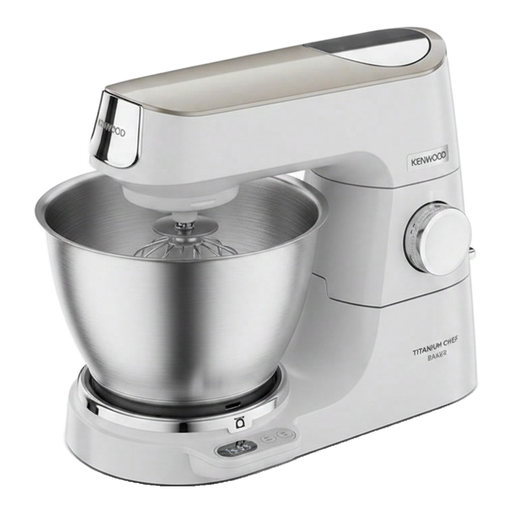
Why it suits this profile: The product specification lists 1200 W of power, a 5-litre stainless-steel bowl and built-in scales for weighing ingredients directly in the bowl.
The built-in scales reduce the number of separate bowls and measuring steps. The included dough hook, whisk and K-beater make the choice of attachments clear.
1200 W, 5L stainless-steel mixing bowl, variable speed with pulse and built-in scales.
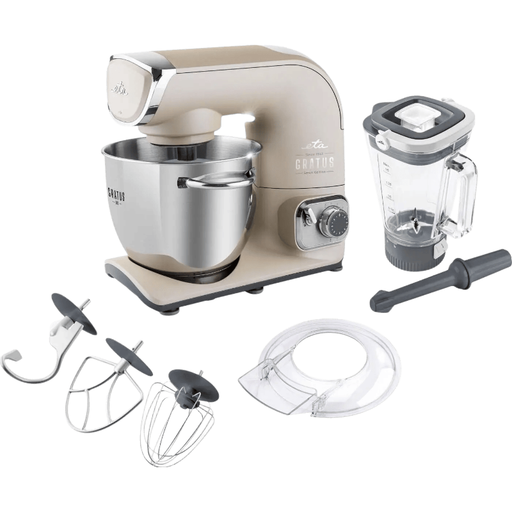
Why it suits this profile: According to the product specification, this model has a planetary mixing action, 1500 W of power, a 5.5-litre stainless-steel bowl and a stated maximum dough capacity of 2.5 kg.
The stated maximum dough capacity provides more context than bowl capacity alone. Thermal protection, a safety lock and a non-slip base are also mentioned.
1500 W, 5.5L stainless-steel bowl, 2.5 kg maximum dough capacity, 1.5-litre glass blender jug and pulse function.
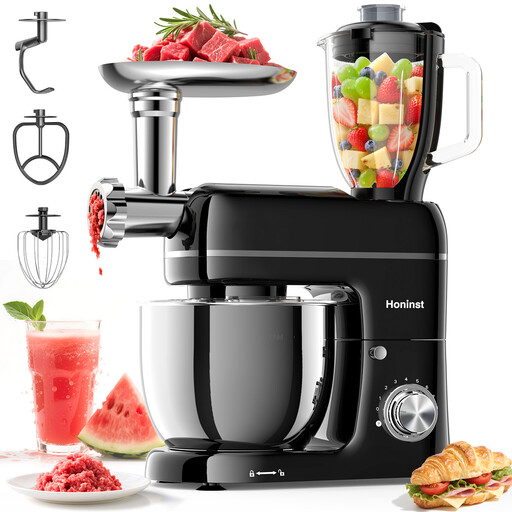
Why it suits this profile: In addition to mixing, kneading and whisking, the product description lists a meat grinder and blender jug. This can save space otherwise taken up by separate appliances if you regularly use these functions.
The attachments are listed clearly, along with the tilt-back head and safety switch. Before buying, however, check whether you will actually use all the accessories.
1300 W maximum motor power according to the product description, 6 QT stainless-steel bowl, 8 speeds plus pulse, blender and meat grinder.
We have put together a complete, up-to-date list of products that fully meet these strict selection criteria and the applicable European safety regulations.
For regular family baking, a 5 to 6-litre bowl is often practical. Do not look only at the total capacity, but also at the recommended quantity of dough or batter. For small batches, a compact food mixer may be more convenient, as ingredients are less likely to remain stuck around the bottom of the bowl.
It can be, provided the model has a dough hook and its maximum dough capacity suits your recipes. When working with heavy yeast dough, use a low to medium speed and follow the stated operating time. A larger bowl does not automatically mean that you can knead more dough.
Consumption depends on the rated power, the speed selected and how long the mixer is used. A 1000 W mixer running for a few minutes does not continuously use 1000 watts at maximum power. So do not compare wattage alone; also consider how often and for how long you use the machine.
