
Vandaag of morgen in huis

Kwaliteit gegarandeerd

Welkomstaanbiedingen ontgrendelen: GRATIS bezorging | Tot 80% korting | Gratis 30 dagen JoyPlus-proefperiode
Download de app
A food mixer can take much of the work out of making bread dough, cake batter, whipped cream and everyday recipes. However, a higher wattage or a long list of accessories does not automatically mean a better match. The right choice mainly depends on the quantities you make, the space available and the types of recipes you prepare most often.
When comparing a food mixer, kitchen machine or stand mixer, pay particular attention to these three pitfalls:
For a household that occasionally makes cakes, biscuits or pizza, a bowl of around 4 to 5 litres is often practical. If you regularly bake bread or prepare larger quantities, consider models with a capacity of 6 litres or more.
Do bear in mind the difference between the bowl’s total capacity and the recommended quantity. For example, the Kenwood Go KZM35 has a 4-litre stainless steel bowl and states a capacity of up to 1.4 kg of dough, with a maximum of 800 grams of flour. This is more useful than simply quoting the bowl size.
A large bowl also takes up more space. Check the height beneath your kitchen cupboards and the width of your worktop beforehand.
A food mixer with multiple speed settings gives you greater control when mixing slowly, kneading and whisking lightly. For everyday use, 6 to 10 settings, optionally supplemented by a pulse function, are common in this range.
Wattage should not be considered separately from the machine’s construction and the instructions for use. A dough mixer processing heavy dough for a long time can become hot. Some models therefore specify a maximum operating time. For example, Honinst models advise kneading heavy yeast dough for no longer than around 6 to 10 minutes at a time, followed by a cooling period. Always follow the instructions and do not exceed the maximum quantities.
For a mixer used for bread and cakes, three attachments are usually the essentials:
A splash guard helps prevent splashes, while non-slip feet or suction cups keep the machine securely in place during kneading. Also check which parts are dishwasher-safe. With some models, the bowl and whisk can go in the dishwasher, while the dough hook or beater must be washed by hand.
Also consider the warranty and the responsible party within the EU. Several Kenwood and Bosch product listings mention a minimum statutory warranty of two years. Check the current product information and terms before placing your order.

Why it suits this profile: This model combines a 5-litre stainless steel bowl with 10 speeds and a pulse function. It offers a straightforward starting point for cake batter, biscuit dough and smaller bread recipes.
The product listing specifies a 400W motor, 5L bowl and 10 speeds separately. This makes it easier to compare the key specifications with other models.
10 speeds, pulse function, dough hook, whisk, beater and non-slip suction cups.

Why it suits this profile: The product information lists a 1200W motor, a 7-litre bowl, automatic speed control and built-in scales. This is well suited to home bakers who regularly prepare larger quantities.
The large bowl is complemented by practical features such as built-in scales and automatic speed control. Do check the dimensions, though: this is not a small food mixer.
7L bowl, 1200W, built-in scales and automatic speed control.
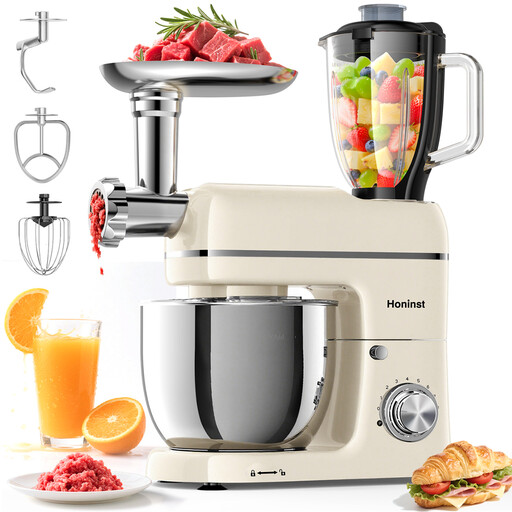
Why it suits this profile: As well as mixing, kneading and whisking, the product page lists a meat grinder and blender. This is appealing to families who want one appliance to handle several everyday kitchen tasks.
The extra functions are clearly specified: meat grinder and blender. Before buying, check that you will genuinely use these accessories and have somewhere to store them.
6QT bowl, up to 1300W according to the product listing, 8 speeds plus pulse function and multiple attachments.

Why it suits this profile: Measuring approximately 33.5 × 18 × 30 cm and with a 4-litre bowl, this model is designed for anyone who wants to use a food mixer without having a large appliance taking up space on the worktop.
The stated dough capacity of 1.4 kg gives you a clearer idea of what to expect than the bowl size alone. A high-speed connection is included; according to the listing, accessories for it are sold separately.
800W, 6 speeds plus pulse function, compact design and three basic attachments.
We have put together a complete, up-to-date list of products that fully meet these strict selection criteria and the applicable European safety regulations.
That depends on how you intend to use it. Lower power may be sufficient for batter, cream and light mixtures. For heavy bread dough, motor power, overheating protection, the drive system and maximum operating time are collectively more important than wattage alone. Compare the rated and maximum values, and follow the instructions.
Yes, provided the model has a dough hook and the manufacturer states that it is suitable for household bread-making. Use a low to medium speed, do not exceed the maximum quantity and allow the motor to cool when instructed to do so. A food mixer with a dough hook and whisk is suitable for a range of preparations, but not every model is designed for large or prolonged batches of dough.
Consumption depends on the power rating and how long the mixer is used. A 1000W machine running for 10 minutes theoretically uses around 0.167 kWh at full power. In practice, a mixer does not run continuously at maximum power. Short preparation times and the correct speed help keep electricity consumption low.
