
Vandaag of morgen in huis

Kwaliteit gegarandeerd

Welkomstaanbiedingen ontgrendelen: GRATIS bezorging | Tot 80% korting | Gratis 30 dagen JoyPlus-proefperiode
Download de app
Buying a food mixer seems straightforward until you discover how many differences there are between a kitchen mixer, stand mixer, food processor and blender. An appliance may look powerful on paper, yet still be impractical for your recipes. Think of a bowl that is too small, accessories you hardly ever use or parts that are difficult to clean.
As a Joybuy Product Recommendation Officer, I focus mainly on verifiable features: power, capacity, functions, dimensions, accessories and safety information. This makes it easier to compare marketing claims with the product specifications.
A higher wattage does not automatically mean that a food mixer will perform every task better. Also consider the type of motor, the recommended operating time and the ingredients it is designed to handle. Some models quote peak power, while their rated power is lower.
For example, the MONSGA SM100 lists 1000 W peak power and 600 W rated power. This difference matters if you regularly want to knead heavy dough. The AUCMA models list motor powers of 400 W and 450 W, respectively. A powerful food mixer should therefore not be judged on just one figure.
A food mixer with a large bowl is useful for families, but the maximum capacity is not always the amount you can process safely. According to the product information, the MONSGA SM100 has a bowl with a maximum capacity of 6 litres and a recommended usable capacity of 5 litres. The permitted quantity may be lower for bread dough.
Therefore, check:
A multifunctional food mixer with accessories may seem appealing. However, every additional part takes up space and needs to be cleaned. First decide whether you mainly want to mix, knead and whisk, or whether you also want to chop, slice, grate and blend.
A stand mixer with a dough hook is suitable for bread, pizza and cake batter. A food processor is a more logical choice for chopping, slicing and grating vegetables. A blender is better suited to smoothies, soups and sauces. One appliance can combine several functions, but check that the accessories are actually included.
For light batter and whipped cream, good speed control is particularly important. For firm dough, you need a suitable dough hook, a stable housing and sufficient torque. An appliance with multiple speeds and a pulse setting offers more control than a model with only on/off operation.
According to the product specifications, the Kenwood Titanium Chef Baker XL has 1200 W, a 7-litre bowl and automatic speed control. The Philips 5000 Series hand mixer operates at 450 W, with six speeds and an automatically rotating bowl. This is a different setup from a heavy-duty stand mixer, but it can be practical for cake batter and smaller baking tasks.
A stainless-steel bowl is sturdy and generally easy to clean. Also check the dimensions of the appliance. A 7-litre model can take up a considerable amount of space on a standard kitchen worktop.
Also look out for:
Parts that are dishwasher-safe can save time. This does not automatically apply to the motor housing or every accessory. The Kenwood MultiPro Go lists dishwasher-safe parts, including the bowl, blade, disc and Express Serve attachment.
Blades, grating discs and beaters may be sharp or move during operation. Always unplug the appliance before changing accessories or cleaning it. Also check for overheating protection, a locking lid mechanism and the specified operating time.
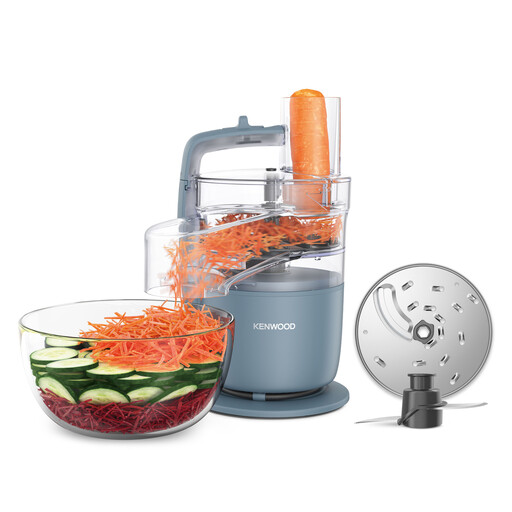
Why it suits this profile: A compact food processor for anyone who wants to chop, slice, grate and mix vegetables without having a large appliance taking up space on the worktop.
The product specifications clearly state 650 W, one speed plus pulse and a 1.3-litre bowl. This means you know in advance that it is primarily a food processor rather than a dough mixer for large quantities.
Compact size, 360 Express Serve and several dishwasher-safe parts.

Why it suits this profile: Designed for home cooks and bakers who often prepare larger quantities and value a spacious bowl and integrated scales.
The stated 7-litre bowl, 1200 W and automatic speed control make the capacity and operation clear. However, check the available space beforehand: the appliance is 40 cm tall.
Generous capacity, 1200 W and integrated scales according to the product information.
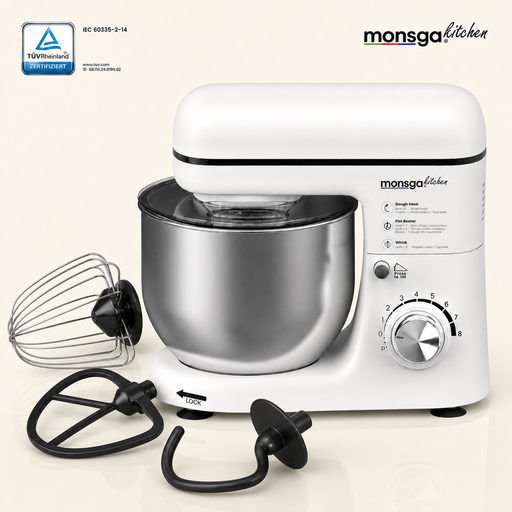
Why it suits this profile: Suitable for users who regularly prepare bread, cake, biscuits or mashed potato and want a stainless-steel mixing bowl with a generous capacity.
The listing distinguishes between a maximum capacity of 6 litres and a recommended usable capacity of 5 litres. It also lists eight speeds, a tilting head and overload protection.
5-litre recommended bowl capacity, eight speeds, splash guard and dishwasher-safe accessories according to the product description.
Also consider energy consumption. An appliance rated at 1000 W theoretically uses more electricity during one hour of continuous operation than a 450 W model, but food mixers usually run for only a few minutes per recipe. The actual cost therefore depends on power, operating time and your energy tariff.
We have put together a complete, up-to-date list of products that fully meet these strict selection criteria and the applicable European safety regulations.
A food mixer or stand mixer is mainly designed for whisking, mixing and kneading in a mixing bowl. A food processor is more focused on chopping, slicing, grating and mixing. Some multifunctional models combine these functions, but always check which accessories are included as standard.
For one or two people, 3 to 5 litres may be sufficient. Families and home bakers who prepare larger quantities may want to consider 5 to 7 litres. Do not automatically treat the full capacity as the working capacity: follow the maximum quantities stated in the manual.
Its lifespan depends on motor load, frequency of use, maintenance and following the specified operating time. Allow the motor to cool down when instructed in the manual, do not overfill the bowl and clean the accessories immediately. When buying, also check the warranty and the availability of replacement parts.
