
Vandaag of morgen in huis

Kwaliteit gegarandeerd

Welkomstaanbiedingen ontgrendelen: GRATIS bezorging | Tot 80% korting | Gratis 30 dagen JoyPlus-proefperiode
Download de app
A food mixer can knead dough, mix batter and whip cream without you having to stir constantly. However, a large model is not automatically the best choice for your kitchen. Marketing copy often focuses on wattage, multiple speed settings or a “multifunctional” design, while other features are just as important.
For home bakers, keen cooks and families, these are the main pitfalls to watch out for:
The wattage indicates the power consumed, but it does not by itself show how well a dough mixer handles heavy dough. Therefore, look at:
For example, the Honinst and Aucma models in this selection mention a copper motor, but their operating times differ. The Honinst 6.5QT states that heavy yeast dough may not be kneaded continuously for more than 10 minutes, after which the machine must cool down for at least 15 minutes. The Aucma 6L specifies a maximum of 6 minutes of continuous use. Always follow the instructions and do not use a mixer for bread and cakes above the stated capacity.
A mixer with a bowl of 5 to 7 litres is suitable for larger family portions, but the practical capacity is lower than the bowl’s total volume. A full bowl may overflow during mixing or place additional strain on the motor.
As a guide:
The Bosch MUMS2AW00 is listed as 5.5 litres in the product title, while the product details state that the bowl holds 3.8 litres. This difference shows why you should check the current specifications on the product page and in the manual before buying.
A planetary mixing system moves the attachment around the bowl, incorporating ingredients from multiple areas. This is useful for batters and light mixtures, but it does not replace using the right attachment or selecting the correct speed.
For many household recipes, these attachments are sufficient:
More speed settings provide extra control, but eight or ten settings are only useful if the machine can also start gently and remain stable. A pulse function is useful for short, powerful bursts, but do not use it as a substitute for the recommended mixing time.

Why it suits this profile: The 5-litre stainless steel bowl, ten speed settings and three basic attachments provide a straightforward starting point for cakes, biscuits, pizza and bread.
The product information states a recommended continuous operating time of no more than 6 minutes and overheating protection. This makes it clear that heavy dough needs breaks.
5L bowl, 10 speeds plus pulse function, dough hook, whisk, beater and non-slip suction feet.

Why it suits this profile: This model is designed for large baking sessions and features a 7-litre stainless steel bowl, 1200 watts and built-in scales.
The built-in scales reduce the need for separate measuring jugs. However, check the actual maximum dough quantity in the manual.
1200 W, 7L bowl, automatic speed control and integrated scales.
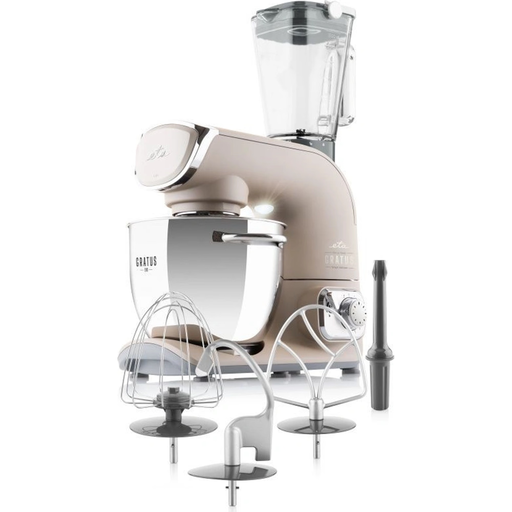
Why it suits this profile: If you want to blend as well as knead and mix, this model offers a 5.5-litre bowl, a 1.5-litre glass blender jug and a stated maximum dough capacity of 2.5 kg.
Alongside 1500 W, the product specification lists a thermal fuse, safety lock and non-slip base. Only use the multifunctional attachments according to the manual.
Planetary mixing system, 5.5L stainless steel bowl, glass blender jug and continuously adjustable speed with pulse function.

Why it suits this profile: Its compact dimensions, 4-litre bowl and stated capacity of up to 1.4 kg of dough make it suitable for everyday baking without the need for an extra-large appliance.
The capacity is clearly stated, so you can match the size to normal household portions instead of looking only at the motor power.
800 W, 6 speeds plus pulse function, 4L stainless steel bowl, dough hook, whisk and K-beater.
We have put together a complete, up-to-date list of products that fully meet these strict selection criteria and the applicable European safety regulations.
Yes, provided the model has a dough hook and the quantity of dough remains within the stated limit. Heavy yeast dough puts more strain on the motor than cake batter. Start at a low speed and take breaks as instructed in the manual.
For one or two people, 3.8 to 5 litres is often sufficient. Families who regularly make bread or several cakes may wish to consider 5 to 7 litres. Pay particular attention to the recommended working capacity, not just the bowl’s total volume.
Consumption depends on the power rating and how long the machine is used. A 1000-watt machine running for 10 minutes theoretically uses around 0.17 kWh, before allowing for any differences between peak and actual power. Shorter mixing times and using the correct quantity can help limit unnecessary electricity consumption.
