
Vandaag of morgen in huis

Kwaliteit gegarandeerd

Welkomstaanbiedingen ontgrendelen: GRATIS bezorging | Tot 80% korting | Gratis 30 dagen JoyPlus-proefperiode
Download de app
A food mixer can knead bread dough, mix cake batter and whip cream without you having to stir constantly. However, not every model is suitable for everyday use. An attractive price, high wattage or large bowl says little about practical performance on its own.
For home bakers, keen cooks and families, stability, usable capacity and the right attachments are particularly important. Read on to find out what to look for and which models suit different needs.
Manufacturers sometimes quote peak power, while the rated power is lower. The Monsga SM100, for example, lists 1000 watts peak power, with a rated power of 600 watts. The Russell Hobbs hand mixer has a power output of 185 watts and peak power of 350 watts.
So don’t compare wattages alone. Also consider the recommended maximum amount of dough, the permitted operating time and the attachments supplied. Even a powerful motor can overheat if it is used for too long without a break.
A 6-litre bowl may appear spacious, but you cannot always fill it completely. The Monsga SM100 lists a maximum capacity of 6 litres, with a recommended capacity of 5 litres. The quantity is particularly important with yeast dough: dough takes up more space while it is being kneaded and proving.
A 5-litre food mixer is often a good choice for everyday baking in a small or average-sized household. A 6-litre food mixer is more practical for larger batches, provided you follow the instructions for maximum dough quantities.
A noise level of 60, 72 or 75 dB may be stated in the product information, but measurement conditions can vary. Check whether the figure was measured at a particular distance and whether it refers to a maximum or average level.
Stability also affects your experience. Suction cups, non-slip feet and a sturdy base help prevent a stand mixer from moving across the worktop while kneading.
For batter, whipped cream and light mixtures, lower power is often sufficient. For a mixer for bread dough, pizza dough or heavier biscuit doughs, motor protection, a suitable dough hook and a stable housing are at least as important as wattage.
Always check:
For heavy dough, generally use a low to medium speed. Follow the manufacturer’s instructions, as the permitted operating time varies from model to model.
A stainless-steel bowl is easy to clean and suitable for everyday use. A bowl with a handle or splash guard can make adding ingredients and cleaning easier. Also check the dimensions of the appliance. A food mixer measuring more than 35 centimetres in height will not fit in every cupboard.
If you mainly make cake batter and whipped cream, you do not necessarily need a large bowl. A larger bowl can be useful for families or when making several loaves at once. When comparing models, look at the usable capacity, not just the figure on the packaging.
A food mixer with a dough hook, whisk and flat beater covers the most common baking tasks. The dough hook is designed for kneading, the whisk for light, airy mixtures, and the flat beater for cake batter, biscuit dough and sauces.
More speed settings give you extra control, but they do not guarantee better results. A pulse function can be useful for a short, powerful burst of mixing. If you only bake occasionally, you could also consider a hand mixer: it takes up less space and can be put away more quickly.

Why it suits this profile: This food mixer has a 5-litre stainless-steel bowl, 10 speeds and three basic attachments for cakes, bread and pizza.
Alongside the 400W motor power, the product information lists overheat protection, non-slip suction feet and a maximum noise level of 75 dB.
5-litre bowl, tilt-head design, pulse function, whisk, dough hook and beater included.
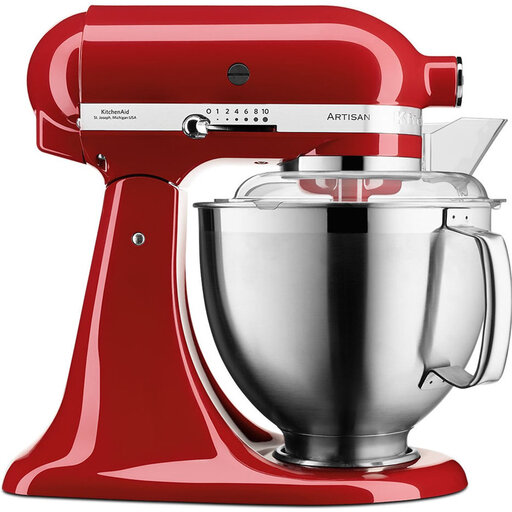
Why it suits this profile: The metal housing, two stainless-steel bowls measuring 4.8 and 3 litres, and five-year manufacturer’s warranty appeal to shoppers looking for a durable kitchen set-up.
The manufacturer states that it has direct drive and a metal construction. The quoted power is 300W, so do not compare this directly with the peak power of other models.
Two bowls, metal housing, three mixing attachments and an expandable attachment hub.

Why it suits this profile: The 7-litre stainless-steel bowl, quoted power of 1200W, integrated scales and automatic speed control are designed for larger quantities and regular use.
The large capacity makes bigger batches easier to manage, but check the available space and the instructions for maximum quantities beforehand.
7-litre capacity, integrated scales, automatic speed control and stainless-steel construction.
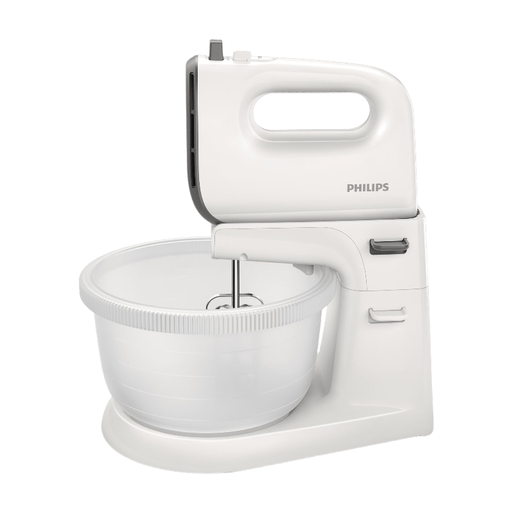
Why it suits this profile: This hand mixer has 450W of power, six speeds, two dough hooks, two beaters and a 3-litre automatically rotating bowl.
The bowl capacity and attachments are clearly specified. This makes it immediately clear that the model is mainly intended for smaller portions, rather than large batches of bread.
Compact size, 3-litre bowl, six speeds and automatically driven bowl.
We have put together a complete, up-to-date list of products that fully meet these strict selection criteria and the applicable European safety regulations.
Choose a stand mixer if you often make bread, pizza, biscuits or large quantities of cake batter. You can keep your hands free and weigh out or prepare ingredients while the mixer is running.
A hand mixer makes more sense if you have limited storage space, make smaller portions or want to put the appliance away quickly after use. For sauces, soups and smoothies, a stick blender with a chopper attachment is often more suitable than a food mixer with a bowl.
Whatever you choose, check that it is suitable for the Dutch 220–240V mains, and review the statutory warranty and safety instructions. A CE mark is relevant to compliance, but it does not automatically mean that a model is suitable for your recipes or how often you plan to use it.
Yes, provided the model has a dough hook and the amount of dough remains within the recommended limit. For heavy dough, use a low to medium speed and observe the maximum operating time stated in the manual.
For everyday cake batter and smaller portions, 3 to 5 litres is often practical. Families and home bakers who make larger quantities may want to consider 6 or 7 litres. Always check the usable capacity; a 6-litre bowl cannot automatically be filled to the brim.
Consumption depends on the power rating and operating time. A 400-watt appliance that runs for a short time uses less energy than a 1200-watt model that runs for a prolonged period. Use the lowest suitable speed and avoid mixing for longer than necessary.
