
Vandaag of morgen in huis

Kwaliteit gegarandeerd

Welkomstaanbiedingen ontgrendelen: GRATIS bezorging | Tot 80% korting | Gratis 30 dagen JoyPlus-proefperiode
Download de app
A food mixer can take much of the work out of making bread, cakes, pizza, biscuits and whipped cream. However, an expensive model is not automatically the right choice for your kitchen. The difference often comes down to bowl capacity, the permitted amount of dough, noise levels and the accessories actually included.
Before buying a kitchen mixer or stand mixer, look beyond just the wattage or the number of speed settings.
A higher wattage sounds appealing, but it does not necessarily indicate the actual kneading power. Manufacturers may also specify different types of power, such as peak power or rated power. A 1000 W model is therefore not automatically better suited to heavy bread dough than a model with a lower stated wattage.
Also consider:
According to product information from various brands, recommended usage differs considerably. For example, the Bosch MUMS2AW00 specifies a maximum of 1.7 kg of dough, while the Kenwood Go KZM35 is rated for up to 1.4 kg of dough.
A 5- or 6-litre bowl may seem spacious, but you cannot fill it right to the brim. Yeast dough in particular needs room to rise and move around. So, as well as checking the capacity, look at the maximum amount of flour, batter or dough.
A food mixer with a bowl of 4 litres may be enough for a small household. Families or users who make several loaves at once are more likely to benefit from a 5.5- to 7-litre bowl.
A baking mixer often comes with a whisk, flat beater and dough hook. This is a practical starting set, but check that the accessories are actually included and whether additional attachments are available separately.
A food mixer with accessories can later be expanded with, for example, a blender, pasta roller or mincer. According to Kenwood’s product information, more than 20 optional accessories are available for the Chef XL. This does not mean that they are included as standard in the box.
Measure the space on your worktop in advance. A stand mixer is often heavy and designed to stay in one place. Also check that you can lift the mixing head without it hitting a kitchen cupboard.
Look out for:
Stainless steel is practical for everyday use and easy to check for damage. A plastic bowl may be lighter, but it has a different feel and may develop scratches over time.
You need a higher speed for whipping cream and egg whites than for kneading bread dough. An electric mixer with several settings gives you more control, but a large number of speeds is not decisive in itself.
A planetary mixer moves the attachment around the bowl, helping to incorporate the ingredients more effectively. According to their own product information, Bosch, Honinst and KitchenAid models use a planetary mixing motion. Assess this claim as a technical feature of the design, not as a guarantee of a particular baking result.
A stated noise level is useful for comparison, but check whether it applies under all conditions. Honinst’s product information states less than 60 dB, while Aucma and Monsga quote levels of up to around 75 dB. The figures are not always measured using the same method.
Also look for:
Follow the instructions when working with heavy dough. For example, Honinst states that the appliance must not be used continuously for more than 10 minutes with heavy yeast dough and must then be allowed to cool down. This helps prevent unnecessary strain on the motor.
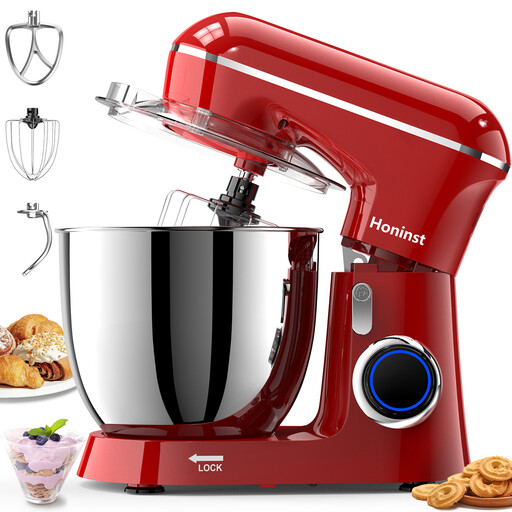
Why it suits this profile: A spacious bowl, 10 speeds and three basic attachments provide a practical starting point for cakes, pizza, biscuits and whipped cream.
The product description mentions a 6.5 QT stainless steel bowl, splash guard, non-slip feet and overheating protection. Check the maximum quantities in the manual.
10 speeds, dough hook, whisk and beater; the manufacturer states less than 60 dB.

Why it suits this profile: Designed for home bakers who regularly make larger quantities and value an integrated weighing scale.
The stated bowl capacity is 7 litres and the power is 1200 W. The built-in weighing scale helps reduce washing up and measuring errors, but follow the maximum load specified in the manual.
1200 W, automatic speed control and integrated weighing scale; stainless steel construction.

Why it suits this profile: This compact model is suitable for people who bake regularly but have limited space and want straightforward controls.
According to the product information, the dimensions are 33.5 × 18 × 30 cm. The stated maximum dough quantity of 1.4 kg gives a clearer indication of capacity than bowl volume alone.
4-litre stainless steel bowl, 6 speeds plus pulse function, whisk, K-beater and dough hook.
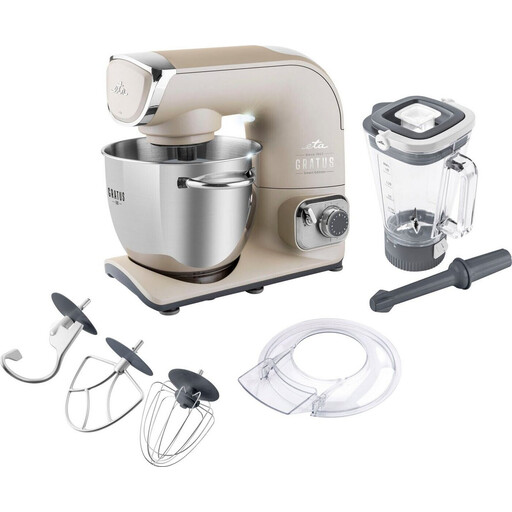
Why it suits this profile: An interesting choice for users who want a blender function and additional safety features alongside kneading and mixing.
The product information states a maximum dough capacity of 2.5 kg, a thermal fuse, safety lock and non-slip base. Check the included parts when the product arrives.
1500 W, planetary mixing motion, 5.5-litre bowl and 1.5-litre glass blender jug.
We have put together a complete, up-to-date list of products that fully meet these strict selection criteria and the applicable European safety regulations.
Yes. Use a dough hook at a low to medium speed. Always check the maximum dough quantity and operating time. Heavy dough puts more strain on the motor than cake batter or whipped cream. Allow the appliance to cool down whenever the manual instructs you to do so.
For a small household, around 4 litres is often practical. For families or larger quantities of dough, a bowl of 5 to 7 litres is generally more suitable. Do not look only at the capacity; pay particular attention to the stated maximum quantity of dough and batter.
Consumption depends on the wattage and operating time. A 1200 W model theoretically uses a maximum of 1.2 kWh in one hour, but a mixer usually runs for less time and not continuously at full power. Actual costs therefore depend on the selected speed, load and baking time.
