
Vandaag of morgen in huis

Kwaliteit gegarandeerd

Welkomstaanbiedingen ontgrendelen: GRATIS bezorging | Tot 80% korting | Gratis 30 dagen JoyPlus-proefperiode
Download de app
A food mixer can make baking bread, cakes, pizza and pastries easier. However, it is not advisable to look only at the wattage or the number of accessories. For example, a large bowl can be awkward for small quantities, while a powerful motor does not automatically mean that a machine is suitable for prolonged kneading.
In this buying guide from the Joybuy Product Recommendation Officer, we look at the key specifications, common pitfalls and some popular choices for different households.
A higher wattage may sound appealing, but it does not tell you everything about performance. The transmission, motor design, maximum dough quantity and recommended operating time are also important. A 300-watt food mixer may be perfectly suitable for cake batter and whipped cream, but according to the KitchenAid Artisan 5KSM125EAC product information, this model is not intended for heavy dough.
Always check:
A 6-litre bowl does not automatically provide room for 6 litres of batter or dough. Ingredients need space to mix properly and must not exceed the maximum fill line. An overfilled bowl can also cause splashing or uneven mixing.
For a household that regularly makes bread or pizza, a bowl of around 5 to 6.5 litres is practical. For smaller portions, cake batter or whipped cream, a bowl of 3.8 to 5 litres may be sufficient.
A multifunctional food mixer with a blender and meat grinder can be useful, but only if you will actually use these functions. Extra attachments take up space and need to be stored and cleaned. If you mainly bake, a food mixer with dough hook, a whisk and a flat beater are often more important than a large accessory bundle.
For light batter, cream and egg whites, several speed settings and a suitable whisk are important. For bread dough and pizza dough, the combination of motor, drive system and stability matters most. Also pay attention to the required cooling time. For example, the Honinst 6.5QT models state that heavy yeast dough should not be processed continuously for more than 10 minutes, after which the machine must cool down for at least 15 minutes. An AUCMA 6L model specifies a maximum continuous operating time of 6 minutes.
Always follow the instructions. A dough mixer that is used for too long without a break can become hot, even if its rated power is high.
Stainless steel is practical for a mixer with bowl: it is durable and easy to wipe clean. A plastic bowl may be lighter, but check whether it is dishwasher-safe and how much dough or batter the manufacturer allows.
Measure the available space before buying. Pay attention to:
A stand mixer should remain stable while kneading. Non-slip feet or suction cups can help. For example, the AUCMA ASM1541 lists four suction cups and a vibration-absorbing design. The Honinst 6.5QT is specified in the product description as producing less than 60 dB, while the AUCMA 6L lists a noise level of 68–72 dB within one metre. Only compare these figures when the measurement conditions are the same.
Also consider cleaning. Some parts may be dishwasher-safe, while others must be washed by hand. Check this for each attachment in the instructions.

Why it suits this profile: The 5-litre stainless-steel bowl and 10 speed settings provide a straightforward starting point for cakes, batter, whipped cream and regular dough-making.
The product information lists 400 watts, 10 speed settings, a pulse function and overheating protection. However, check the maximum dough quantity in the instructions.
5L stainless-steel bowl, dough hook, whisk, beater, splash guard and non-slip suction feet.
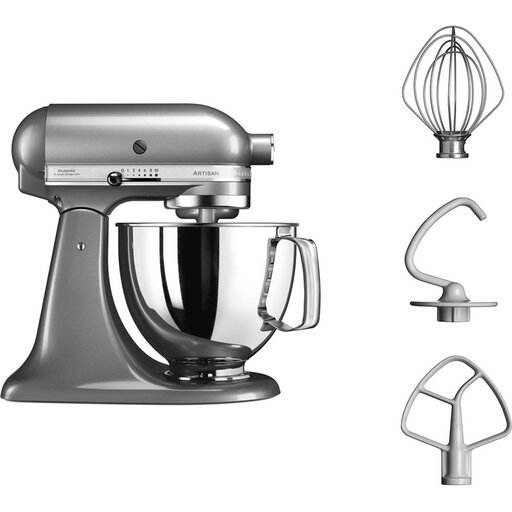
Why it suits this profile: This stand mixer is designed for controlled mixing with 10 settings and a direct-drive system, making it suitable for users who value build quality and expandable attachments.
The product information warns that the 300 watts are not suitable for heavy dough. This makes the operating limit clear rather than leaving it unclear.
4.8L stainless-steel bowl, 10 speed settings, direct-drive system, whisk, beater and dough hook included.
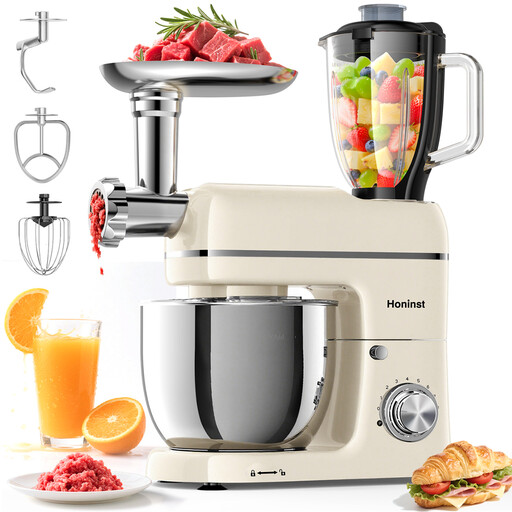
Why it suits this profile: In addition to mixing and kneading, this food mixer is described as having a meat grinder and blender, making it suitable for users who want to combine several appliances.
According to the product information, the safety lock prevents operation when the head is not properly closed. Use approved attachments only.
1300 watts maximum motor power, 6QT stainless-steel bowl, 8 speed settings plus pulse function, and multiple functions.

Why it suits this profile: This compact food mixer combines a 3.8-litre bowl with a baking set for batter and lighter dough, without making a large accessory bundle the main focus.
The product information specifies a maximum of 1.7 kg of dough and 2.4 kg of batter. This makes the operating limits more concrete than motor power alone.
700 watts, 3D planetary mixing action, non-slip feet and dishwasher-safe attachments according to the product description.
We have put together a complete, up-to-date list of products that fully meet these strict selection criteria and the applicable European safety regulations.
Do not look at wattage alone. For bread and pizza dough, the drive system, dough hook, bowl capacity, maximum quantity and operating time are at least as important. A model with overheating protection provides an additional safety feature, but it does not replace the cooling periods specified in the instructions.
A stand mixer can handle many tasks normally performed by an electric mixer, such as whisking, mixing and kneading. As the bowl is fixed in place, you do not need to hold the appliance. For small quantities or quick jobs, however, a hand mixer may take up less space and be easier to use.
Consumption depends on the power rating and operating time. A 1000-watt machine running for 10 minutes theoretically uses around 0.167 kWh; actual consumption may be lower because the motor does not operate continuously at maximum power. Use the correct quantity of ingredients and do not leave the appliance running for longer than necessary.
