
Vandaag of morgen in huis

Kwaliteit gegarandeerd

Welkomstaanbiedingen ontgrendelen: GRATIS bezorging | Tot 80% korting | Gratis 30 dagen JoyPlus-proefperiode
Download de app
A food mixer can make mixing, whisking and kneading considerably easier. However, it is not wise to focus solely on wattage, the number of speed settings or a long list of accessories. Some models take up a lot of space, while the usable bowl capacity is smaller than the marketing copy suggests. Other food mixers come with accessories you are unlikely to use very often.
For home bakers, keen cooks and families, three pitfalls are particularly important:
Power is measured in watts, but you should consider this figure alongside the operating instructions. A food mixer for cakes and pastries needs less motor power than a mixer for bread dough. For heavy yeast dough, a stable drive system, effective overload protection and a clearly stated maximum operating time are more important than a high wattage alone.
Pay attention to rest periods too. The product information for various models states that the machine should not be used continuously for unlimited periods when handling heavy dough. For example, Honinst models recommend a limited operating time followed by a cooling period. The AUCMA 6L states that the mixer should not run continuously for more than six minutes without a rest. Always follow the instructions and do not exceed the stated quantities.
A mixer with a bowl of 5 to 7 litres provides room for larger quantities of batter, cream or dough. However, the effective capacity is lower than the bowl’s total volume. Liquid batter, whipped cream and bread dough each require a different maximum fill level.
A smaller food mixer can be more practical in a flat or compact kitchen. The Kenwood Go has a 4-litre bowl and states a capacity of up to 1.4 kg of dough, with a maximum of 800 grams of flour. A model with a 6 or 6.5-litre bowl is better suited to families or people who regularly prepare several loaves, pizzas or cakes. Always check the permitted dough quantity in the product specifications.
A food mixer’s basic set usually consists of:
For many home bakers, a food mixer with a dough hook and whisk is sufficient. A food mixer with a blender or mincer is mainly worth considering if you regularly use those functions. Check whether the accessories are included or available separately.
A stainless-steel bowl is generally practical for everyday use. Also look for non-slip feet, a splash guard and a tilt-head design. According to the product descriptions, several models use suction cups or non-slip feet for added stability. This helps prevent the machine from moving, but you should still place it on a flat, dry and sturdy worktop.

Why it suits this profile: This food mixer offers a 5-litre stainless-steel bowl, ten speeds and three basic attachments for baking, whisking and kneading.
The product details state both the 400 W motor power and recommended use with overload and overheating protection. This means you can look beyond a high marketing figure alone.
5L stainless-steel bowl, 10 speeds plus pulse function, whisk, beater, dough hook and splash guard.

Why it suits this profile: This model is designed for people who bake frequently and value a spacious bowl, automatic speed control and integrated scales.
The stated specifications clearly list 1200 W, a 7-litre bowl, automatic speed control and integrated scales. Before buying, check that you have enough space for its dimensions of 37 × 22.5 × 40 cm.
1200 W, 7L bowl, stainless-steel housing, automatic speed control and built-in scales.
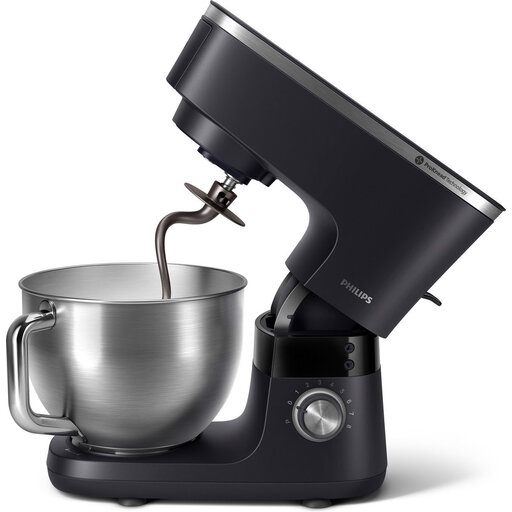
Why it suits this profile: This food mixer with a blender and mincer is ideal for families who want to prepare sauces, soups, smoothies or mince as well as dough and batter.
The blender and mincer are explicitly listed in the product specifications. This means you do not have to assume that optional accessories are included as standard.
1000 W, 5.5L bowl, 8 speeds, 1.5L glass blender, mincer and timer with automatic shut-off.

Why it suits this profile: Measuring 33.5 × 18 × 30 cm, this model is well suited to anyone looking for a food mixer that takes up less worktop space.
The product information states both the compact dimensions and the maximum dough quantity. This makes comparisons more practical than looking at bowl capacity alone.
800 W, 4L stainless-steel bowl, 6 speeds plus pulse function, dough hook, whisk and K-beater.
We have put together a complete, up-to-date list of products that fully meet these strict selection criteria and the applicable European safety regulations.
Yes, you use a dough hook for this. Choose a model with a sturdy base, sufficient bowl space and clear instructions on the maximum dough quantity. Start at a low speed and allow rest periods as instructed in the manual. A mixer for bread dough is not automatically suitable for unlimited or professional use.
Its lifespan depends on the workload, maintenance, storage and whether you follow the maximum quantities. Clean the attachments according to the instructions, keep the motor unit away from water and allow the motor to cool down after heavy kneading. A statutory guarantee period gives you rights if problems arise, but it does not prevent damage caused by incorrect use.
Consumption depends on the power rating and operating time. A 1000 W food mixer theoretically uses a maximum of 1 kWh in one hour, but in practice the motor usually runs for less time and not continuously at full power. Both the wattage and the total preparation time are therefore relevant to energy costs.
