
Vandaag of morgen in huis

Kwaliteit gegarandeerd

Welkomstaanbiedingen ontgrendelen: GRATIS bezorging | Tot 80% korting | Gratis 30 dagen JoyPlus-proefperiode
Download de app
A food mixer with a bowl can mix batter, whip cream and knead dough without you having to hold the bowl continuously. However, not every stand mixer is suitable for the same tasks. A lightweight mixer may be perfectly capable of handling cake batter but struggle with bread dough. A large bowl sounds practical, but it also takes up more space on a Dutch kitchen worktop.
The Joybuy Product Recommendation Officer sets out the key differences. This allows you to compare a stand mixer based on verifiable specifications rather than vague marketing claims.
A higher wattage does not automatically mean that an electric mixer will perform better with dough. The transmission, motor control, maximum dough capacity and operating time are at least as important. Check whether the power is listed as rated power or peak power. For example, the Monsga SM100 is listed with 1000 W peak power and 600 W rated power. These values are not the same.
A 5-litre food mixer cannot always safely process five litres of batter or dough. The maximum amount depends on the recipe and the density of the mixture. A manufacturer may state the bowl’s total capacity, while the recommended working quantity is lower. With the Monsga, for example, the bowl holds 6 litres, with a recommended capacity of 5 litres.
So do not look only at “5 litres” or “6 litres”. Also check the stated maximum dough capacity and the recommended amount of batter.
A mixer with a dough hook, whisk and flat beater is more versatile than a model with just one accessory. Also check whether the accessories are dishwasher-safe. With some models, the bowl can go in the dishwasher, but the dough hook or beater must be washed by hand.
A splash guard, tilting head and non-slip feet are not minor details: they determine how much mess and manual effort you have to deal with while baking.
Several low and high speed settings are useful for cake batter and whipped cream. For bread and pizza dough, a stable low speed is particularly important. A planetary mixer moves the accessory around the bowl, allowing the ingredients to be incorporated more evenly according to the product description. Performance can vary from one model to another, so check the manual and the stated maximum quantities.
Pay attention to these points:
A food mixer with a stainless steel bowl is practical for families and frequent bakers. Stainless steel is durable, does not absorb odours and is generally easy to clean. A plastic bowl may be lighter and suit compact models, but check that it locks securely into place.
Guidelines for use:
A food mixer that moves around while kneading is inconvenient and may slide off the worktop. Non-slip feet or suction cups can help, but always place the appliance on a flat, dry surface. A larger model is not automatically quieter, either. Manufacturers sometimes state a noise level in decibels; only compare these figures when the measurement conditions are the same.
Measure the available space before buying. Do not just consider the width and height, but also the room needed to tilt the head and remove the bowl.

Why it suits this profile: According to the product information, this compact model has a 700 W motor, a 3.8-litre bowl and a baking set with a whisk, beater and dough hook. That makes it suitable for smaller quantities of cake batter, cream and lighter dough.
The stated capacity is clearly specified: up to 1.7 kg of dough and 2.4 kg of batter. This means you do not have to rely on the bowl size alone.
3D planetary mixing action, non-slip feet and dishwasher-safe accessories according to the product description.

Why it suits this profile: The stated specifications include 1200 W of power, a 7-litre stainless steel bowl, automatic speed control and integrated scales. This suits anyone who bakes frequently and in larger quantities.
The capacity, power and scales are listed separately. This allows you to assess which features you will actually use rather than looking only at the design.
Large bowl, automatic speed control and a 2-year manufacturer's warranty according to the product information.
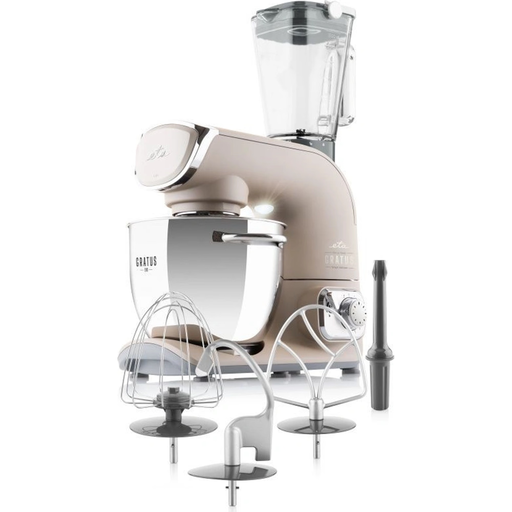
Why it suits this profile: The product specifications state 1500 W, a planetary mixing function, a 5.5-litre stainless steel bowl and a maximum dough capacity of 2.5 kg. This is aimed at larger preparations and regular kneading.
The maximum dough quantity is clearly stated. A thermal fuse, safety lock and non-slip base are also specified.
5.5-litre stainless steel bowl, variable speed control with pulse function and non-metal components that are dishwasher-safe according to the information provided.
We have compiled a complete, up-to-date list of products that fully meet these strict selection criteria and the applicable European safety regulations.
Yes, but check the maximum dough capacity, the type of dough hook and the recommended operating time. Start at a low speed and do not add more dough than stated in the manual. A motor can heat up more quickly with heavy yeast dough than with light batter.
For one or two people, 3 to 4 litres is often sufficient. Families can usually manage with a 5-litre food mixer. If you make several loaves or large quantities of batter, you could consider a 6- or 7-litre model. A larger bowl is only useful if the appliance is also approved for processing the corresponding quantity of dough.
Consumption depends on the power and how long the appliance is used. A 500 W model running for ten minutes uses less energy per baking session than a 1200 W model running for the same amount of time, but actual consumption is also affected by the load and speed setting. So consider both the stated power and your usage pattern, rather than looking at wattage alone.
