What should you look for when choosing one?
The main considerations are the space available for one batch, planning the drying time, storing the tomatoes carefully and how much room the appliance takes up.
| What to consider |
What to look for |
Who is this most important for? |
| Space for a batch |
Compare the usable tray dimensions with the appliance’s external dimensions; don’t judge capacity by the number of tiers alone. |
If I want to lay out plenty of slices for one gathering, I’ll check how much tray space is available without overlapping them. Around 34% of consumers put space for one batch first. |
| Planning the drying time |
Compare the temperature settings and timer range, but also allow time to check the tomatoes. |
If the tomatoes need to be ready before the family arrives, I want to leave enough time for a longer drying cycle. Around 33% of consumers prioritise making that schedule work. |
| Use and storage |
Check that the trays are easy to access and clean, and decide in advance how you’ll store the tomatoes after drying. |
When I’m preparing food for family, I want to be able to check how dry it is and know how to store the tomatoes safely. Around 20% of consumers prioritise careful use and storage. |
| Space and storage |
Measure the available width, depth and height, and take the placement instructions into account. |
If I have limited worktop space and make small batches, fitting and storing the appliance matters more than making the largest batch. Around 13% of consumers prioritise this balance of space. |
Food dehydrators at Joybuy
These food dehydrators have multiple trays or racks for spreading out tomato slices. Compare the stated settings and tray features with the batch you want to make and the space you have available.
 No image available
YASHE GGJ-261B food dehydrator
The five height-adjustable trays let you spread slices across multiple levels.
The product name specifies temperature control from 35–70 °C, a timer of up to 72 hours and a power rating of 240 W.
View at Joybuy
 No image available
YASHE GGJ-261A food dehydrator
The five adjustable trays provide multiple levels for spreading out tomato slices.
The product name specifies temperature control from 35–70 °C and a power rating of 240 W.
View at Joybuy
 No image available
YASHE FD-1019 food dehydrator
The five stainless steel trays are useful if you want to spread the slices across multiple levels.
The product name specifies an adjustable timer and temperature, 360° air circulation and a power rating of 400 W.
View at Joybuy
 No image available
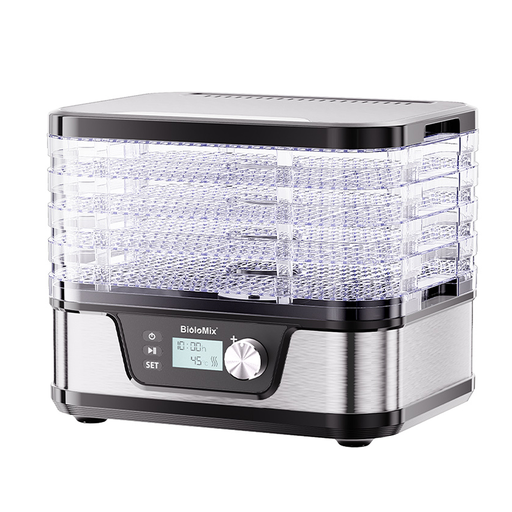
BioloMix BFD1300 food dehydrator
The five trays provide multiple levels for spreading out tomato slices.
The product name specifies a 24-hour timer, temperature control from 35–75 °C, a 10 L capacity and 360° air circulation.
View at Joybuy
 No image available
Rommelsbacher DA 650 food dehydrator
For a larger batch, you can spread the slices across the seven racks. Rommelsbacher lists 0,5 m² of drying area; that figure alone doesn’t tell you how many tomatoes will fit at once.
Rommelsbacher lists a timer of up to 99 hours. Check the tomatoes as they dry; the timer doesn’t determine when they’re fully dry.
View at Joybuy
Frequently asked questions
How far in advance should I start if the tomatoes need to be ready when the family arrives?
Start well in advance: Penn State Extension gives a drying time of 6 to 24 hours for tomatoes, depending on how they’re prepared. Lay the slices out without overlapping them and check the texture yourself; a timer doesn’t prove that they’re dry.
Can I dry tomato slices in my oven too?
You can, if your oven’s instructions say it’s suitable for prolonged drying at a low temperature and for venting moisture. Penn State Extension describes oven drying at 60–65 °C with the door ajar, but first check that this method is safe and permitted for your oven.
How should I store the tomatoes after drying?
Let fully dried tomatoes cool, then store them in a sealed container in a cool, dry, dark place. For home-dried tomatoes in oil, use only an appropriate, tested method: Oregon State University Extension notes a potential risk from Clostridium botulinum. Advice for an opened commercial jar doesn’t automatically give you a storage period for a homemade jar.
Is the statutory guarantee in the Netherlands always exactly two years?
No. According to the Dutch government, there is no fixed statutory guarantee period in the Netherlands. You’re entitled to a product that is fit for purpose, and the seller is your point of contact if there’s a problem. Any manufacturer’s guarantee may also have its own terms and conditions.
Which product rules are relevant when buying in the Netherlands?
CE marking is mandatory for the 230 V electric food dehydrators discussed here. Parts intended to come into contact with the tomatoes must meet the applicable requirements for food-contact materials. A product listing or CE logo alone doesn’t prove that an individual item meets every requirement.


