Who is a food dehydrator suitable for?

If you dry delicate garden herbs

If you come home from an evening class with damp basil or mint, you’ll want to dry the leaves using adjustable heat. The National Center for Home Food Preservation recommends spreading herbs in a single layer and checking them as they dry.

If you process varying harvests

When your harvest varies in size, the key question is how many leaves will fit on the trays without overlapping. Utah State University Extension suggests spreading herbs on a cloth or tray as one way to air-dry them.

If you start late and have limited space

If you only get started after an evening class, ease of use, worktop space and safety instructions all matter. The manual for Princess 01.112380.01.001 says that the appliance must not be left unattended while plugged in.

What to look for when drying garden herbs

Food dehydrator

Choose this if: you regularly dry delicate or damp herbs and want to control the temperature and air circulation.

Bear in mind: worktop space, electricity and cleaning; the National Center for Home Food Preservation gives a guide drying time of 1–4 hours, but this depends on the harvest and needs to be checked.

Air-drying

Choose this if: you have a small amount of sturdy herbs, such as thyme, sage or rosemary, and can use a dry, well-ventilated space.

Bear in mind: damp, delicate leaves can go mouldy if they dry too slowly; Utah State University Extension describes air-drying as a method suitable for herbs, among other things.

Your existing oven

Choose this if: you only dry a batch occasionally and your oven can provide enough air circulation at a suitably low temperature.

Bear in mind: the temperature can be harder to control; University of Minnesota Extension explains that oven-drying takes longer because ovens do not have a built-in fan to circulate the air.

What to consider What to look for when buying Who should pay extra attention?
Low temperature and checking Compare the lowest setting with the herbs you want to dry; the National Center for Home Food Preservation gives 95–115 °F (around 35–46 °C) as a guideline. When I dry delicate or damp leaves, I want to be able to adjust the heat and check them as they dry. Around 36% of consumers put carefully drying delicate herbs at the top of their list.
Room for your harvest Compare the usable tray dimensions, mesh size and overall measurements; check whether small leaves need an herb mat. With a varying harvest, I want to be able to spread the leaves in a single layer without piling them up. Around 29% of consumers focus mainly on capacity for their own harvest.
Controls and supervision Check the timer, any automatic shut-off and, above all, the safety instructions for the exact model. If I’m starting late, I want to know when I can check the dehydrator and what supervision instructions apply. Around 21% of consumers prioritise controls and supervision when starting late.
Positioning and cleaning Measure the space where you plan to put the appliance, allow for the specified clearance and check which parts can be removed. With limited worktop space, I want to know in advance whether the dehydrator will fit and how to clean it after use. Around 14% of consumers prioritise space and maintenance.

Common pitfalls when buying and using a food dehydrator

  • Assuming the timer proves the herbs are dry

    Drying time varies from one harvest to another. The manual for Princess 01.112380.01.001 also says not to leave the appliance unattended while it is plugged in.

    Check the leaves as they dry and follow the instructions in the manual for the exact model you’re using.

  • Comparing only the number of tiers

    The number of trays doesn’t tell you how many herbs will fit without overlapping. Small leaves can also fall through the gaps.

    Compare the usable tray dimensions and mesh size with your harvest, and check whether you need an herb mat.

  • Assuming another model from the same brand is identical

    The Rommelsbacher DA 350 and DA 650 are different models; the Joybuy product named DA 650 is not the DA 350.

    Check the full model number before buying and compare the specifications for that exact version.

Brands to compare

Princess

The Dutch product information for Princess 112380, version 01.112380.01.001, describes a stackable model with six tiers.

  • Princess lists a temperature range of 40–70 °C, 350 W and overall dimensions of 33 × 33 × 20 cm for this version.
  • The manual says not to leave the appliance unattended while it is plugged in. The lowest stated temperature is 40 °C.

Wartmann

The manufacturer describes the WM 2206 DH as having six trays, horizontal airflow, and adjustable time and temperature.

  • These features may be useful if you want to adjust the drying tiers and running time.
  • The manufacturer gives different temperature limits. Check the range for the exact version before making your choice.

Rommelsbacher

The manufacturer describes the DA 350 as having five height-adjustable trays, suitable for drying herbs among other things.

  • According to Rommelsbacher, the DA 350 has a temperature range of 35–75 °C, a drying area of 0,42 m² and a 36-hour timer.
  • The DA 350 is a different model from the DA 650. Check the full model number and don’t assume that specifications for one version also apply to another.

Steba

Steba describes the ED 5 as a stackable model with five tiers and an included herb mat.

  • According to Steba, the temperature can be set from 40–70 °C and the timer from 1–36 hours; the herb mat is designed for small leaves.
  • The lowest stated temperature is 40 °C. Compare this with the herbs and method you have in mind.

Food dehydrators at Joybuy

These Joybuy products are food dehydrators with adjustable temperatures for garden herbs. In particular, compare the trays, controls and dimensions with your harvest and the space where you plan to use the appliance.

YASHE GGJ-261B food dehydrator

YASHE GGJ-261B food dehydrator

An option if you want to set the temperature for drying herbs and need several trays.

Temperature control: 35–70 °C; 360° air circulation; five height-adjustable trays; 72-hour timer; 240 W.

View at Joybuy

YASHE GGJ-261A food dehydrator

YASHE GGJ-261A food dehydrator

An option if you want to spread herbs across several adjustable trays and set the temperature.

Temperature control: 35–70 °C; 360° air circulation; five adjustable trays; 240 W.

View at Joybuy

YASHE FD-1019 food dehydrator with five stainless steel trays

YASHE FD-1019 food dehydrator

An option if you’re looking for an adjustable temperature and several stainless steel trays for garden herbs.

Temperature control: 35–70 °C; 360° airflow; five stainless steel trays; 400 W. The trays are described as dishwasher-safe.

View at Joybuy
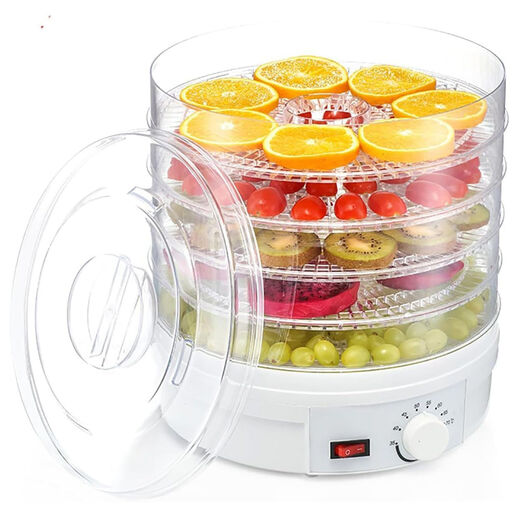
Food dehydrator with five tiers and temperature control from 35–70 °C

Food dehydrator with 5 tiers, 35–70 °C

An option if you want to spread herbs across five trays and need an adjustable temperature.

Temperature control: 35–70 °C; 350 W; vertical airflow. The removable trays are described as dishwasher-safe.

View at Joybuy

Frequently asked questions

How can I tell if my herbs are dry enough to store?

Check the herbs as they dry: according to the National Center for Home Food Preservation, they’re dry when the leaves crumble and the stems snap when bent. Don’t let a set drying time replace this check.

Can I switch on the dehydrator after my evening class and leave it running unattended?

Follow the manual for the exact model. The manual for Princess 01.112380.01.001 explicitly says the appliance must not be left unattended while it is plugged in; don’t treat a timer as permission to ignore that instruction.

How should I store dried herbs?

The Netherlands Nutrition Centre recommends storing whole or ground dried herbs in a sealed jar in a dark place. Light, heat and moisture affect their quality; advice for packaged herbs does not automatically give a shelf life for every home-dried harvest.

What can I do if a food dehydrator I bought in the Netherlands is faulty?

According to the Dutch Government, the seller must provide a solution if a product is faulty. A manufacturer’s guarantee does not replace your statutory rights, and there is no single statutory guarantee period for all products.

Is CE marking required for an electric food dehydrator?

The Netherlands Food and Consumer Product Safety Authority (NVWA) states that CE marking is compulsory for electrical consumer products covered by this requirement. Check the documentation and the exact version before buying; CE marking is the manufacturer’s declaration of conformity, not an independent quality mark.
