What to consider when choosing
When drying tomatoes for a neighbourhood meal, your choice mainly comes down to portion size, planning, kitchen space and how often you’ll use a dedicated appliance.
| Consideration |
What to look for |
Who might find this more important? |
| Enough slices per batch |
Compare the usable area of each tray and leave space between the slices. |
If I’m drying tomatoes for several guests, I want to know how many slices will fit without overlapping. Around 33% of consumers are most concerned about portion size when buying. |
| Ready in time to serve |
Check the timer and allow extra time to assess the slices; Penn State Extension gives a drying time of 6 to 24 hours for tomatoes. |
If I have a set serving time, I want to allow for a longer drying cycle. Around 27% of consumers are most concerned about timing. |
| Fitting it in and putting it away |
Measure the available worktop and cupboard space, then compare it with the appliance’s external dimensions. |
If my kitchen has limited worktop or cupboard space, finding an appliance that fits is a priority. Around 20% of consumers are most concerned about space when buying. |
| An appliance that may be used for just one meal |
Check whether your oven can reach around 60–65 °C and vent moisture; Penn State Extension describes drying in an oven with the door ajar. |
If I’m only drying tomatoes once, I want to weigh up whether a separate appliance is practical. Around 20% of consumers give priority to occasional use. |
Food dehydrators at Joybuy
These models have multiple trays or tiers for spreading out tomato slices. Compare the tray and appliance dimensions with your portion size and the space available in your kitchen. Before use, check that the specific model has the CE marking and that any parts that come into contact with tomatoes meet the Dutch requirements for food contact materials.
 Image unavailable
YASHE GGJ-261B food dehydrator
Ideal if you want to spread tomato slices across multiple levels and set the running time in advance.
Five height-adjustable trays; temperature control from 35–70 °C; 1–72-hour timer; 240 W.
View at Joybuy
 Image unavailable
YASHE GGJ-261A food dehydrator
An option if you want to spread slices across multiple trays and adjust the temperature.
Five adjustable trays; temperature control from 35–70 °C; external dimensions of 31 × 29 × 24,5 cm; 240 W.
View at Joybuy
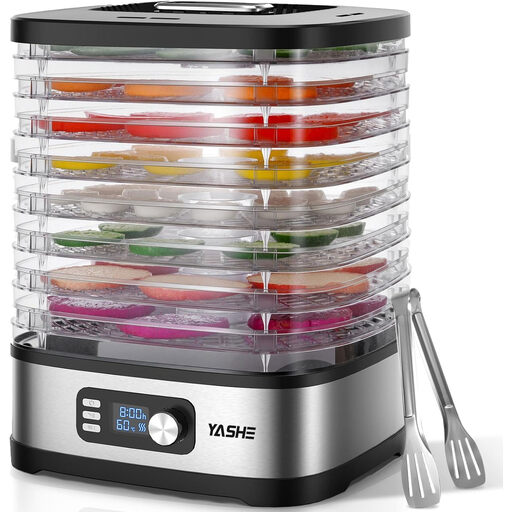 Image unavailable
YASHE GGJ-261C food dehydrator
Ideal if you want to spread tomato slices across multiple tiers and set the drying time in advance.
Eight trays; temperature control from 35–70 °C; 1–72-hour timer. Includes mesh mats, a fruit leather tray and stainless steel tongs.
View at Joybuy
 Image unavailable
YASHE FD-1019 food dehydrator
An option if you want to spread tomato slices across multiple trays and adjust both the time and temperature.
Five stainless steel trays; temperature control from 35–70 °C; 1–48-hour timer; 360° airflow; 400 W.
View at Joybuy
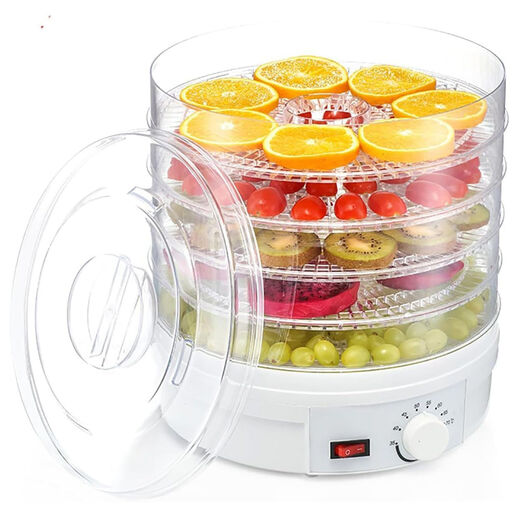 Image unavailable
Five-tier food dehydrator
Ideal if you want to spread tomato slices across multiple tiers and adjust the temperature.
Five tiers; temperature control from 35–70 °C; 350 W; removable trays and vertical airflow.
View at Joybuy
Frequently asked questions
Is a timer enough to tell me when the tomatoes are ready?
No. Penn State Extension gives a drying time of 6 to 24 hours for tomatoes and describes the finished texture as leathery to crisp. Use the timer to plan, then check the slices yourself.
How should I arrange tomato slices on the trays and store them afterwards?
Slice the tomatoes as evenly as possible and arrange the slices without overlapping. Once dried, let them cool and pack them in clean, airtight containers. The National Center for Home Food Preservation advises storing dried foods in a dry place and checking for moisture that may return during storage.
Can I store dried tomatoes in oil with garlic or herbs without refrigeration?
No, don’t store this mixture without refrigeration. Oregon State University Extension advises refrigerating dried tomatoes in oil with garlic and/or herbs and using them within four days, or freezing them for longer storage. This is food safety advice, not a legally prescribed storage period in the Netherlands.
What can I do if a food dehydrator I’ve bought turns out to be faulty?
According to the Dutch government, the seller must provide a solution if a product doesn’t meet the requirements. Any manufacturer’s warranty is in addition to your statutory rights.
What Dutch rules apply to food dehydrators and a neighbourhood meal?
The Netherlands Food and Consumer Product Safety Authority states that CE marking is compulsory for electrical consumer products, and that parts that come into contact with food must meet the applicable requirements for food contact materials. If you sell food several times a year, you must register with the NVWA. Whether those rules apply to a neighbourhood meal depends on how it is organised.


