What should you look for when buying?
First weigh up the storage dimensions against the space you need for your citrus batch. Then compare the controls and cleaning requirements.
| Consideration |
What to look for |
Who is this important for? |
| Will the appliance fit in the cupboard? |
Measure the width, depth and height of the storage space. Compare these with the external dimensions and, if the model has several stacking arrangements, the one you plan to use. |
If I have limited cupboard space, I want to know whether the appliance will genuinely fit after use. Storage size is the top priority for around 36% of consumers. |
| Is there room for my batch? |
Compare the tray dimensions with the diameter and quantity of citrus you usually dry. Arrange the slices in a single layer without overlapping them. |
If I want to dry several slices at once, I look at the usable space on each tray. Around 29% of consumers give batch size the highest priority. |
| How do I control and check the drying? |
Check the adjustable temperature range and whether there is a timer. Test a slice once it has cooled; setting a time does not confirm that every slice is dry. |
If I want to adjust the settings, I compare the temperature control and timer. Process control is the most important factor for around 21% of consumers. |
| How much maintenance does it need? |
Read the cleaning instructions and check whether the trays are dishwasher-safe. To estimate costs, you’ll need the actual energy consumption, drying time and your own electricity tariff. |
If I want to minimise cleaning after use and keep an eye on energy consumption, I check these points in advance. Maintenance and running costs are top priorities for around 14% of consumers. |
Food dehydrators at Joybuy
These models are food dehydrators for fruit, with different numbers of drying tiers and settings. Compare their features with your cupboard dimensions and citrus batch size. For each model, also check the documentation for the trays and other parts that come into contact with food: a ‘BPA-free’ label alone does not confirm that all applicable requirements have been met.
 No image available
YASHE GGJ-261B food dehydrator, 35–70 °C, 72-hour timer, 5 adjustable trays, 240 W
An option to compare if you want to set the temperature and drying time. Measure the cupboard space before choosing.
Features: 35–70 °C, 72-hour timer, 5 height-adjustable trays and 240 W.
View at Joybuy
 No image available
YASHE GGJ-261A food dehydrator, 240 W, 5 adjustable trays, 35–70 °C
Compare this model if you’re looking for several drying tiers and an adjustable temperature. Check its external dimensions against the space you have available.
Features: 240 W, 5 adjustable trays and a temperature range of 35–70 °C.
View at Joybuy
 No image available
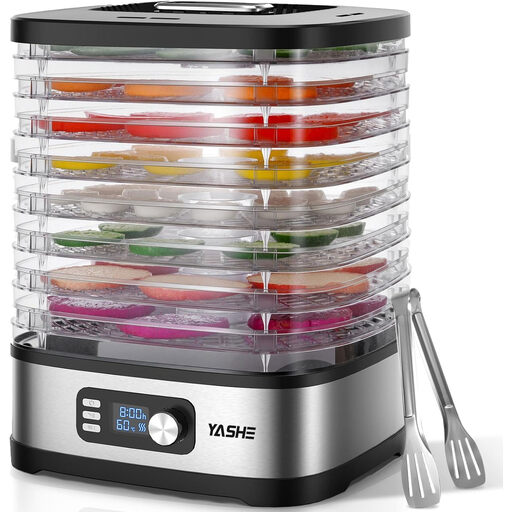
YASHE GGJ-261C food dehydrator, 8 trays, timer and temperature control
An option to compare if you want several trays and adjustable time and temperature. Check for yourself whether your batch will fit on the trays.
Features: 8 trays and timer and temperature control.
View at Joybuy
 No image available
YASHE FD-1019 food dehydrator, 5 stainless steel trays, adjustable timer and temperature, 400 W
Compare this model if you want stainless steel trays and adjustable time and temperature. Measure your available storage space.
Features: 5 stainless steel trays, adjustable timer and temperature, and 400 W.
View at Joybuy
 No image available
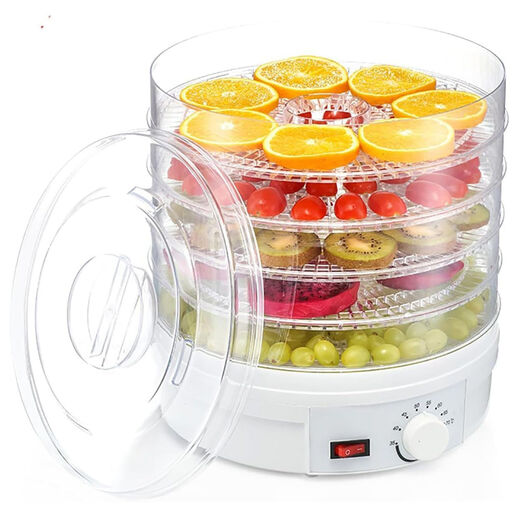
Food dehydrator, 5 tiers, 35–70 °C, 350 W
An option to compare if you want to dry fruit on several tiers. Check the cleaning instructions and the cupboard space you have available.
Features: 5 tiers, adjustable temperature of 35–70 °C and 350 W.
View at Joybuy
Frequently asked questions
How can I tell whether my citrus slices are dry?
Let a slice cool before checking it, as warm fruit can feel softer. Follow your appliance’s instructions and check the slices yourself: a timer alone won’t confirm that everything is dry.
Can I put the trays in the dishwasher?
It depends on the model. Fritel says the DH 2025 is dishwasher-safe; Tristar states that parts of the PD-9064 and PD-4910 are not dishwasher-safe. Check the instructions for the exact model.
How should I store homemade dried citrus slices?
Let the slices cool completely, then store them in clean, dry, airtight containers in a cool, dry, dark place. The National Center for Home Food Preservation also recommends a conditioning period to help identify any unevenly distributed residual moisture. Check for condensation and mould.
What rules apply in the Netherlands to trays that come into contact with food?
In the Netherlands, articles intended to come into contact with food must comply with the Warenwetbesluit verpakkingen- en gebruiksartikelen; the requirements for food-contact materials under Regulation (EC) 1935/2004 also apply. The NVWA explains these rules. Check the product documentation for the trays and any other parts that come into contact with food; a ‘BPA-free’ label alone does not confirm full compliance.
What temperature and drying time should I use for orange slices?
In a recipe for its own dehydrator, NESCO recommends 135 °F and 4–10 hours for orange slices cut 1/4 inch thick. This is not a guaranteed setting for a different appliance, a different thickness or another type of citrus. Follow your dehydrator’s instructions and check cooled slices for any remaining moisture.


