Who is this buying guide for?

Facilitator of a larger group

You’ll need enough tray space to lay out plenty of pear slices in a single layer, and you can continue drying them after the workshop. Utah State University Extension explains why air needs to circulate between and around the food. HENDI and Rommelsbacher provide tray and surface measurements for their models.

Teacher running a short session

You may want participants to taste something during the workshop. Bear in mind the difference between the preparation time for thin slices in an oven or air fryer and the longer drying cycle in a food dehydrator, as described by Voedingscentrum and Excalibur Dehydrator Recipes.

Organiser with limited worktop space

You’ll want to know whether the appliance will fit on your available worktop and whether its trays are practical to clean after use. WMF, Princess and Utah State University Extension offer useful pointers on taking space, tray layout and air circulation into account.

What should you look for when buying?

Large food dehydrator with pull-out trays

Choose this when: several participants will be preparing pears at the same time and drying can continue after the workshop. Compare the usable tray area, external dimensions and timer.

Bear in mind: a larger appliance needs more space. HENDI lists ten 395 × 380 mm trays for the Profi Line 229026; Rommelsbacher specifies seven drying trays and around 0.5 m² of drying area for the DA 650. These are product specifications, not measured drying performance.

Compact or stackable food dehydrator

Choose this when: your group is smaller or worktop space is limited. WMF describes the KITCHENminis 415250011 as having five levels; Princess lists six stackable layers for the 112380.

Bear in mind: the number of layers doesn’t tell you how many slices will fit on each one. Compare the usable tray dimensions and external dimensions with the space available.

Your existing oven or air fryer

Choose this when: you want to offer a small tasting session during the same workshop. Voedingscentrum gives a cooking time of 35–40 minutes in an air fryer or 50–60 minutes in an oven at 100 °C for very thin slices.

Bear in mind: turn the slices over partway through, as directed in the recipe. These cooking times don’t apply to thicker slices or a food dehydrator. For this recipe, store the fruit in an airtight container for a few days or freeze it.

What to consider What to look for Who is this important for?
Will it fit the batch size? Compare the usable tray dimensions, number of trays and external dimensions. Arrange the slices with enough space for air to circulate. If I’m slicing pears for several participants at once, I want to know how many slices will fit in one layer. Around 36% of consumers prioritise having enough space for a group batch.
Will the pears be ready in time? Match the slice thickness and preparation method to the time available. A timer alone doesn’t confirm that the fruit is sufficiently dry. If I want participants to taste the fruit during the same session, the time between preparation and serving matters a lot. Around 29% of consumers say when the result will be ready is their main concern.
Will the appliance fit in the workspace? Measure the space available and leave room to remove the trays. Check the instructions to see how the parts can be cleaned. If I’m using a shared kitchen, I want to be able to set up the appliance and clean it easily afterwards. For around 21% of consumers, workspace and cleaning are the most important factors.
Do I need a separate dehydrator? Take existing appliances, expected frequency of use and the length of a drying cycle into account. Calculate electricity costs using actual consumption and your own tariff. If I only need a dehydrator occasionally for a workshop, I want to weigh up whether my existing appliances will do the job. Around 14% of consumers prioritise purchase and running costs.

Common pitfalls

  • Assuming the timer proves the pears are ready

    Drying time can vary. Warm fruit also feels softer, so a piece straight from the appliance may feel different once it has cooled.

    Plan a time to check the fruit. Let a test piece cool, then assess it before storing or serving the batch.

  • Comparing only the number of layers

    The number of trays doesn’t tell you how many slices of your chosen size will fit side by side. Air needs to circulate between and around the slices during drying, as Utah State University Extension explains.

    Compare the usable tray dimensions and sketch out how the planned quantity of pear slices will fit in a single layer.

  • Assuming quick oven preparation means the fruit will keep for a long time

    For its specific quick oven or air fryer recipe, Voedingscentrum recommends storing the fruit in an airtight container for a few days or freezing it in portions. That advice doesn’t automatically apply to a batch dried another way.

    Make sure your storage instructions match the preparation method you used, and don’t promise a longer shelf life without suitable evidence.

Brands worth considering

HENDI

The Profi Line 229026 is a useful point of comparison for larger batches. HENDI lists ten stainless steel trays measuring 395 × 380 mm.

  • The stated tray size helps you plan the layout for your batch.
  • The external dimensions are 430 × 550 × 416 mm and the rated power is 1000 W. HENDI’s claim that it dries evenly without turning the trays is a manufacturer claim, not an independent test result.

Rommelsbacher

The DA 650 is worth comparing if you want to plan a larger batch without automatically opting for a model with ten trays.

  • Rommelsbacher lists seven drying trays, around 0.5 m² of drying area, a temperature range of 35–75 °C and a timer of up to 99 hours.
  • The stated area doesn’t tell you how many pear slices will fit. Also check the model specification, accessories and available space.

Princess

The 112380 is a stackable model with six layers, making it worth comparing for a smaller or more flexibly arranged batch.

  • Princess lists a temperature range of 40–70 °C, 350 W and external dimensions of 33 × 33 × 20 cm.
  • Don’t judge batch capacity by the number of layers alone. Check the usable tray space for the slices you want to dry.

WMF

The KITCHENminis 415250011 Snack to-go is a compact dehydrator described as having five levels.

  • WMF lists a temperature range of 30–70 °C and a timer from 0–24 hours.
  • Check the usable tray size for your batch. A timer or automatic shut-off doesn’t by itself show that the pears are sufficiently dry.

Steba

The ED 6 is an alternative with six stainless steel drying surfaces, each measuring 37 × 30 cm, and a hinged door.

  • Steba lists a temperature range of 35–90 °C, a timer from 1–24 hours, 800 W at 230 V and external dimensions of 29 × 36,5 × 47,5 cm.
  • These are manufacturer specifications for the model, not measurements of drying performance or confirmation of stock availability.

Food dehydrators at Joybuy

These food dehydrators are included as a starting point for drying fruit across multiple trays, with batch layout and adjustable drying cycles in mind.

YASHE GGJ-261B food dehydrator with five height-adjustable trays

YASHE GGJ-261B food dehydrator, 5 trays, 240 W

The height-adjustable trays offer different levels for arranging a batch. Check that the available surface area suits the quantity of pears you need to dry.

Temperature control: 35–70 °C. Timer: 72 hours. Power: 240 W.

View at Joybuy

YASHE GGJ-261A food dehydrator with five adjustable trays

YASHE GGJ-261A food dehydrator, 5 trays, 240 W

The five adjustable trays provide several levels for a workshop batch. Compare the layout with the number of slices you want to dry at once.

Temperature control: 35–70 °C. Power: 240 W.

View at Joybuy
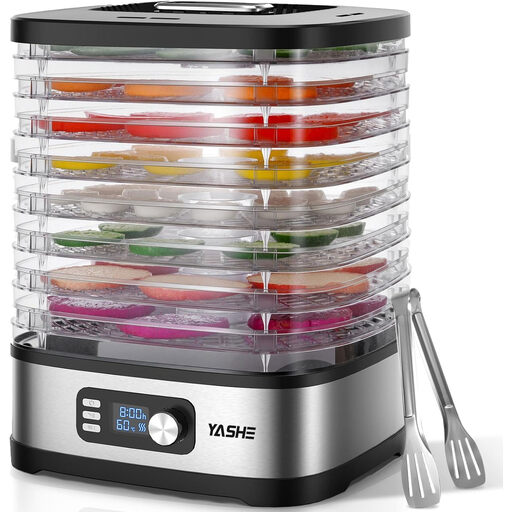
YASHE GGJ-261C food dehydrator with eight trays and included mesh screens

YASHE GGJ-261C food dehydrator, 8 trays

The eight trays offer several levels for spreading out a batch. When planning, also allow for the space needed for air to circulate.

Timer and temperature control: 72 hours. Mesh screens included.

View at Joybuy

YASHE FD-1019 food dehydrator with five stainless steel trays

YASHE FD-1019 food dehydrator, 5 stainless steel trays, 400 W

The five trays provide several levels for a batch of pear slices. Check the tray dimensions and how the parts can be cleaned.

Adjustable timer and temperature control. Power: 400 W.

View at Joybuy

Food dehydrator with five layers and temperature control from 35–70 °C

Food dehydrator, 5 layers, 35–70 °C, 350 W

The five layers can help you spread a batch across several levels. Check the available tray space for your slices.

Temperature range: 35–70 °C. Power: 350 W.

View at Joybuy

Frequently asked questions

Can participants taste their pear slices during the same session?

It depends on the slice thickness and preparation method. For very thin pear slices, Voedingscentrum gives a cooking time of 50–60 minutes in an oven or 35–40 minutes in an air fryer at 100 °C, turning them every ten minutes. A recipe from Excalibur Dehydrator Recipes for thicker slices in a food dehydrator gives a drying time of 20–36 hours at 135 °F. Don’t apply those timings to a different method or batch.

How can you check whether the pears are dry enough, and how should you store them?

First, let a test piece cool, as warm fruit feels softer. Utah State University Extension recommends checking the cooled fruit by cutting and squeezing it; no moisture should be visible. For its specific quick oven or air fryer recipe, Voedingscentrum recommends storing the fruit in an airtight container or bag for a few days, or freezing it in portions. Don’t automatically apply this advice to a batch dried another way.

How do you work out running costs, and what warranty applies?

The stated wattage isn’t a measure of energy used per drying cycle. Work out the cost using actual consumption, the time in use and your own electricity tariff. For consumer purchases in the Netherlands, ACM ConsuWijzer also explains that statutory consumer rights apply: the seller must provide a product that meets what you could reasonably expect. Any manufacturer’s warranty doesn’t replace this right.

What should you check about trays that come into contact with the pears?

Check the information for the exact tray specification. The Netherlands Food and Consumer Product Safety Authority states that items intended to come into contact with food must meet the applicable requirements for food contact materials. A description of the material alone doesn’t prove that a specific version meets those requirements.

Does a cookery workshop organiser need to register and follow HACCP procedures?

This depends on how the workshop is organised and what food activities take place. The Netherlands Food and Consumer Product Safety Authority says that food businesses supplying food directly to consumers must register. Businesses that prepare or process food must have a food safety plan based on HACCP or an applicable hygiene code. Assess your specific situation before applying these requirements to a workshop.
