What should you look for when buying?
Start by working out how much space you need to spread out the pear slices. Then check whether the appliance will fit on your worktop and suit the way you want to dry and clean it.
| What to consider |
What to look for |
Who should pay particular attention? |
| Space for your batch |
Compare the usable tray area with the amount you plan to dry, and arrange the slices without overlapping them. |
If I want to dry lots of slices at once for a shared meal, I need enough room to spread them out. About 36% of consumers prioritise having enough space for their batch. |
| Drying and storage |
Check the temperature controls and timer, but don’t assume that a set time proves every slice is dry. |
If I’m preparing the pears in advance, I want to check the drying results and avoid moisture problems during storage. About 29% of consumers prioritise control over drying and storage. |
| Placement and storage |
Measure the available worktop space and compare the external dimensions. Stackability may also matter when you put the appliance away. |
If my kitchen has limited space, I want to choose an appliance that I can fit in while it’s drying and put away afterwards. About 21% of consumers prioritise placement and storage. |
| Cleaning |
Check which parts can be removed and follow the cleaning instructions for the specific model. |
If I want to remove fruit residue after drying, I look for parts that I can clean separately and clear instructions. About 14% of consumers prioritise cleaning and aftercare. |
Joybuy product picks
These Joybuy picks are stackable food dehydrators with multiple trays. Compare each model’s temperature controls, timer and number of tiers with the amount you want to dry.
 No image available
YASHE GGJ-261B food dehydrator
The five adjustable trays offer several levels for spreading out pear slices.
Temperature control: 35–70 °C. Timer: up to 72 hours. Power: 240 W.
Joybuy
 No image available
YASHE GGJ-261A food dehydrator
The five adjustable trays offer several levels for a batch of pear slices.
Temperature control: 35–70 °C. Power: 240 W.
Joybuy
 No image available
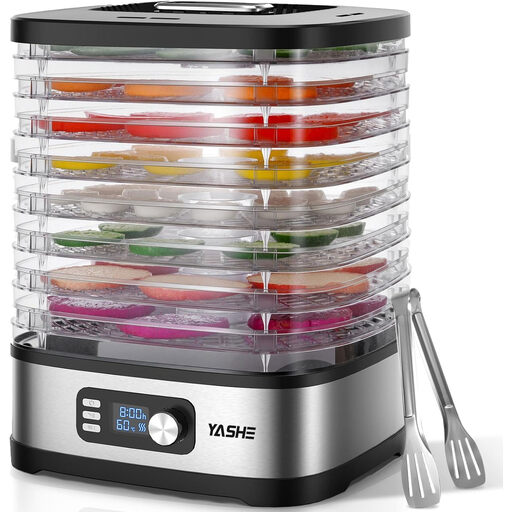
YASHE GGJ-261C food dehydrator
With eight stackable trays, you can spread pear slices across several levels.
Temperature control: 35–70 °C. Timer: 1–72 hours. The product name lists mesh screens, a fruit roll sheet and stainless steel tongs among the included accessories.
Joybuy
 No image available
YASHE FD-1019 food dehydrator
The five stainless steel trays offer several levels for spreading out fruit.
Temperature control: 35–70 °C. Timer: 1–48 hours. Power: 400 W. The description mentions 360° air circulation.
Joybuy
 No image available
Five-tier food dehydrator
The five tiers offer several levels for spreading out pear slices.
Temperature control: 35–70 °C. Power: 350 W.
Joybuy
Frequently asked questions
How can I tell whether one drying cycle will be enough for the meal?
Compare the amount you plan to dry with the usable tray area, and leave space between the slices. The number of trays or a maximum weight capacity alone won’t give you a reliable indication of the number of portions.
Can I dry pear slices to an exact timer setting?
No. A timer doesn’t confirm that every slice is dry enough. The University of Minnesota Extension lists factors such as the thickness of the slices and the fruit’s moisture content as things that affect drying time. If condensation appears in the sealed jar after the fruit has cooled and been stored, the National Center for Home Food Preservation advises drying it again.
How should I store home-dried pears until the meal?
After drying, leave the pears to cool, check for any remaining moisture, then store them in a sealed container in a cool, dry and dark place. The Voedingscentrum recommends this storage method for dried pears; the storage period for commercially packaged pears doesn’t automatically apply to home-dried slices. Discard any mouldy fruit.
Which regulations apply to the dehydrator and its trays?
Electrical equipment within the scope of the EU Low Voltage Directive, including equipment rated for 230 V AC, must carry CE marking. Trays intended for direct contact with food must comply with the applicable rules for food contact materials. EUR-Lex explains the low-voltage rules; the Netherlands Food and Consumer Product Safety Authority and the European Commission outline the requirements for food contact. Ask for product-specific information if you want to check whether a model or tray is suitable.
Who should I contact about a faulty product, and does the two-year legal guarantee automatically apply?
If a product is faulty, the seller must provide a solution. According to the Dutch government, there is no set two-year statutory guarantee period in the Netherlands. What you can reasonably expect depends, among other things, on the product, its price and the sales information.


