
Cook preparing a larger community meal
You want to prepare plenty of pear slices for your guests and need to work out how much drying space you’ll need, including for any extra batches.


When choosing a food dehydrator for pear slices for a community meal, consider how many slices you can spread out without overlapping and how much time you have for any extra batches. A cabinet-style model with multiple trays may suit larger quantities if you have the space; a stackable model could be more convenient if you’d rather start small. Penn State Extension recommends 57–60 °C for dehydrating pears, but check the slices themselves and let them cool before packing.
You want to prepare plenty of pear slices for your guests and need to work out how much drying space you’ll need, including for any extra batches.
You want to monitor the temperature and progress, and allow time to check the slices and how they’re stored before serving.
You want to dry pears for this occasion without automatically opting for a large appliance that may be difficult to store.
Start with the quantity you want to prepare and the worktop space available. Then consider how much monitoring and aftercare you can fit into your preparations.
| What to consider | What to look for | Who it’s for |
|---|---|---|
| Drying space per batch | Compare the usable area of the trays and arrange the slices without overlapping. The number of tiers alone won’t tell you how many pears will fit. | For a full community meal, I want to be able to lay out enough slices at once, so I don’t have to plan extra batches unexpectedly. That’s why around 36% of consumers prioritise capacity. |
| Control over drying | Penn State Extension recommends 57–60 °C for dehydrating pears. Check slices in different positions; a timer won’t tell you when they’re dry. | When I’m drying fruit for guests, I want to check the temperature and progress rather than rely on the timer alone. Around 29% of consumers put control over the drying process first. |
| Kitchen and storage space | Compare the appliance’s dimensions with your worktop and storage space. Consider whether your schedule allows time for multiple batches. | For occasional use in a small kitchen, I want to be able to put the appliance away afterwards and allow time for extra batches if needed. Around 21% of consumers prioritise limited space and the purchase price. |
| Cleaning and storage | Check the cleaning instructions. Allow time for the slices to cool and for packed fruit to be checked for condensation. | After drying, I want to have time for cleaning, cooling and careful packing. Around 14% of consumers prioritise this aftercare. |
How many slices fit in each batch also depends on the usable tray area and the space between the slices. The National Center for Home Food Preservation lists limited capacity as a disadvantage of food dehydrators.
Work out how many pears you want to slice and compare the tray areas. If needed, first lay out a test batch without overlapping the slices.
A smaller loading area may mean extra batches and more preparation time.
Slices in different positions may dry at different rates. The National Center for Home Food Preservation recommends drying the fruit further if you find condensation during conditioning.
Check slices in different positions and let them cool completely before packing. The Netherlands Nutrition Centre advises throwing away mouldy food immediately.
The VitaDry is a cabinet-style model with multiple trays, suited to those who want to spread out a larger quantity in one go.
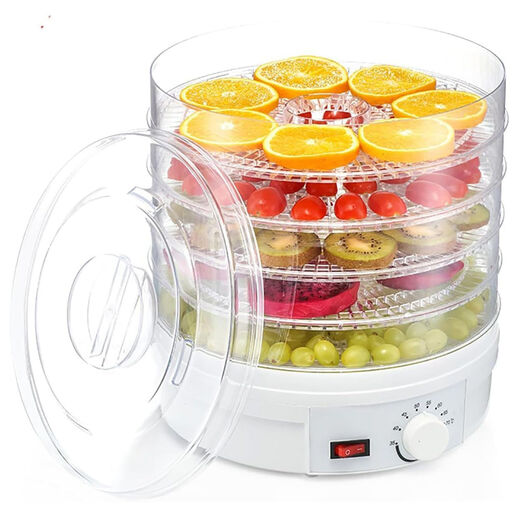
The DH 2025 is a stackable dehydrator with five trays, for those who want to spread the slices across several levels.
WMF describes the KITCHENminis 415250011 Snack to-go as a compact model with a timer.
The DA 350 has adjustable tiers, which may be useful if you want to dry thicker pieces as well as thin slices.
These food dehydrators are suitable for drying fruit. Compare their listed temperature settings and tray layouts with the quantity of pears you want to prepare and the space you have available.
 No image available
The five height-adjustable trays provide several levels for spreading out pear slices.
Temperature setting: 35–70 °C. Timer: 72 hours. Power: 240 W.
 No image available
With five adjustable trays, you can spread pear slices across several levels.
Temperature setting: 35–70 °C. Power: 240 W.
 No image available
The five trays provide several levels for spreading out pear slices.
Stainless steel trays. Timer: 1–48 hours. Power: 400 W.
 No image available
The five tiers provide several levels for spreading out pear slices.
Temperature range: 35–70 °C. Power: 350 W.
 No image available
A food dehydrator to compare if you’re preparing pear slices for a larger gathering; match the quantity you want to prepare to the drying space available.
Penn State Extension recommends 57–60 °C for dehydrating pears. Also follow your appliance’s instructions and check the slices themselves; a temperature setting won’t determine a fixed drying time.
Wash the pears under running water before slicing them. Oregon State University Extension recommends ripe pears that aren’t soft or mushy, and describes slices measuring ¼–½ inch.
Let the slices cool completely first to prevent condensation in the packaging. For longer storage, the National Center for Home Food Preservation also describes a conditioning period of 7–10 days, during which you check the fruit daily for condensation.
If dried fruit has condensation on it, dry it further, as advised by the National Center for Home Food Preservation. Throw away any mouldy slices; the Netherlands Nutrition Centre advises throwing away mouldy food immediately.
It depends on the activity. The Netherlands Food and Consumer Product Safety Authority states that a food safety plan is required if you prepare and sell food at markets and events several times a year. This rule for sales shouldn’t automatically be applied to a one-off meal where no food is being sold. Check which rules apply if you plan to sell food or organise the gathering more often.