For small batches of pears, the usable tray area and where you plan to store the dehydrator matter more than the number of tiers alone. Then compare the temperature and timer settings, but check the result yourself before putting the slices away. If you only dry fruit occasionally, you could first see whether you want to use an oven you already own.
Who is a food dehydrator suitable for?
If you dry small batches
You occasionally dry a few pears and need to consider both the space for the slices and where you’ll store the appliance. Compare the tray dimensions with your usual batch size; Utah State University Extension recommends leaving space between slices to allow air to circulate.
If you dry fruit regularly
You dry fruit more often and want to space out the slices and set the drying cycle yourself. Utah State University Extension explains that drying times can vary, so you’ll also need to check the result yourself.
If you want easy cleaning and storage
You’ll want to consider how to clean the trays after use and how to check and store a small batch. The Netherlands Nutrition Centre advises storing dried pears in a well-sealed container in a cool, dry and dark place.
What should you look for when drying small batches of pears?
Compact stackable dehydrator
When to choose it: If you regularly make small batches and want to put the appliance away after use, compare its external dimensions and tray area with your slices and cupboard space.
Trade-off: A compact casing doesn’t tell you how many slices will fit on the trays without overlapping.
Dehydrator with more tray or setting options
When to choose it: If you also want to spread out larger quantities of fruit more often, compare the individual trays and the controls.
Trade-off: Extra tiers or settings don’t prove that fruit will dry faster or more evenly, and they may take up more space.
Use an oven you already own
When to choose it: If you only dry pears occasionally and want to see whether this method suits you first, drying them in an oven is a possible option according to Utah State University Extension.
Trade-off: Slices still need space for air to circulate in an oven, and you’ll need to check the result.
| What to consider |
What to look for |
Who it matters to |
| Usable drying space and size |
Compare the tray and appliance dimensions with your batch size and the space available on your worktop or in a cupboard. |
If I only dry a few pears at a time, I want to fit the slices without overlapping and be able to put the appliance away. Around 36% of consumers give space and batch size top priority. |
| Control over drying |
Check the adjustable temperature range and controls; test a cooled slice yourself. |
I want to be able to set the drying cycle, but also judge for myself whether the cooled slices are dry enough. Around 29% of consumers prioritise control over the drying result. |
| Cleaning and storage |
Read the cleaning instructions for the model and check the slices for moisture after drying and during conditioning. |
If I use the dehydrator regularly, I want to be able to clean the trays thoroughly afterwards and spot any moisture in my stored fruit. Around 21% of consumers give cleaning and storage top priority. |
| Purchase cost and electricity use |
Compare measured consumption in kWh per drying cycle and how long it takes; wattage alone doesn’t tell you the consumption per batch. |
If I only dry fruit occasionally, I want to weigh up whether I need a separate appliance or should try my oven first. Around 14% of consumers prioritise purchase cost and electricity use for occasional use. |
Common things to consider
-
Comparing only the number of trays
Five or six tiers don’t tell you how many slices from your batch will fit with enough space between them.
Measure the space available and compare the tray dimensions before choosing based on the number of tiers.
An appliance that doesn’t fit your kitchen or cupboard could take up more space than necessary.
-
Assuming the timer determines the drying result
Drying times can vary. Setting a timer doesn’t tell you on its own whether all the slices are dry enough.
Let a slice cool before checking it, and look for condensation in your batch during conditioning. Dry the fruit further if condensation appears.
-
Confusing wattage with consumption per batch
The stated power rating isn’t a measurement of the energy used during a drying cycle, and it doesn’t tell you how much energy your batch will need.
Only compare energy use using figures in kWh per drying cycle, and take the duration into account. Don’t treat a power rating as a comparison of drying results.
Brands to compare
WMF
WMF lists five tiers, a temperature setting of 30–70 °C and a timer of 0–24 hours for the KITCHENminis 415250011 Snack to-go.
- The range of settings and included storage containers help you assess the controls and storage options.
- The number of tiers doesn’t tell you how many pear slices will fit on the trays; compare the usable space with your batch size.
Fritel
According to Fritel, the DH 2025 has five plastic trays measuring 24,5 × 31,5 cm, two stacking positions and a temperature range of 35–70 °C.
- The stated tray dimensions give you a useful reference for estimating how your small batch will fit.
- Don’t use the claim of even drying to compare it with other models; also check how you arrange the slices and assess the drying result yourself.
Steba
Steba lists five trays that can be used individually, electronic controls from 40–70 °C and a timer of 1–36 hours for the ED 5.
- The stated tray size of 32 × 25 cm and appliance dimensions of 33,5 × 26,5 × 28,5 cm help you compare tray space and storage space.
- The settings and dimensions alone don’t tell you how your pears will dry.
Princess
According to Princess, the 112380 has six stackable tiers, analogue controls and a thermostat ranging from 40–70 °C.
- The stated appliance dimensions of 33 × 33 × 20 cm let you check in advance whether it will fit on your worktop or in your cupboard.
- Six tiers don’t tell you how many slices will fit without overlapping or what drying result you’ll get; compare the usable tray area.
Rommelsbacher
Rommelsbacher lists five height-adjustable drying levels, a drying area of 0,42 m² and a 36-hour timer for the DA 350.
- Adjustable space between the levels may be useful if you want to dry slices of different thicknesses.
- The stated total area doesn’t tell you how many pear slices will fit with space between them; also look at the tray layout.
Food dehydrators at Joybuy
These product picks are food dehydrators for fruit, selected with tray layout and adjustable drying cycles in mind. Check the documentation for the specific version of your chosen model: electrical equipment within the scope of Directive 2014/35/EU is subject to the applicable electrical safety requirements, while parts that come into contact with food are covered by the relevant EU rules, including Regulation (EC) No 1935/2004.
 No image available
YASHE GGJ-261B food dehydrator, 5 adjustable trays
The product title lists fruit as a use and adjustable trays for arranging the drying space.
Temperature: 35–70 °C. Timer: 72 hours. Power: 240 W. BPA-free.
View at Joybuy
 No image available
YASHE GGJ-261A food dehydrator, 5 adjustable trays
The product title lists fruit as a use and five adjustable trays for arranging the drying space.
Temperature: 35–70 °C. Power: 240 W. BPA-free.
View at Joybuy
 No image available
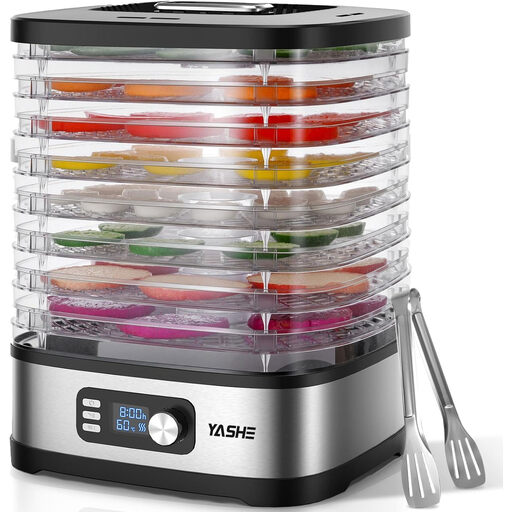
YASHE GGJ-261C food dehydrator, 8 trays
The product title lists fruit as a use and mentions accessories as well as the trays.
Timer and temperature: up to 72 hours. Includes mesh trays, a fruit leather tray and stainless steel tongs. BPA-free.
View at Joybuy
 No image available
YASHE FD-1019 food dehydrator, 5 stainless steel trays
The product title lists fruit as a use; the adjustable timer and temperature give you control over the drying cycle.
360° airflow. Power: 400 W. BPA-free.
View at Joybuy
 No image available
Food dehydrator with 5 tiers, 35–70 °C
The product title lists fruit as a use and five tiers for arranging the ingredients.
Temperature: 35–70 °C. Power: 350 W. BPA-free.
View at Joybuy
Frequently asked questions
How should you arrange and check pear slices while they dry?
Arrange the slices with space between them so air can circulate. Let a slice cool before checking it: Utah State University Extension describes sufficiently dried fruit as leathery, not hard, with no visible moisture when cut or squeezed. Drying times can vary.
Can you put home-dried pears straight into an airtight container?
Don’t rely on the timer alone. The National Center for Home Food Preservation recommends conditioning cooled dried fruit for 7–10 days and checking daily for condensation; dry the fruit further if condensation appears.
How do you compare the energy use of a small drying cycle?
Compare the measured consumption in kWh per drying cycle and take the duration into account. A power rating such as 250 W or 350 W doesn’t on its own measure the energy used for your batch.
What are your rights when you buy a food dehydrator online?
According to ACM ConsuWijzer, when a consumer makes an online purchase, they generally have up to 14 days after delivery to change their mind; check which exceptions and conditions apply. Your statutory rights if a product doesn’t meet what you could reasonably expect under normal use are separate from any manufacturer’s warranty. The seller is responsible for providing a solution.
Which product regulations are relevant when buying in the Netherlands?
Electrical equipment within the scope of Directive 2014/35/EU must meet the applicable electrical safety requirements and CE marking obligations, as explained by EUR-Lex. Parts intended to come into contact with food are subject to the relevant EU rules for food contact materials, including Regulation (EC) No 1935/2004, as explained by the European Commission. Check the documentation for the exact model and version on offer; a product listing alone doesn’t demonstrate full compliance.


