
Late-night starter
You only get started slicing late and want to set in advance when the dehydrator will stop. A stop time doesn’t guarantee that the pears will be dry by then; WMF lists an adjustable timer for the KITCHENminis 415250011.


Start by considering how many pears you want to dry and where the dehydrator can sit during a long drying cycle. A compact stackable model generally takes up less worktop space, while a cabinet model may offer more drying area. A timer won’t guarantee that the pears are dry enough when it stops, so check them before storing the slices and follow the instructions for your chosen appliance.
You only get started slicing late and want to set in advance when the dehydrator will stop. A stop time doesn’t guarantee that the pears will be dry by then; WMF lists an adjustable timer for the KITCHENminis 415250011.
You regularly dry larger quantities and want to know how much usable drying area you’ll get and how to store the slices afterwards. Rommelsbacher and Wartmann describe models with multiple trays; take care when storing dried fruit.
You make smaller batches and need to fit the appliance on your worktop during a long drying cycle. Compare its external dimensions with the space you have available; Tristar lists dimensions of 25 × 23,4 × 27,1 cm for the PD-9064.
Best suited to: making smaller batches or having limited worktop space. Compare the external dimensions and timer of the Tristar PD-9064; WMF lists a 0–24-hour timer for the KITCHENminis 415250011.
Trade-off: the number of tiers doesn’t tell you how many slices will fit without overlapping; check the usable tray area.
Best suited to: drying larger batches more often and having space for the appliance. According to the manufacturer, the Rommelsbacher DA 650 has an adjustable running time of up to 99 hours.
Trade-off: compare the external dimensions with your workspace. More drying area doesn’t automatically mean a batch will dry faster or more evenly.
CE marking is compulsory for an electric food dehydrator sold as an electrical consumer product in the Netherlands. Trays and other parts intended to come into contact with food must meet the applicable requirements for food contact materials. The Netherlands Food and Consumer Product Safety Authority sets out these requirements; check the documentation for the specific product listing.
| What to consider | What should you check? | Who is this important for? |
|---|---|---|
| Timer and planning | Check the timer range, automatic shut-off and instructions for extended use. | If I only start after my evening class, I want to be able to plan the drying cycle without assuming the pears will be ready in time. Around 36% of consumers are mainly looking to meet a planning need when buying. |
| Dryness and storage | Check the temperature control and air circulation; inspect the slices afterwards and watch out for condensation during storage. | If I want to store the pears, I need to be able to check that they’re dry enough and see whether moisture appears later. Around 29% of consumers prioritise control over dryness and storage. |
| Batch size | Compare the tray dimensions with the number of slices you usually cut at a time. | If I want to dry a typical batch in one go, I look at the usable area, not just the number of tiers. Around 21% of consumers mainly need enough room for their batch. |
| Worktop space | Measure the available width, depth and height, and follow the positioning instructions in the manual. | If the dehydrator needs to stay on the worktop throughout the drying cycle, I want to know in advance whether it will fit. Around 14% of consumers prioritise a suitable fit in their kitchen. |
Drying time depends on factors including the thickness of the slices and the conditions. A timer on its own won’t tell you whether the pears have lost enough moisture.
Check the pears after drying. Let them cool and watch for condensation during storage. If condensation appears, dry them further; discard any fruit that has gone mouldy.
The number of tiers doesn’t tell you how many slices will fit on the usable area. External dimensions also vary from model to model.
Compare the tray area and external dimensions with your usual batch size and the space you have available.
A thermostat may switch the heating on and off during use. The Wartmann WM-2110 DH product page also lists both 400 W and 800 W.
First, check the correct rated power for this exact model. To estimate the cost, use an appropriate consumption figure for the model and drying time.
The KITCHENminis 415250011 is a compact model with an adjustable timer and portable containers.
The PD-9064 is a stackable model worth comparing if the space available on your worktop is a factor.
The 112380 is a stackable model with six tiers.
The DA 650 is a cabinet model with an adjustable running time and multiple drawers.
The WM-2110 DH is a cabinet model with ten trays, designed for comparison when drying larger batches.
This selection includes food dehydrators with multiple trays, from models for smaller batches to the Rommelsbacher DA 650 cabinet dehydrator, with seven drawers and 0,5 m² of drying area.
 No image available
The timer and temperature control offer adjustable settings for a drying cycle; check the pears for dryness afterwards.
Five height-adjustable trays; 35–70 °C; timer up to 72 hours; 240 W.
 No image available
The five adjustable trays give you several levels to spread the fruit across; compare the external dimensions with the space available on your worktop.
240 W; five trays; 35–70 °C; dimensions 31 × 29 × 24,5 cm.
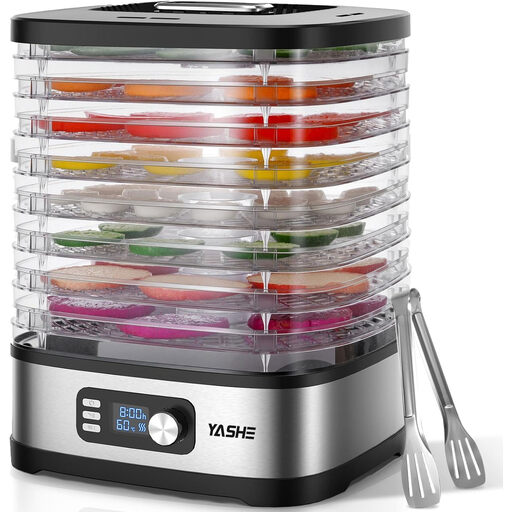 No image available
The product name lists a 72-hour timer and temperature control; check the pears for dryness when the cycle ends.
The product name also lists a mesh screen, a fruit roll tray and stainless steel tongs.
 No image available
The adjustable timer and temperature control give you options for planning a drying cycle; check the pears before storing them.
Five stainless steel trays; adjustable timer and temperature; 360° air circulation; 400 W.
 No image available
The cabinet model offers 0,5 m² of drying area across seven drawers, which may be useful if you want to dry larger batches.
Temperature setting of 35–75 °C; timer up to 99 hours with automatic shut-off.
Not necessarily. For one of its own recipes using ¼–⅜ inch slices at 135 °F, Excalibur gives a guideline of 20–36 hours, until the slices are dry and pliable. Slice thickness, conditions and the appliance all affect drying time, so don’t treat that recipe time as a guarantee for a different model.
Cut the pears into even slices and let them cool completely after drying before packing them away. The National Center for Home Food Preservation recommends conditioning home-dried fruit for 7–10 days and checking it daily for condensation; if condensation appears, the fruit needs further drying. Discard any fruit that has gone mouldy.
No. The wattage doesn’t automatically represent the average consumption for the entire drying cycle. The temperature control may switch the heating off during the cycle. For the Wartmann WM-2110 DH, you should also first confirm which of the power ratings on the product page applies to the exact model.
CE marking is compulsory for an electrical consumer product placed on the market in the Netherlands. Parts intended to come into contact with food must meet the applicable requirements for food contact materials. The Netherlands Food and Consumer Product Safety Authority sets out these requirements; check the documentation for the specific product listing.
Having a timer doesn’t, by itself, mean that unattended use is suitable. WMF describes overnight use for the KITCHENminis 415250011, but follow the instructions and positioning guidance for the exact appliance. Don’t automatically assume the manufacturer’s description applies to other models.