
Cooking for a large community meal
You want to estimate in advance how many slices can dry at once, so preparing the meal doesn’t depend on unexpected extra batches.


For a community meal, choose a food dehydrator based on the usable space on each tray, the portion you’re planning and how much control you want over the drying process. A timer can help with planning, but it can’t tell you whether every slice is dry. And don’t use drying as a substitute for thorough heating before serving. Utah State University Extension notes that drying doesn’t kill micro-organisms, and the Netherlands Nutrition Centre advises heating mushrooms before eating them.
You want to estimate in advance how many slices can dry at once, so preparing the meal doesn’t depend on unexpected extra batches.
You’re looking for adjustable heat and a clear overview of the drying cycle, but still want to check the results yourself.
You want to dry mushrooms for this meal without choosing an appliance that’s inconveniently large for smaller batches later on.
Start with the quantity you’re planning and check that the slices can sit on the trays without overlapping. Then compare the controls and the space the appliance takes up with how you plan to use it.
| What to consider | What should you look for? | Who should pay particular attention? |
|---|---|---|
| Space for your portion | Compare the usable tray dimensions and arrange the slices without overlapping. Allow for an extra drying cycle if everything won’t fit. | If you’re preparing a large portion for a community meal, you’ll want to know in advance how much usable tray space there really is. Around 33% of consumers put sufficient drying space for their portion first. |
| Control over the drying cycle | Check the temperature range and timer for the exact model. Check the slices yourself: a timer can’t determine how dry they are. | If you’re planning your preparation around other dishes, adjustable heat is useful, but you’ll also want to check the result. Around 27% of consumers give process control top priority. |
| Handling and storage | Read the cleaning instructions for the trays. Store cooled mushrooms protected from moisture, and heat the dish before serving. | If you’re preparing the portion in advance, you’ll want to be able to clean the trays properly and store the food carefully until the meal. Around 27% of consumers prioritise hygienic food handling. |
| Kitchen space | Measure the space available for use and storage, and compare it with the appliance’s dimensions. Also check the dimensions of each individual tray. | If you might only use the appliance for this meal, storage space matters just as much as the quantity you can dry. Around 13% of consumers choose with compact, occasional use in mind. |
Slices may dry unevenly on different trays. A set time doesn’t measure the remaining moisture.
Check pieces from different trays before packing them, and dry any damp pieces for longer.
Drying doesn’t make poisonous wild mushrooms safe to eat. The Netherlands Nutrition Centre warns that poisonous varieties can be difficult to tell apart from edible ones, and advises heating mushrooms before eating them.
Use mushrooms from a reliable food source and serve them thoroughly heated.
An appliance with more trays doesn’t automatically have a known amount of usable tray space. Slices need room for air to circulate.
Compare the stated usable dimensions of each tray with the portion you’re planning, and ask for the internal measurements if needed.
Worth considering if you want to factor the stated tray dimensions and adjustable timer into your plans.
The tray dimensions and two stacking configurations give you details to compare with your planned tray space in advance.
A stackable dehydrator to compare if the number of individual tiers is an important consideration.
Worth considering if temperature control and a timer are important for your plans.
WMF lists mushrooms as a suitable use. This model may be worth considering if you’re also thinking about space for smaller batches in future.
These product picks are food dehydrators for planning drying cycles. Compare the listed trays, temperature settings and controls with your portion and the space you have available.
 No image available
The temperature control, 72-hour timer and five height-adjustable trays are useful if you want to plan your drying cycle in advance.
According to the product title: 35–70 °C, 240 W and BPA-free.
 No image available
The five adjustable trays and temperature control make it easier to plan a drying cycle for mushrooms.
According to the product title: 240 W, 35–70 °C and BPA-free.
 No image available
The adjustable timer and temperature control are useful if you want to plan the drying cycle around your meal preparation.
According to the product title: five stainless steel trays, 360° airflow, 400 W and BPA-free.
 No image available
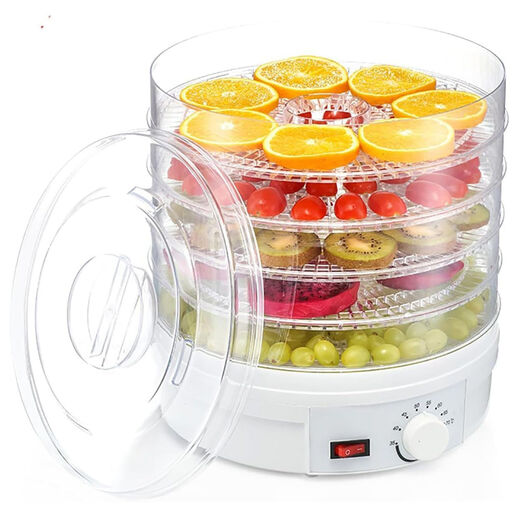
The five tiers provide separate surfaces for arranging your drying cycle.
According to the product title: 350 W and BPA-free.
 No image available
This model is worth comparing if you’re looking for a food dehydrator to prepare a portion for a community meal.
Yes. Use them in a thoroughly heated dish. The Netherlands Nutrition Centre advises heating mushrooms before eating them; drying doesn’t kill micro-organisms.
For a community meal, use mushrooms from a reliable food source. The Netherlands Nutrition Centre warns that poisonous wild varieties can be difficult to tell apart from edible ones, and drying doesn’t make them safe to eat.
Leave the mushrooms to cool, then pack them so they’re protected from moisture and store them in a cool, dark, dry place. Utah State University Extension notes that pieces don’t always dry evenly, so check the portion before packing and before use.
If a consumer product is faulty in the Netherlands, you’re entitled to a legal guarantee, with no fixed statutory guarantee period. According to the Government of the Netherlands, the appropriate solution depends on the circumstances.
That depends on how the meal is organised and sold. The Netherlands Food and Consumer Product Safety Authority states that rules for selling at markets and events also apply to private individuals. If you prepare and sell food several times a year, it says a food safety plan is required. This doesn’t establish which requirements apply to a one-off meal where no food is sold.