Choose a food dehydrator based on how many slices you want to spread out without overlapping, and how much space you have. A cabinet-style model with pull-out trays may suit larger batches for groups, while a stackable model is an option for smaller demonstrations and limited worktop space. Penn State Extension gives a drying time of 8–10 hours for sliced mushrooms, so don’t expect a full drying cycle to finish during a short workshop.
Who is this choice for?
Workshop leader with a large group
Wants to spread out slices from several participants across the trays at the same time, without overlapping, and has room for a larger appliance. The National Center for Home Food Preservation points out that a food dehydrator’s limited capacity can be a factor to consider.
Teacher running a short session
Wants to distinguish between a drying demonstration and a fully dried result. Penn State Extension gives a drying time of 8–10 hours for sliced mushrooms in a food dehydrator.
Cook with limited worktop space
Dries a small sample batch and needs to weigh up the appliance’s external dimensions against the available space and tray area. Fritel lists five trays measuring 24,5 × 31,5 cm for the DH 2025.
What should you look for when choosing?
| What to consider |
What to look for when buying |
Who is this important for? |
| Usable drying space |
Compare the tray dimensions and number of trays with the quantity of slices you want to spread out. Measure the appliance’s external dimensions too. |
If I want to dry slices for a group at the same time, I need to work out whether they’ll fit without overlapping. Around 31% of consumers prioritise having room for group-sized batches. |
| Drying time and session length |
Check the adjustable temperature and timer, but don’t treat the timer as a way to check whether the food is dry. |
With a fixed session length, I want to know whether the result will only be ready later and whether I need to prepare in advance. Around 25% of consumers prioritise a schedule that fits the session length. |
| Cleaning and storage |
Check how the trays can be removed and cleaned. Plan to use clean, dry, airtight packaging once the mushrooms have cooled completely. |
After using the dehydrator with several participants, I want to be able to clean the trays and store the slices dry. Around 25% of consumers prioritise cleaning and storage. |
| Space required |
Measure the available worktop and storage space, then compare it with both the appliance’s external dimensions and the tray dimensions. |
For a small sample batch, I don’t want to choose an appliance that won’t fit on my worktop. Around 19% of consumers prioritise a compact set-up. |
Common pitfalls
-
Expecting a short workshop to be long enough to dry mushrooms completely
Penn State Extension gives a drying time of 8–10 hours for sliced mushrooms in a food dehydrator. A higher temperature doesn’t guarantee that you can safely reduce the drying time.
Plan the demonstration and the fully dried result as separate steps; prepare a sample batch in advance if needed.
-
Assuming the number of trays tells you the batch capacity
The number of layers doesn’t tell you how many slices you can spread out without overlapping. Usable space varies by model and also depends on the tray dimensions.
Compare the tray dimensions and try arranging a sample batch in advance.
-
Sealing dried mushrooms while they’re warm or not dry enough
The National Center for Home Food Preservation says that warm food can release moisture when packaged; dried food can also absorb moisture again.
Let the batch cool completely, use clean, dry, airtight packaging and check later for moisture or mould.
Brands to consider
HENDI
The Kitchen Line and Profi Line include cabinet-style models. According to HENDI, the Profi Line 229026 has ten trays, making it a model to consider for group-sized batches.
- For the Profi Line 229026, HENDI specifies removable stainless steel trays, a temperature range of 35–75 °C and a timer of up to 24 hours. The manufacturer says the fan means you don’t need to rotate the trays.
- The fan claim isn’t an independent drying test. Compare the stated tray dimensions of 395 × 380 mm and the external dimensions of 430 × 550 × 416 mm with the space available.
Fritel
The DH 2025 is a stackable model for smaller demonstration batches and limited worktop space.
- Fritel lists five trays measuring 24,5 × 31,5 cm, two stacking options and a temperature range of 35–70 °C.
- Five trays alone don’t tell you how many slices will fit without overlapping. Measure the space available for the appliance and compare the tray dimensions with your planned batch.
Rommelsbacher
According to Rommelsbacher, the DA 650 is a cabinet-style model with seven drying trays.
- The manufacturer lists 0,5 m² of drying space, a temperature range of 35–75 °C and a timer of up to 99 hours.
- The stated area and claim of even distribution aren’t based on a test with a loaded batch of mushrooms. So, consider the space available and how you’ll arrange your own batch too.
Wartmann
The WM 2206 DH is a cabinet-style model with airflow from the rear.
- Wartmann lists six trays and a timer of up to 72 hours.
- Before buying, ask the retailer to confirm the temperature range for the exact version.
Princess
The 112380 is a stackable model with six layers, suitable for a small demonstration.
- Princess lists a temperature range of 40–70 °C and external dimensions of 33 × 33 × 20 cm.
- Six layers don’t tell you how many mushroom slices will fit without overlapping. The manufacturer doesn’t list comparable dimensions for the individual layers.
Food dehydrators for this workshop
These Joybuy picks are food dehydrators with multiple drying layers or adjustable settings. Compare the dimensions and settings with your batch and the space available.
 No image available
YASHE GGJ-261A food dehydrator
The five trays provide several layers for spreading out a demonstration batch; check the available space against the tray dimensions.
Power: 240 W. Temperature range: 35–70 °C. Five adjustable trays. The product name states that it is BPA-free.
View at Joybuy
 No image available
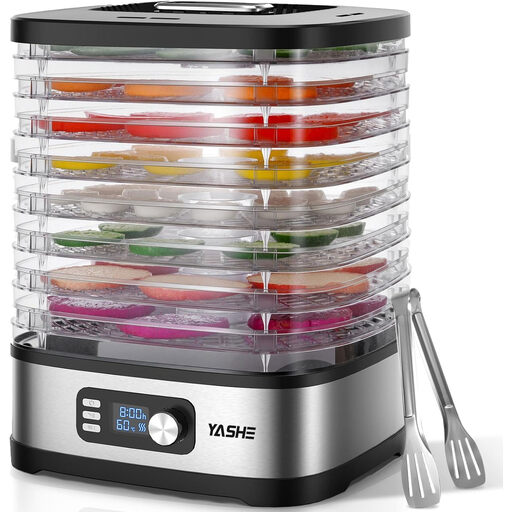
YASHE GGJ-261C food dehydrator
The eight trays may suit a workshop where you want to use several layers; the number of trays doesn’t tell you how many slices will fit without overlapping.
Eight trays. Timer of up to 72 hours. Includes mesh screens, a fruit roll tray and stainless steel tongs. The product name states that it is BPA-free.
View at Joybuy
 No image available
YASHE FD-1019 food dehydrator
The five trays provide several layers for a demonstration batch; compare the tray dimensions with the number of slices you want to dry.
Five stainless steel trays. Temperature range: 35–70 °C. Adjustable timer and temperature. Power: 400 W. The product name states that it is BPA-free.
View at Joybuy
 No image available
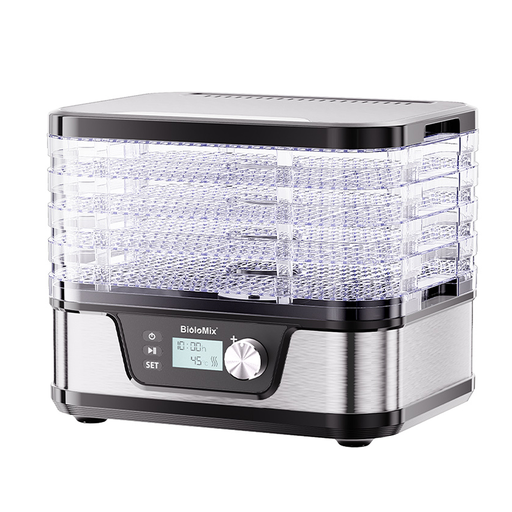
BioloMix BFD1300 food dehydrator
The five trays provide several drying layers; compare the stated capacity and settings with your planned batch and workshop length.
Five trays. Capacity: 10 L. Timer of up to 24 hours. Temperature range: 35–75 °C. The product name states that it has 360° air circulation.
View at Joybuy
Frequently asked questions
Can I show fully dried mushrooms at the end of a short cookery workshop?
Don’t count on it without preparing in advance. Penn State Extension gives a drying time of 8–10 hours for sliced mushrooms in a food dehydrator. You can use fresh slices to demonstrate the process and, if needed, prepare a separate sample batch beforehand; check that the mushrooms are dry rather than relying on the timer alone.
How should I store dried mushrooms after the workshop?
First, let the mushrooms cool completely, then put them in clean, dry, airtight packaging. The National Center for Home Food Preservation recommends careful packaging to help prevent moisture problems; check later for moisture or mould, and discard any mouldy food.
Are foraged mushrooms suitable for a demonstration?
For a workshop, it’s better to use mushrooms from a reliable retailer or grower. The Netherlands Nutrition Centre advises against eating wild mushrooms you’ve picked yourself, as poisonous varieties can be difficult to tell apart from edible ones.
Which Dutch food regulations apply if I run the workshop as a food business?
If your business supplies or sells food directly to consumers, the Netherlands Food and Consumer Product Safety Authority (NVWA) says that registering the food business is compulsory. The NVWA also says that businesses preparing, processing or selling food must follow a food safety plan based on HACCP or an applicable hygiene code. Whether these requirements apply to your particular workshop depends on how it is organised.
What should I look for when it comes to electrical safety and food-contact parts?
Electrical equipment covered by the EU Low Voltage Directive must meet the applicable electrical safety and CE marking requirements; the directive covers equipment rated at 50–1.000 V AC. Parts that come into contact with food during normal use are subject to the applicable food contact materials rules in Regulation (EC) No 1935/2004. Check the product information and documentation for the specific model; these rules alone don’t confirm that a particular item on sale complies with them.


