
Herb grower with limited cupboard space
You dry small quantities from your own garden and want to know whether both the appliance and its separate parts can be put away after use.


Before choosing, measure both your available storage space and the spot where the dehydrator will sit while in use, then compare these with its overall dimensions and separate parts. For herbs, a low adjustable temperature and a suitable tray or mat for small leaves are useful features. Extra trays can help with a larger harvest, but they don’t tell you how much cupboard space the appliance will take up. The National Center for Home Food Preservation recommends preheating a dehydrator to 95–115 °F, approximately 35–46 °C, for herbs.
You dry small quantities from your own garden and want to know whether both the appliance and its separate parts can be put away after use.
You dry herbs such as basil or mint and pay attention to temperature control, air circulation and how easily you can monitor the drying process.
You sometimes want to dry several bunches at once, and need to weigh up extra tray space against the room the appliance takes up.
First, measure your cupboard and the space where the dehydrator will run. Then compare the temperature control, usable trays and cleaning requirements with the quantity of herbs you want to dry at once.
| What to consider | What should you check? | Who is this important for? |
|---|---|---|
| Overall dimensions and storage | Compare the width, depth and height with your cupboard opening and the space where you’ll use it. Remember to allow for trays and accessories that need to be stored separately. | If my cupboard is cramped, I want to know in advance whether the separate parts will fit too; around 36% of consumers say storage is their top priority. |
| Low temperatures | Check the adjustable temperature range and the instruction manual. The National Center for Home Food Preservation recommends preheating a food dehydrator for herbs to 95–115 °F, approximately 35–46 °C. | For delicate leaves, I want to be able to adjust the temperature and monitor the drying process; around 29% of consumers prioritise careful drying. |
| Tray space and small leaves | Compare the number of trays and the stated drying area with the size of your usual harvest. Check whether a fine-mesh tray or herb mat is included. | If all my herbs are ready to dry at the same time, I want to process several batches and keep small leaves in place; around 21% of consumers prioritise handling a bumper harvest. |
| Cleaning and use | Check the cleaning instructions for each part. Wattage alone doesn’t tell you what a drying cycle costs: you also need to know the actual energy consumption and drying time. | I want to know how much effort cleaning involves and how to assess running costs; around 14% of consumers prioritise maintenance and running costs. |
More trays don’t automatically mean an appliance will fit in your cupboard. According to the manufacturer, the Rommelsbacher DA 650 has seven trays and measures 29 × 43 × 27,5 cm; the Tristar PD-9064 has five tiers and measures 25 × 23,4 × 27,1 cm. These measurements alone don’t tell you anything about drying performance.
Measure your cupboard opening and the space where you’ll use it, then compare these with the appliance’s overall dimensions and accessories before deciding how much capacity matters.
The manufacturer lists an herb mat for the Steba ED 5 and an extra tray for small ingredients for the Rommelsbacher DA 650. These aren’t standard accessories on every food dehydrator.
Check what’s included in the box. If you’re buying a separate fine-mesh tray or mat, check that it’s suitable for food contact too.
A suitable fine-mesh tray or herb mat may be needed if the included trays have gaps that are too large.
Moisture during storage can encourage spoilage, while light and heat affect quality. Dried herbs don’t stay good indefinitely.
Check that the herbs are thoroughly dry, let them cool completely and store them in a sealed container in a dry, dark place.
The PD-9064 is worth comparing for small batches if compact overall dimensions are a priority.
The KITCHENminis 415250011 has temperature and timer controls, making it an option if you want to dry small batches of other foods as well as herbs.
The DA 650 is designed for larger quantities, provided you have enough room for the appliance.
The 112380 has six stackable tiers, so you can weigh up capacity against the space available.
The ED 5 is worth considering if an included herb mat for small leaves is important to you.
These product picks are suited to drying garden herbs, with adjustable temperatures and multiple trays. For each model, also check the overall dimensions and the space needed for separate parts.
 No image available
The adjustable temperature starts at 35 °C, within the preheating range recommended by the National Center for Home Food Preservation for herbs.
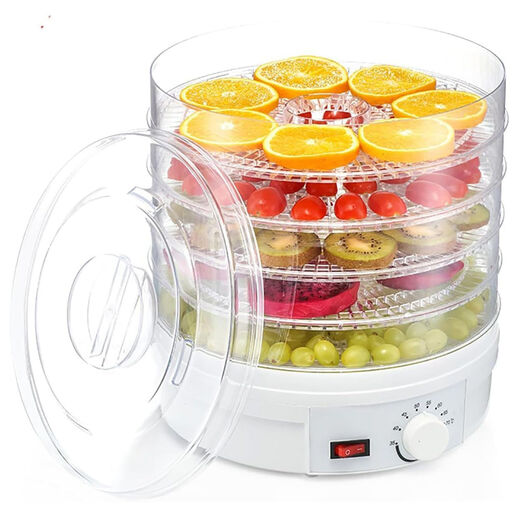
The product description lists five removable trays, which are dishwasher-safe. Check the overall dimensions and the cupboard space required before buying.
 No image available
The temperature range of 35–70 °C includes the preheating range for herbs recommended by the National Center for Home Food Preservation.
The product description lists five adjustable trays, 360° air circulation and dimensions of 31 × 29 × 24,5 cm. Compare these measurements with your cupboard and worktop.
 No image available
The adjustable temperature starts at 35 °C, which is useful if you want to dry herbs at a low heat.
The product name lists five stainless steel trays and 360° airflow. The product description mentions an adjustable timer of 1–48 hours; check that the overall dimensions will fit your storage space.
 No image available
The 35–70 °C temperature range includes the preheating range recommended for herbs by the National Center for Home Food Preservation.
The product name lists a timer of up to 72 hours. Check the overall dimensions and whether the adjustable trays are easy to store after use.
 No image available
This model is suited to larger harvests and small ingredients, but takes up more space than a compact dehydrator. Rommelsbacher lists overall dimensions of 29 × 43 × 27,5 cm.
The manufacturer lists seven trays, a drying area of 0,5 m², temperature control starting at 35 °C and an extra tray for small ingredients. The drying area is a figure stated by the manufacturer.
Arrange the herbs in a single layer and check them regularly. The National Center for Home Food Preservation recommends a preheating setting of 95–115 °F, approximately 35–46 °C; drying times vary. Herbs are dry when they crumble and their stems snap when bent. Also follow your appliance’s instruction manual.
Let them cool completely first. The National Center for Home Food Preservation warns that warm food can condense when packed, which may encourage mould. Store herbs in a clean, dry, sealed container in a dark place; the Netherlands Nutrition Centre notes that light, heat and moisture affect their quality.
No. According to ACM ConsuWijzer, your statutory warranty is separate from any manufacturer’s or seller’s warranty, and depends on what you could reasonably expect from the product under normal use. If a product breaks down too soon, contact the seller for an appropriate free solution.
The Netherlands Food and Consumer Product Safety Authority states that CE marking is mandatory for electrical products sold in the Netherlands. Trays, mats and other items that come into direct contact with food must comply with the relevant Dutch and European requirements for food contact materials. CE marking alone says nothing about the drying performance of a specific model.