
If you dry delicate garden herbs
When drying leafy herbs, you’ll want to adjust the temperature and check them as they dry. Oregon State University Extension Service recommends a temperature of 95–115 °F, around 35–46 °C, for drying herbs.


Choose a food dehydrator based on its lowest adjustable temperature and usable tray space, taking into account how many herbs you’ll be drying and the space available for your workshop. A timer can help with planning, but it doesn’t prove that the herbs are dry: check them as they dry. Also check the intended use and product safety information for the exact appliance.
When drying leafy herbs, you’ll want to adjust the temperature and check them as they dry. Oregon State University Extension Service recommends a temperature of 95–115 °F, around 35–46 °C, for drying herbs.
You’ll want to spread portions out in a single layer and match the drying space to both the harvest and the room available. Oregon State University Extension Service’s drying instructions recommend arranging herbs in a single layer.
An adjustable timer can help with planning, but drying times vary and you’ll need to check the results. Make sure your schedule allows time for interim checks.
Oregon State University Extension Service recommends drying herbs at 95–115 °F, around 35–46 °C, and arranging them in a single layer on the trays. Drying times vary, so don’t rely on the timer alone.
| Buying consideration | What to check before buying | Who is it important to? |
|---|---|---|
| Low temperature and easy checking | Minimum temperature and access to individual trays | If I’m drying delicate leaves, I want to set a low temperature and check the herbs as they dry. Around 36% of consumers say temperature and ease of checking are their top priorities. |
| Drying space for the group | Tray dimensions or drying area, and the appliance’s overall dimensions | If several participants bring herbs, I want to spread out their portions without overlap and still have enough room to work. Around 29% of consumers prioritise capacity for group use. |
| Planning and use | Timer, automatic shut-off and intended use | If drying needs to fit into my lesson plan, I want to be able to set the cycle without assuming the herbs will be dry in time. Around 21% of consumers say scheduling and suitability for their needs are their main buying considerations. |
| Accessories and maintenance | Included mats, cleaning instructions and what to do if the appliance develops a fault | If I need to clean and maintain the appliance after a workshop, I want to know which accessories are included and who to contact if something goes wrong. Around 14% of consumers prioritise accessories, maintenance and aftercare. |
The time you set doesn’t, by itself, tell you whether the leaves have reached the desired level of dryness. Oregon State University Extension Service recommends checking that the leaves crumble and the stems break.
Check the herbs during the cycle and follow the appliance instructions too.
The number of trays doesn’t tell you how many herbs you can fit without overlap. The appliance’s dimensions also determine whether it will fit in your workshop space.
Compare the usable tray space and the appliance’s overall dimensions with your harvest and workspace.
The Princess 112380 manual limits the appliance to domestic use. The Steba ED 5 manual excludes commercial use.
Check whether your workshop is private or professional, and what the manual for the exact model allows.
For a consumer purchase, your statutory rights apply alongside any retailer’s or manufacturer’s warranty. ACM ConsuWijzer states that you can contact the retailer if a product is faulty.
Keep your proof of purchase and contact the retailer if the appliance develops a fault.
The KITCHENminis 415250011 is worth considering if you’re drying smaller portions and have limited workspace.
The DA 650 is worth comparing if you need plenty of space to spread out a larger harvest.
The 112380 is a stackable domestic model for anyone who values six levels and is happy with a higher minimum temperature.
The ED 5 is a domestic dehydrator with five levels and an included herb mat.
These selected products are food dehydrators with temperature ranges that include the approximately 35–46 °C recommended for herbs by Oregon State University Extension Service. Compare the tray space and timer with your portions and schedule. The Netherlands Food and Consumer Product Safety Authority states that CE marking is mandatory for electrical consumer products placed on the market in the Netherlands. Check the marking and documentation for the specific appliance, as well as its intended use.
 No image available
Its temperature range includes the approximately 35–46 °C recommended for drying herbs by Oregon State University Extension Service.
The product name lists five height-adjustable trays and 240 W.
 No image available
Its temperature range includes the approximately 35–46 °C recommended for drying herbs by Oregon State University Extension Service.
The product information lists five adjustable trays, a 24-hour timer, 240 W and a capacity of 10 litres.
 No image available
Its stated temperature range of 35–70 °C includes the approximately 35–46 °C recommended for herbs by Oregon State University Extension Service.
The product information lists an adjustable timer of 1–48 hours.
 No image available
Its temperature range includes the approximately 35–46 °C recommended for drying herbs by Oregon State University Extension Service.
The product name lists five levels and 350 W.
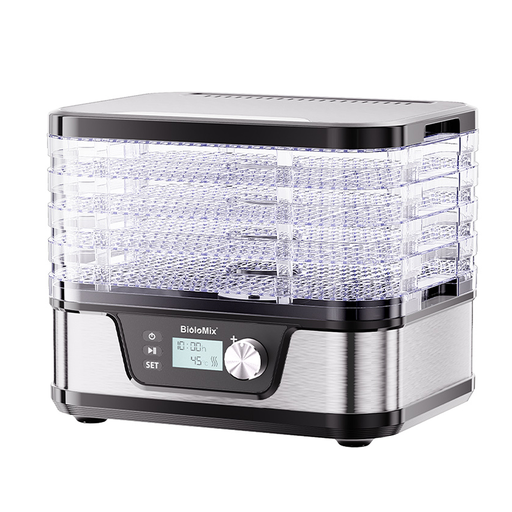 No image available
Its temperature range includes the approximately 35–46 °C recommended for drying herbs by Oregon State University Extension Service.
The product name lists five trays; the product information gives a capacity of 10 litres.
Oregon State University Extension Service recommends 95–115 °F, around 35–46 °C, and says drying usually takes 1–4 hours, depending on conditions. Arrange the herbs in a single layer, check them as they dry and stop when the leaves crumble and the stems break. Follow your appliance’s instructions too.
Don’t plan this based on the timer alone: Oregon State University Extension Service says drying times vary and can be around 1–4 hours. Check the herbs as they dry and, if necessary, prepare some dried herbs in advance for the tasting.
Yes. The Netherlands Food and Consumer Product Safety Authority states that CE marking is mandatory for electrical consumer products placed on the market in the Netherlands. Check the marking and product information for the specific appliance; these don’t, by themselves, tell you how well it dries.
That depends on the intended use of the exact model. According to its manual, the Princess 112380 is intended for domestic use only; the Steba ED 5 manual excludes commercial use. Check the manual before choosing a model for professional use.
If you’re a business serving food to consumers, the Netherlands Food and Consumer Product Safety Authority says you must provide information about any allergens present. If you sell food more than once a year, the NVWA also specifies registration and a food safety plan. Whether these requirements apply to your workshop depends on how it’s run.