
Fruit leather maker ready to get started
You’re looking for a suitable surface for wet fruit purée and want to know how many solid trays are actually included.


For fruit leather, a food dehydrator with a suitable solid drying tray or mat matters more than simply having a large number of racks. Then choose according to how many sheets you want to dry at once and how much kitchen space you have. Check which trays are actually included, and follow a suitable recipe for preparation and drying.
You’re looking for a suitable surface for wet fruit purée and want to know how many solid trays are actually included.
You want to make several sheets in one drying cycle, so you’re looking at the usable surface area, suitable liners and the space the appliance takes up.
You’d rather make smaller batches in a compact appliance, as long as you can use a suitable fruit leather sheet with it.
First check whether a solid tray or mat will fit on the racks. Then decide how many suitable sheets you want to use at once, and whether the appliance will fit in your kitchen.
| What to consider | What to look for | Who is this important to? |
|---|---|---|
| Solid surface for purée | Check the dimensions, fit and number of solid trays or suitable mats included. | When I spread out fruit purée, I want it to stay on a suitable solid surface; around 36% of consumers prioritise a suitable surface for purée. |
| Amount per drying cycle | Compare the usable area of suitable sheets with the number of racks; the racks alone don’t tell you how many sheets of purée you can make. | For a shared meal, I want to know how many suitable sheets will fit at once; around 29% of consumers give the amount per drying cycle top priority. |
| Kitchen space | Measure the space available and compare it with the appliance’s external dimensions. | If my worktop or storage space is limited, I want to know in advance whether the appliance will fit; around 21% of consumers prioritise the space it needs in the kitchen. |
| Preparation and cleaning | Read the cleaning instructions for the appliance and sheet, and check what your recipe says to look for in the finished product. | I want to plan the drying properly and clean any sticky parts according to the instructions; around 14% of consumers mainly value ease of use and cleaning. |
A model may have several open racks but come with just one solid drying tray. So the number of racks doesn’t tell you how many sheets of purée you can dry at once.
Count the trays suitable for purée and check that they fit the model you’ve chosen.
WMF describes the silicone mould included with the KITCHENminis 415250011 as a granola bar mould. This doesn’t confirm that you can spread a full layer of fruit purée on it.
Before choosing it, check the usable dimensions and the intended use of the specific accessory.
The drying time alone doesn’t confirm that the fruit leather has the texture you want. Penn State Extension’s recipe also gives checks for the finished product and a separate heating step for the purée.
Follow the preparation steps in one suitable recipe and check the texture as described.
Wartmann describes the WM-2006-DH as a model with six racks, while elsewhere on the same product page it gives different information about the number of layers and capacity. So don’t base the amount of fruit leather you plan to make on these conflicting capacity details.
Check the exact model and the number of usable, suitable sheets before planning a drying cycle.
The DA 650 is worth considering if you want a drying tray included and a manufacturer that lists fruit leather as a possible use.
The WM-2006-DH may suit you if you want a drying cabinet with six racks and are happy to choose silicone liners separately.
The KITCHENminis 415250011 is a compact option if you’re happy to make smaller batches and can first find a suitable sheet for fruit purée.
These food dehydrators are suitable for drying fruit. For fruit leather, the number of suitable solid trays and how well they fit each model are important things to check.
 No image available
Suitable for drying fruit and vegetables; for fruit leather, check whether a suitable solid tray or mat is available.
Five height-adjustable trays; temperature control from 35–70 °C; timer up to 72 hours; 240 W.
 No image available
For drying fruit and other foods; check in advance whether a solid sheet for purée will fit this model.
Five adjustable trays; temperature control from 35–70 °C; 240 W.
 No image available
A food dehydrator for fruit and other foods; check which solid fruit leather sheet will fit the trays.
Five stainless steel trays; temperature control from 35–70 °C; timer from 1–48 hours; 360° airflow; 400 W.
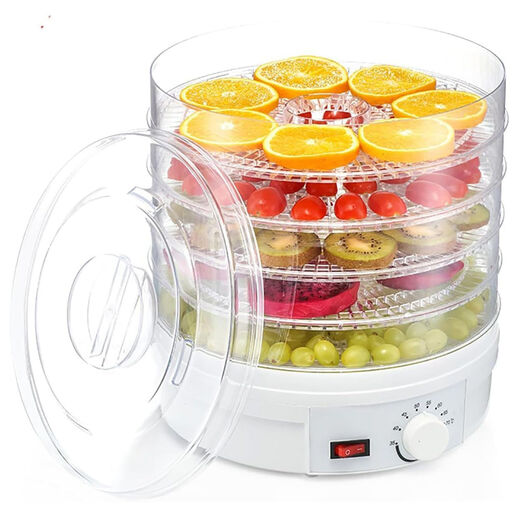 No image available
The product description lists fruit leather as a possible use; check how many suitable solid trays for purée are included.
Five levels; temperature control from 35–70 °C; 350 W.
 No image available
The manufacturer lists fruit leather as a possible use and says one drying sheet is included; you’ll need more suitable sheets to make several at once.
Seven drying trays; one drying sheet; total drying area of 0.5 m²; temperature control from 35–75 °C; timer up to 99 hours.
For spreadable purée, use a solid drying tray or mat that fits the model and is intended for food contact. Rommelsbacher lists one drying sheet with the DA 650; if you want to make several sheets at once, check how many suitable trays are included.
Start well before serving and follow one suitable recipe; a drying time doesn’t guarantee the fruit leather is ready. For its berry purée recipe, Penn State Extension recommends 140–145 °F for 4–10 hours. It also says the leather should leave no impression when lightly touched and should peel off easily. The preparation and results depend on the recipe you follow.
Wash your hands and the fruit, and use clean kitchen utensils, as advised by the Netherlands Nutrition Centre. In its recipe, Penn State Extension heats the berry purée to 160 °F before drying and explains that any E. coli present may survive the drying process. So don’t use drying as a substitute for other preparation steps in that recipe.
An additional commercial warranty isn’t required for your statutory warranty in the Netherlands. ACM ConsuWijzer states that the seller is responsible for providing an appropriate free solution if a product proves faulty under normal use; an additional warranty has its own terms and conditions.
Materials that come into contact with food must meet the applicable Dutch and European requirements; electrical kitchen appliances must meet the applicable requirements for electrical equipment. The Netherlands Food and Consumer Product Safety Authority says that businesses are responsible for product safety and that not all food contact materials are checked in advance by the NVWA. These general rules therefore don’t confirm that a specific sheet or appliance on sale complies with the requirements.