
If you want to make several portions
You want to make fruit leather for several family members, so you’re comparing how much purée will actually fit on suitable dehydrator sheets at once.


First, compare how many tiers are actually suitable for fruit purée, rather than simply counting the dehydrator’s trays. Then check that the temperature setting suits your recipe, and allow time to check that the fruit leather is dry. More drying space may also mean needing more worktop space and suitable dehydrator sheets.
You want to make fruit leather for several family members, so you’re comparing how much purée will actually fit on suitable dehydrator sheets at once.
You want to stop purée from running through open trays and are looking for a practical way to check whether the fruit leather is dry enough.
You’re looking for an appliance that’s easy to place and store, and weighing that up against the option of drying in several batches.
Start by checking how many usable, solid dehydrator sheets there are and how much fruit leather you need. Then look at the temperature setting, timer and the space the appliance takes up.
| What to consider | What to look for | Who is this important for? |
|---|---|---|
| Amount per batch | Compare the dimensions of the trays and count only solid sheets that are suitable for purée and fit the model. | If I want to make fruit leather for several family members at once, usable surface area matters more than the total number of trays. Around 34% of consumers say the amount per batch is their main buying concern. |
| Suitable for fruit purée | Check whether solid fruit leather trays or suitable liners are included, and how many you need. | I want to be able to spread out purée without it running through an open tray. Around 33% of consumers give top priority to drying tiers suitable for purée. |
| Planning a drying batch | Compare the temperature setting and timer and allow time to check different areas for damp or sticky spots. | If it needs to be ready before a gathering, a timer can help you plan, but it won’t replace checking the result. Around 20% of consumers prioritise being able to plan ahead. |
| Kitchen and cupboard space | Compare the external dimensions with your worktop and storage space, and consider whether several drying batches are practical. | If I have little space to set up or store the appliance, a compact model may be a better fit, even if I might need to run more batches. Around 13% of consumers name compactness as their main buying concern. |
A tray with holes isn’t automatically suitable for spreading out fruit purée. For example, Rommelsbacher lists seven trays and one solid drying sheet for the DA 650.
Before buying, count the sheets suitable for purée and check that any additional sheets fit the exact model.
If you need more tiers suitable for purée, you may need to buy compatible dehydrator sheets separately.
Drying time depends partly on the conditions, so the set time alone won’t tell you whether the fruit leather is dry all the way through.
Start well before the gathering, and check the thickest areas for damp or sticky spots before packing the fruit leather.
Fruit slices and spread-out fruit purée are prepared differently. A temperature recommendation for one isn’t automatically suitable for the other.
Use a fruit leather recipe and check that your oven or dehydrator can maintain the temperature specified in it.
For the DA 650, Rommelsbacher lists seven trays, a temperature range of 35–75 °C and one solid drying sheet; the manufacturer specifically mentions fruit leather.
Wartmann describes the WM 2206 DH as a model with six trays, horizontal airflow and adjustable time and temperature.
According to the manufacturer, the Princess 112380 is a stackable model with six transparent tiers and a temperature range of 40–70 °C.
WMF describes the KITCHENminis Snack-to-go as a space-saving dehydrator with a temperature range of 30–70 °C.
According to Steba, the ED 5 has five stackable tiers, a temperature range of 40–70 °C and a timer of 1–36 hours.
This selection includes food dehydrators with multiple drying tiers and adjustable temperature settings. Check whether a compatible solid tray for fruit purée is included with each model.
 No image available
The multiple adjustable trays may suit a batch with several tiers; check separately whether a solid tray for fruit purée is included.
Temperature control: 35–70 °C. Timer: 72 hours. 5 height-adjustable trays. Power: 240 W. BPA-free.
 No image available
The five adjustable trays provide multiple drying tiers; check whether you need a compatible solid tray for fruit purée.
Temperature: 35–70 °C. 5 adjustable trays. Power: 240 W. BPA-free.
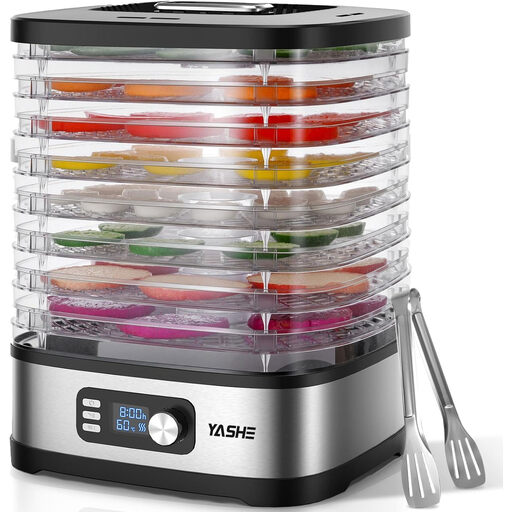 No image available
The product name mentions a fruit leather tray, which is a useful feature to check for if you want to dry purée.
8 trays. The product name lists a 72-hour timer and temperature control, as well as mesh screens. Also listed: stainless steel tongs.
 No image available
The five trays provide multiple drying tiers; check whether you need solid trays for fruit purée and whether they fit this model.
5 stainless steel trays. Adjustable timer and temperature. The product name lists 360° airflow and 400 W power.
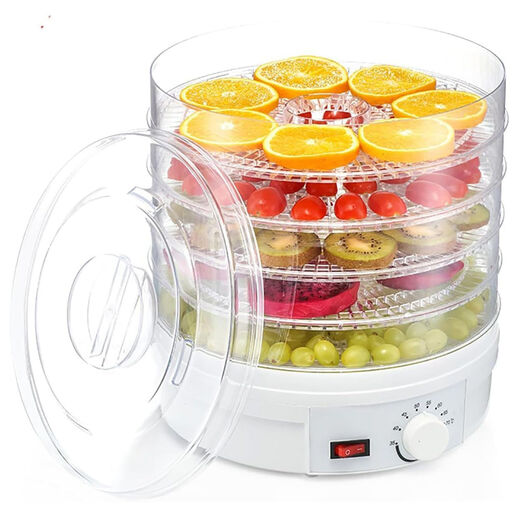 No image available
The product name mentions fruit as a use; check whether a solid tray for fruit purée is included before choosing this model for that purpose.
5 tiers. Temperature range: 35–70 °C. Power: 350 W. BPA-free.
Use a solid fruit leather tray or a suitable liner. The National Center for Home Food Preservation at the University of Georgia describes specially designed trays for fruit leather; an open tray won’t stop purée from running through.
Check several areas, especially the centre, for sticky patches. The mango fruit leather recipe from the National Center for Home Food Preservation at the University of Georgia gives a drying time of around 10 hours, but notes that it depends greatly on the humidity in the drying area. So don’t treat that time as a guarantee for every type of fruit.
Leave the fruit leather to cool, then pack the rolls in an airtight container. For short-term storage, the recipe from the National Center for Home Food Preservation at the University of Georgia recommends a cool, dark, dry place; for longer storage, it recommends freezing. Also follow the recipe instructions and take account of the ingredients used.
According to ACM ConsuWijzer, for an ordinary online product purchase you generally have a statutory 14-day cooling-off period after delivery. You’re also covered by the statutory guarantee if the appliance doesn’t perform as you could reasonably expect under normal use; a manufacturer’s guarantee doesn’t replace this statutory right.
No. According to the European Commission, the manufacturer uses the CE marking to declare that the product complies with the applicable EU product rules. The marking isn’t an independent test of the dehydrator’s performance or its results when making fruit leather.