Choose based on how many puree sheets you can actually use in each drying cycle: the number of racks alone doesn’t tell you how much fruit leather you can make at once. A drying sheet included with the dehydrator makes it easier to try your first small batch; a larger appliance is only useful if you have suitable sheets and enough space to work. Drying time also depends on the puree and how thickly it’s spread, so allow time to check the result.
Which approach is right for you?
Cooking for a large group of neighbours
You want to make several portions for the same meal and are weighing up usable drying space against the time needed for extra batches. Wartmann and Steba’s product information describes their racks and surfaces; University of Minnesota Extension notes that drying time depends in part on the method and the thickness of the food.
Making fruit leather for the first time
You want to dry puree without spills or sticking, so you’re looking at suitable drying sheets rather than just the number of racks. Princess lists a drying sheet in the box contents; for other models, check which compatible accessories you’ll need.
Planning a careful preparation
You want to get started in good time and check that the fruit leather has dried sufficiently before serving. Penn State Extension describes how fruit leather can look and feel after drying; drying time can vary depending on the method.
What should you look for when making fruit leather?
For a community meal, key considerations include the usable surface for puree, planning the drying cycle and finding space for the appliance. University of Minnesota Extension notes that drying time depends on factors including the food, layer thickness, moisture content and method.
| Consideration |
What to check before buying |
Who should pay particular attention? |
| Surface area per drying cycle |
How many rolls you want to make, the size of the racks and how many compatible puree sheets you have. |
If I want to make several portions for the same community meal, I need to know how much puree I can spread out in each cycle. Around 36% of consumers put this capacity first. |
| Suitable sheets |
How many sheets are included and whether extra sheets fit the exact model and its racks. |
When I’m drying puree for the first time, I want a surface designed for the job rather than having to adapt ordinary racks. Around 29% of consumers give compatible puree sheets top priority. |
| Drying schedule and serving |
Suitable preparation instructions, time for a trial batch and a check of the texture and drying result. |
If the serving date is fixed, I want enough time to finish the preparation carefully. Around 21% of consumers prioritise planning and careful drying. |
| Space and cleaning |
Appliance dimensions, box contents and cleaning instructions; also check the cost of any additional compatible sheets. |
When I use the appliance for a community meal, I want to know whether it will fit and how much cleaning up it involves. Around 14% of consumers give space and ease of use top priority. |
What to look out for when buying
-
Confusing the number of racks with the number of fruit leather sheets
The Princess 112398 comes with six racks and one drying sheet. For other models, check which sheets are suitable for puree; having more racks doesn’t prove that you can use the same number of fruit leather sheets at once.
Only count surfaces for which you’ve confirmed a suitable, food-safe way to dry puree. Also check that any extra sheets fit the dimensions of the racks.
-
Turning up the temperature to speed up a drying cycle
Simply using a higher setting to make up for lost time doesn’t guarantee that the fruit leather will dry evenly. University of Minnesota Extension describes factors that affect drying time, while Penn State Extension explains how to recognise dried fruit leather.
Follow suitable preparation instructions, start in good time and check the result rather than relying on the timer alone.
Brands to consider
Princess
The 112398 is an option for trying fruit leather on a small scale, with a drying sheet included.
- According to Princess, the 112398 has six stainless steel racks, one drying sheet and a fine-mesh mat. The manufacturer lists an adjustable temperature of 35–75 °C and a timer of up to 48 hours.
- The box contents don’t confirm that all six racks can be used with puree at the same time; check for suitable extra sheets if you need more surface area.
Wartmann
The WM-1912-DH offers plenty of rack space if you can arrange suitable puree sheets for several levels before buying.
- Wartmann lists twelve racks measuring 38 × 40 cm, horizontal airflow and a drip tray.
- The listed racks and drip tray don’t confirm that puree sheets are available for every level. Also check the temperature range for the exact model: the product information lists different ranges.
Steba
The ED 6 has six large rectangular drying surfaces, and Steba also describes it as suitable for fruit puree.
- Steba lists six racks measuring 37 × 30 cm, a timer and a herb mat; the appliance is rated for 230 V.
- A herb mat isn’t automatically a leakproof fruit leather sheet. Check separately which accessories are suitable for puree.
Fritel
The DH 2025 is a compact stackable model; Fritel also publishes a recipe for fruit rolls.
- According to Fritel, the DH 2025 has five racks measuring 24,5 × 31,5 cm and an adjustable temperature range of 35–70 °C. The manufacturer provides a fruit roll recipe.
- Check which suitable puree sheets are supplied with the appliance and how many racks you can use with them at once.
Food dehydrators at Joybuy
These food dehydrators are suitable for preparing fruit. For each model, check whether the included or separately available sheets are suitable for puree and fit the number of portions you want to make.
 No image available
YASHE GGJ-261B food dehydrator, 5 adjustable trays
The five height-adjustable trays offer different layout options; check which surfaces are suitable for puree.
Temperature control: 35–70 °C; timer up to 72 hours; 240 W. The product description lists a stackable design and dishwasher-safe trays.
View at Joybuy
 No image available
YASHE GGJ-261A food dehydrator, 5 adjustable trays
The product description lists fruit as a use; check whether compatible puree sheets are available for this model.
Five adjustable trays, 240 W and temperature control from 35–70 °C. Listed dimensions: 31 × 29 × 24,5 cm.
View at Joybuy
 No image available
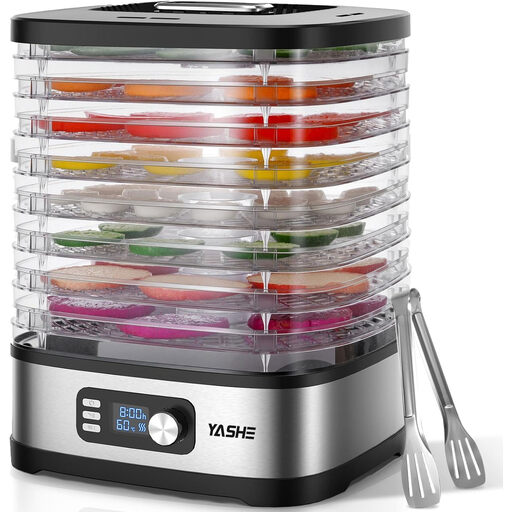
YASHE GGJ-261C food dehydrator, 8 trays and fruit roll tray
The product description mentions fruit leather and an included fruit roll tray; check how much puree you can dry on it in each cycle.
Eight trays and mesh screens; temperature control from 35–70 °C and a timer up to 72 hours, according to the product description. Includes stainless steel tongs.
View at Joybuy
 No image available
YASHE FD-1019 food dehydrator, 5 stainless steel trays
The product description lists fruit as a use; check which sheets are suitable for drying puree.
Five stainless steel trays, adjustable timer and temperature, 360° airflow and 400 W according to the product name. The product description lists dishwasher-safe trays and automatic shut-off.
View at Joybuy
 No image available
Food dehydrator, 5 tiers, 35–70 °C, 350 W
The product description lists fruit leather as a possible use; check whether the trays are suitable for liquid puree and how many you can use at once.
Five tiers, temperature control from 35–70 °C and 350 W. The product description lists removable, dishwasher-safe trays.
View at Joybuy
Frequently asked questions
How can you tell if fruit leather is dry enough?
Penn State Extension describes fruit leather that is slightly tacky, peels off easily and doesn’t leave an indentation when lightly touched. The stated 4–10 hours is a guide for the method described, not a fixed time for every puree, layer thickness or machine.
Is a trial batch a good idea if you have a fixed serving date?
Yes. A trial batch gives you time to assess how long your puree and layer thickness will take to dry. University of Minnesota Extension lists the type of food, thickness, moisture content and drying method among the factors that affect drying time. Before preparing the food, wash your hands and the fruit, and use clean kitchen utensils, as advised by Voedingscentrum.
What allergen information should you provide when selling food?
Dutch government guidance requires customers to receive sufficient information about the allergens used when non-prepacked food is sold. This doesn’t automatically clarify which sales rules apply to a private community meal; in any case, let guests know which ingredients you’ve used.
Can you work out the electricity use or total cost from the wattage?
No, the wattage alone isn’t enough. To calculate electricity costs, you also need the actual running time and the applicable rate; drying time varies with factors including layer thickness and the method used.


