
First-time fruit leather maker
Wants to spread out fruit purée after class without it running through a mesh tray; first, check for a suitable dehydrator tray and that it is suitable for food contact.


First, choose a dehydrator with a suitable solid tray for spreading out fruit purée; an open mesh tray is not a proven substitute. Then match the timer and usable tray area to your batch size and the time you have available, but check the fruit leather itself before storing it. For the exact dehydrator and surface that will touch the food, also check the relevant food-contact and electrical safety information.
Wants to spread out fruit purée after class without it running through a mesh tray; first, check for a suitable dehydrator tray and that it is suitable for food contact.
Prepares fruit in the evening and wants to set the temperature and drying time, but still needs to check whether the result is dry enough.
Wants to make several sheets in one drying cycle, so needs to distinguish the number of suitable fruit leather trays from the number of standard mesh trays.
For fruit leather, first check whether there is a suitable solid tray for the purée. Then match the settings and capacity to your evening schedule and batch size.
| Buying consideration | What to look for | Who should pay particular attention? |
|---|---|---|
| Suitable tray for purée | Count solid trays, not open mesh trays. Rommelsbacher lists one tray alongside seven mesh trays for the DA 650; HENDI lists a fruit leather tray for item 229033. Check the size and suitability of the part supplied. | If I want to spread out purée straight after class, I need to know whether there is a suitable solid tray. Around 36% of consumers prioritise a suitable tray for purée. |
| Adjustable drying time | Compare the timer and temperature settings of the exact model. Rommelsbacher lists a timer of up to 99 hours for the DA 650, while HENDI lists a timer of up to 24 hours for item 229033. Settings do not tell you when a batch is dry. | If you start late in the evening, you’ll want to set the drying time and check the result. Around 29% of consumers prioritise adjustable settings when starting late. |
| Number of sheets per cycle | Compare the usable area of the trays for purée, not just the number of mesh trays. HENDI’s stated mesh-tray size does not automatically tell you the size of the supplied tray. | If I want to make several batches at once, I check how many suitable trays can actually be used. Around 21% of consumers prioritise the number of sheets per cycle. |
| Space and cleaning | Measure the space available and allow for the clearance specified in the manual. Princess lists external dimensions of 33 × 33 × 20 cm for the 112380; Rommelsbacher lists 29 × 43 × 27.5 cm for the DA 650. Also check the cleaning instructions. | If you have limited worktop space or cleaning is a key consideration, the size of the appliance matters just as much. Around 14% of consumers prioritise space and cleaning effort. |
Mesh trays with openings and a solid tray for purée serve different purposes. The Rommelsbacher DA 650 is described as having seven mesh trays and one solid tray.
Only count trays supplied with the dehydrator or confirmed as a suitable fit when planning your batch.
You may need extra compatible trays or mats to make more sheets.
A set running time won’t tell you whether the centre of the fruit leather is dry. Penn State Extension gives a drying time of 4 to 10 hours for the recipe described and recommends checking the result.
Follow the recipe and manual, check the sheet, and don’t store it just because the timer has finished.
A batch that hasn’t dried sufficiently may need more time in the dehydrator.
The European Commission states that food-contact materials placed on the European market must comply with the relevant rules. The absence of one substance does not, by itself, confirm that the entire part is suitable.
Check the information for the exact tray or mat you’ll use to spread out the purée.
You may need a different contact surface that is confirmed as suitable.
The DA 650 is a cabinet-style dehydrator worth comparing if you’re looking for a supplied tray and adjustable running time.
Item 229033 is a cabinet-style dehydrator worth comparing if you’re looking for separate mesh trays and a tray that the manufacturer identifies as suitable for fruit leather.
The 112380 is a stackable model worth comparing if the stated external dimensions matter and you want to assess a suitable tray for purée separately.
The ED 5 is a stackable model with a timer worth comparing if you want to find a suitable tray for purée separately.
The WM 2206 DH is a cabinet-style model worth comparing if you want to plan several batches.
These food dehydrators are worth comparing for making fruit leather and starting late in the day. Check for each model whether a suitable tray for purée is supplied or needs to be bought separately.
 No image available
Could be a good fit if you want to schedule an adjustable drying time; use a suitable solid surface for food contact when drying fruit purée.
The product name lists a range of 35–70 °C, a timer of up to 72 hours, five height-adjustable trays and 240 W.
Check the food-contact information for the tray or mat you use, as well as the relevant electrical safety information for this model and market version.
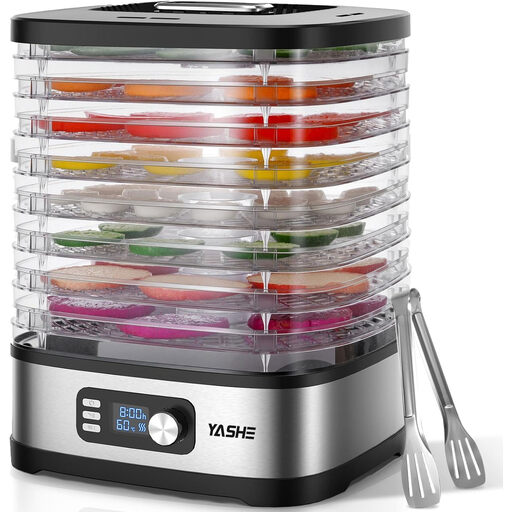 No image available
Could be a good fit if you want to compare a model that lists a fruit leather tray; check that the tray suits your batch size and needs.
The product name lists eight trays, mesh screens, a fruit leather tray and stainless steel tongs.
Check the food-contact information for the supplied tray, as well as the relevant electrical safety information for this model and market version.
 No image available
Could be a good fit if you’re looking for a model with an adjustable timer and temperature; you’ll also need a suitable solid surface for food contact when drying fruit purée.
The product name lists five stainless steel trays and an adjustable timer and temperature.
Check the food-contact information for the tray or mat you use, as well as the relevant electrical safety information for this model and market version.
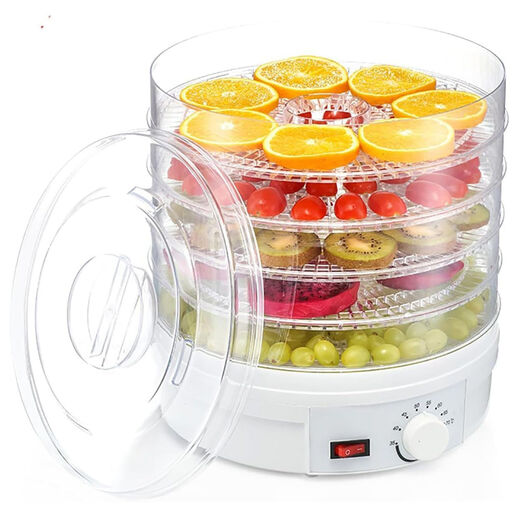 No image available
Could be a good fit if you’re comparing a five-tier food dehydrator; assess the usable area for trays of purée separately from the number of tiers.
The product name lists five tiers, a range of 35–70 °C and 350 W.
Check the food-contact information for the tray or mat you use, as well as the relevant electrical safety information for this model and market version.
 No image available
Could be a good fit if you want to compare a model with a supplied tray for your first batch; don’t count the mesh trays as separate trays for purée.
Rommelsbacher lists seven mesh trays, one drying tray, a range of 35–75 °C and a timer of up to 99 hours.
Check the food-contact information for the supplied tray, as well as the relevant electrical safety information for this model and market version.
Start by following your recipe and the appliance manual. For berry fruit leather, Penn State Extension describes spreading the mixture ⅛–¼ inch thick, drying it at 140–145 °F, and checking that the centre doesn’t leave an indentation and that the sheet peels away easily. The stated 4–10 hours is a guide for that recipe, not a set drying time for every type of fruit or dehydrator.
A timer ends the set running time, but it doesn’t check whether the purée is dry. Follow the manual for placement and use; Brandweer Nederland advises connecting electrical appliances safely and leaving room for heat to dissipate. The timer alone doesn’t confirm that unattended overnight use is suitable for every model.
Check that the mat is suitable for food contact and for the operating temperature, and that it fits your dehydrator. The European Commission states that food-contact materials placed on the EU market must comply with Regulation (EC) No 1935/2004.
For a standard online consumer purchase, you generally have a 14-day cooling-off period after delivery, subject to legal exceptions. ACM ConsuWijzer also explains that the seller must provide a product that, under normal use, meets what you could reasonably expect; in the Netherlands, the legal guarantee does not have a fixed general term of two years.