
Workshop leader with a large group
Wants participants to lay out slices at the same time without overcrowding the trays. The amount of drying space you need depends on the size of the group.


Choose a stackable dehydrator for smaller batches, or a cabinet-style dehydrator with more tray space if lots of participants want to lay out slices at the same time. Plan the drying cycle separately from the length of the class: a timer doesn’t guarantee that citrus slices will be dry in time. For a small demonstration, an oven you already own may be enough; check the relevant requirements for electrical equipment and food-contact materials for each appliance.
Wants participants to lay out slices at the same time without overcrowding the trays. The amount of drying space you need depends on the size of the group.
Needs to decide in advance whether the workshop is a demonstration or whether participants will also take home a fully dried result. Slice thickness and how full the dehydrator is will affect drying time.
Will benefit from trays that are easy to clean between groups, as well as a safe preparation and storage process, especially if the slices will be handed out.
Start with the number of participants and the amount of worktop space available. Then plan when the dehydrator can run and who will check the results afterwards.
Suitable when: you want to spread several smaller batches across multiple tiers and have limited worktop space. FRITEL lists five trays measuring 24,5 × 31,5 cm for the DH 2025; Princess lists six stackable tiers for the 112380.
Consider: compare the usable space between tiers and the cleaning instructions for the exact model.
Suitable when: lots of participants will be making their own batches at the same time and there’s enough work and storage space. HENDI lists ten trays measuring 395 × 380 mm for the Profi Line 229026; Rommelsbacher lists seven trays and 0,5 m² of drying space for the DA 650.
Consider: a larger drying area needs more space. Work out the batch size you need before choosing a cabinet-style model.
Suitable when: you’re running a small demonstration and don’t want to use a separate appliance. Voedingscentrum describes an oven and air fryer recipe for thinly sliced fruit, but not specifically for citrus slices.
Consider: University of Minnesota Extension describes oven drying in general as slower than using a food dehydrator. The result depends on the appliance, how full it is and the recipe.
| What to consider | What to look for | Who is this most relevant to? |
|---|---|---|
| Drying space for the group | Count the participants and slices per person; compare the tray dimensions and the space available on each tray. | If I want everyone to lay out slices at the same time, I need to know how many will fit on each tier. Around 31% of consumers say group capacity is their main concern. |
| Drying cycle and class length | Test in advance using the same slice thickness and load; arrange for someone to supervise if the appliance will keep running after the class. | If the class has a fixed end time, I need to know in advance whether participants will have to collect the results later. Around 25% of consumers prioritise planning the drying cycle. |
| Cleaning between groups | Check how the trays are removed and cleaned, and follow the instructions for the exact model. | If I use the appliance for consecutive groups, I need to be able to clean the trays between sessions. Around 19% of consumers prioritise ease of cleaning. |
| Using an appliance you already own | Decide whether your oven is suitable for the demonstration, and take the recipe and level of attention needed during drying into account. | I want to check first whether the oven I already have will be enough for a small demonstration. Around 13% of consumers prioritise making use of an existing appliance. |
| Work and storage space | Measure the space available and compare it with the external dimensions and placement instructions for the exact model. | If I also need the worktop for slicing and preparation, I need to know how much space the dehydrator will take up. Around 12% of consumers focus mainly on the work and storage space available. |
A timer you can set won’t tell you when a particular batch of citrus slices is dry enough.
Test in advance using the same slice thickness and load. Also decide whether participants will collect the results later and who will supervise if the cycle is still running.
A test batch takes time to prepare, so schedule it before the workshop.
Tray dimensions and the space between tiers vary. Slices need room for air to circulate, so the number of trays alone tells you little about batch capacity.
Work out how many slices each participant will need and compare the usable area of the exact model.
Requirements for electrical products and for parts that come into contact with food are separate considerations. The CE marking is a declaration by the manufacturer and, on its own, does not prove that all food-contact requirements have been met.
Check the product and conformity information for the exact model before using the appliance with participants. The European Union explains the scope of CE marking; NVWA sets out the Dutch requirements for food-contact materials.
According to HENDI, the Profi Line 229026 is a cabinet-style dehydrator with ten stainless steel trays measuring 395 × 380 mm.
The DA 650 is a cabinet-style model for which the manufacturer lists seven trays and 0,5 m² of drying space.
According to FRITEL, the DH 2025 is a stackable model with five plastic trays measuring 24,5 × 31,5 cm.
According to Princess, the 112380 is a stackable model with six transparent tiers.
According to Steba, the ED 5 is a stackable model with five trays measuring 32 × 25 cm.
These products are stackable food dehydrators that let you spread workshop batches across several tiers. Compare the layout and timer with your batch plan; before use, check the requirements for the exact model and the parts that come into contact with food.
 No image available
The five adjustable trays provide space for several workshop batches.
Temperature control: 35–70 °C; timer: 72 hours; power: 240 W.
 No image available
The five adjustable trays let you spread batches across several tiers.
Temperature control: 35–70 °C; power: 240 W.
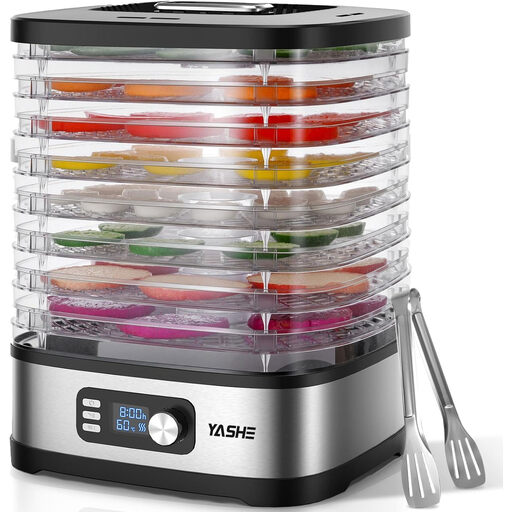 No image available
The eight trays provide several tiers for spreading out batches.
Timer: 72 hours. The product name also mentions mesh screens, a fruit roll tray and stainless steel tongs.
 No image available
The five trays provide a multi-tier layout for workshop batches.
Trays: stainless steel; timer: 1–48 hours; temperature control: 35–70 °C; power: 400 W.
 No image available
The five tiers provide space to spread batches across several levels.
Temperature control: 35–70 °C; power: 350 W.
Don’t assume they will based only on the timer or the stated power rating. Test in advance using the same slice thickness and load, and agree whether participants will collect the results later. The Voedingscentrum recipe is for other fruit and doesn’t give a validated drying time for citrus.
Wash the fruit thoroughly under running water and prevent it from coming into contact with raw meat or fish, or the utensils used to prepare them. Colorado State University Extension recommends conditioning dried fruit for long-term storage and drying it again if it is still too moist. Don’t automatically apply a general storage period to these citrus slices.
It varies by model, so check the manual. FRITEL says the DH 2025 is dishwasher-safe, but stainless steel or a BPA-free claim doesn’t mean that other models have this feature.
Calculate electricity costs using actual consumption and your own tariff; the stated wattage alone isn’t enough. For a consumer purchase in the Netherlands, if a product doesn’t perform as you could reasonably expect under normal use, the seller must put it right free of charge under the statutory guarantee, as ACM ConsuWijzer explains. For a business purchase, check the applicable terms separately.
Check which product rules apply to the exact appliance and whether the parts that touch the citrus slices meet the requirements for food-contact materials. According to NVWA, a food business that directly provides or sells food to consumers must register in the cases described and work in accordance with an HACCP plan or hygiene code. NVWA also lists food safety rules for private individuals who occasionally sell food or drink; simply calling something a cooking workshop doesn’t determine which obligations apply to your setup.