
Anyone drying small batches
You want to dry a few orange, lemon or lime slices now and then for drinks or food, without having a large harvest to process.


For small, regular batches of citrus slices, a stackable dehydrator with adjustable temperature and enough room to arrange the slices in a single layer is a sensible place to start. If you only dry them occasionally, first check whether your oven can provide the low temperature and airflow required by the method you’re using. A drying cabinet with horizontal airflow may suit you if you want to use several trays or dry different ingredients at once, but it will usually take up more space. Also check the model-specific information on electrical safety and food-contact materials.
You want to dry a few orange, lemon or lime slices now and then for drinks or food, without having a large harvest to process.
You want to weigh up the space and cleaning involved against the amount of citrus you dry each time.
You dry slices more often and want to control the temperature and drying process, perhaps alongside other ingredients.
First choose a drying method that suits how often you dry citrus. Then compare the space required, controls and practical considerations.
Suitable if: you regularly dry a small batch and want to stack the trays after use.
Bear in mind: tray sizes and temperature settings vary. Vertical airflow may transfer more flavour between different ingredients, according to the University of Georgia’s National Center for Home Food Preservation.
Suitable if: you also want to dry several trays or different ingredients at once, and removable drawers are important to you.
Bear in mind: the extra drying space may be unnecessary for one small batch; check the external dimensions.
Suitable if: you only dry citrus occasionally and your oven can provide the low temperature and airflow required by the method you’re using.
Bear in mind: the University of California Agriculture and Natural Resources describes leaving a gap for airflow when using the oven method. The time given applies to that method and does not predict the results or electricity consumption of every oven.
| Consideration | What to look for | Who should consider this? |
|---|---|---|
| Space for a small batch | Compare tray sizes and external dimensions; citrus slices should be arranged in a single layer according to the drying method you’re using. | If you dry only a few slices at a time, you won’t want to use more drying space and worktop space than necessary. Around 36% of consumers prioritise having the right amount of drying space for a small batch. |
| Temperature and control | Check the adjustable temperature range and, if you want one, the timer and how easy it is to access the trays. | Do you want to set the drying process for repeated batches and check the slices afterwards? Around 29% of consumers say controlling the temperature and drying results is their main concern. |
| Cleaning and storage | Check the cleaning instructions, whether the trays are removable and how much space the appliance takes up. | If space is limited, cleaning the trays and storing the appliance after use may matter more than maximum capacity. Around 21% of consumers put these practical considerations first. |
| Running costs | Don’t compare the stated wattage directly with the cost per drying cycle; you need consumption figures measured on the same basis to do that. | For long or repeated drying cycles, you’ll want to know what it costs to use the appliance without treating wattage as consumption per batch. Around 14% of consumers say running costs are their main purchasing concern. |
The citrus method requires enough room to arrange the slices in a single layer, but that doesn’t automatically mean you need lots of trays.
Compare your usual batch with the stated tray size, then check the external dimensions against your worktop and storage space.
An appliance with extra trays may take up more worktop and storage space.
The stated wattage doesn’t measure the electricity used to dry the same batch of citrus. The drying method may take many hours.
Compare running costs only using consumption figures measured on the same basis; don’t assume that an oven or dehydrator is automatically cheaper.
Moisture may be unevenly distributed after drying. The University of Georgia’s National Center for Home Food Preservation advises drying fruit again if condensation appears; mouldy food should be discarded.
Let the slices cool, check them and condition them before storing them for a long time.
If condensation appears, you may need to dry the fruit again; mouldy food should be discarded.
The DH 2025 is a stackable dehydrator with five trays and two stacking options. Tray space and storage are therefore useful points to compare.
The 112380 is a stackable dehydrator with six layers. Its external dimensions and stackable design are worth considering if you want to compare the space available.
The DA 650 is a cabinet-style model with seven trays, offered as a comparison option for anyone who regularly dries food on several levels.
The DA506 is a cabinet-style model with six pull-out trays, for anyone who wants to consider the layout and access to the trays.
The products below are food dehydrators with trays or layers. Compare each model’s temperature settings, capacity and cleaning requirements with how you plan to use it. For citrus, the University of California Agriculture and Natural Resources recommends arranging slices in a single layer. For each model, check the information on applicable electrical safety requirements and food-contact components. The Government of the Netherlands describes the CE marking and EU declaration of conformity for electrical appliances covered by the rules; the Netherlands Food and Consumer Product Safety Authority (NVWA) and the European Commission explain the requirements for food-contact materials. A statement that a component is BPA-free does not, on its own, prove that all applicable requirements have been met.
 No image available
The adjustable trays may suit you if you want to spread slices across several levels.
Temperature range: 35–70 °C. Five height-adjustable trays. Timer up to 72 hours. Power: 240 W.
The product information states that it has 360° air circulation and dishwasher-safe trays.
 No image available
The adjustable temperature and five trays are useful features if you want to spread small batches out in a single layer.
Temperature range: 35–70 °C. Five adjustable trays. Power: 240 W.
The product information states that it has 360° air circulation and dishwasher-safe trays.
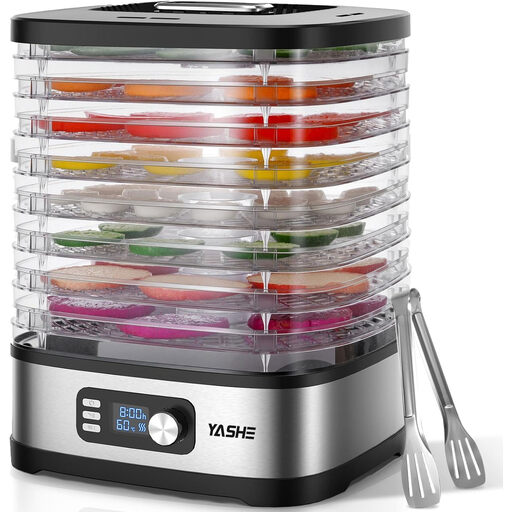 No image available
Eight trays provide several levels for arranging slices; consider whether you’ll use that capacity for small batches.
Temperature range: 35–70 °C. Timer up to 72 hours.
The product name mentions mesh inserts, a fruit leather tray and stainless steel tongs.
 No image available
The five trays are worth considering if you want to spread your batch across several layers.
Temperature range: 35–70 °C. Timer: 1–48 hours. Power: 400 W.
The product information states that it has five stainless steel trays and 360° air circulation.
 No image available
The adjustable temperature and five layers are useful features if you want to spread batches across several levels.
Temperature range: 35–70 °C. Power: 350 W.
The product information states that it has removable, dishwasher-safe trays and vertical airflow.
Wash the citrus and, following the University of California Agriculture and Natural Resources’ instructions, cut the fruit into slices 1/8–1/4 inch thick and arrange them in a single layer. The instructions recommend drying in a food dehydrator at 130–135 °F for 12–18 hours, turning the slices halfway through. Treat this as a guideline for that method and check the results too.
Let the slices cool first, then condition them before storing them for a long time. The University of Georgia’s National Center for Home Food Preservation recommends conditioning dried fruit for 7–10 days and checking it daily for condensation. If condensation appears, dry the fruit again. Discard any mouldy food.
Applicable safety requirements apply to electrical appliances in the Netherlands. For appliances covered by these rules, the Government of the Netherlands describes the CE marking and EU declaration of conformity. Components that come into contact with food are also covered by the applicable EU and Dutch rules for food-contact materials, as explained by the Netherlands Food and Consumer Product Safety Authority (NVWA) and the European Commission. A CE or BPA-free statement alone does not prove that the entire specific model meets all requirements.
No. A manufacturer’s warranty does not limit your statutory rights against the seller. ACM ConsuWijzer explains that, subject to the applicable conditions, the seller must repair, replace or refund a product free of charge if it breaks sooner under normal use than you could reasonably have expected.
When you buy from a business online, you usually have a 14-day cooling-off period. The Government of the Netherlands lists some exceptions and distinguishes between buying from a business and buying from a private individual. Check which terms apply to your purchase.