Relevant brands and models
The features listed apply to the specific models, not automatically to every product from the same brand. Tray sizes, settings and timers alone don’t predict how evenly citrus slices will dry.
Fritel
The DH 2025 is a stackable food dehydrator with five trays measuring 24,5 × 31,5 cm and a stated range of 35–70 °C.
- The manufacturer lists two ways to stack the trays.
- Tray dimensions are more useful for estimating capacity than the number of tiers alone.
Rommelsbacher
The DA 650 is a cabinet-style model; Rommelsbacher lists seven racks and 0,5 m² of drying space.
- The manufacturer lists a timer of up to 99 hours.
- At 29 × 43 × 27,5 cm, this model needs a suitable spot.
Steba
Steba states that the ED 6 has six stainless steel racks measuring 37 × 30 cm; the ED 5 is a smaller stackable model.
- For the ED 6, the manufacturer lists a range of 35–90 °C and a timer of 1–24 hours.
- The ED 5 has different settings: 40–70 °C and a timer of 1–36 hours. These specifications don’t apply to the ED 6.
Princess
The 112380 is a stackable model with six tiers and a stated range of 40–70 °C.
- Multiple tiers give you different places to arrange ingredients.
- Don’t compare the number of tiers directly with rack-style models without checking the usable dimensions too.
Tristar
The PD-4910 is a stackable food dehydrator with five tiers and a stated range of 35–70 °C.
- The manufacturer lists a timer.
- According to the manufacturer, the parts aren’t dishwasher-safe, so allow for hand washing.
Food dehydrators on Joybuy
These food dehydrators available from Joybuy have multiple trays or tiers for home use. Compare the usable dimensions with the number of citrus slices you want to dry in each batch.
 No image available
YASHE GGJ-261B food dehydrator
May suit you if you want multiple drying layers and an adjustable timer; check the tray dimensions against your slices first.
Five height-adjustable trays; temperature control from 35–70 °C; 72-hour timer; 240 W.
Joybuy
 No image available
YASHE GGJ-261A food dehydrator
An option if you want multiple drying layers; compare the tray size with the amount of citrus you want to prepare in one batch.
Five adjustable trays; temperature control from 35–70 °C; 240 W.
Joybuy
 No image available
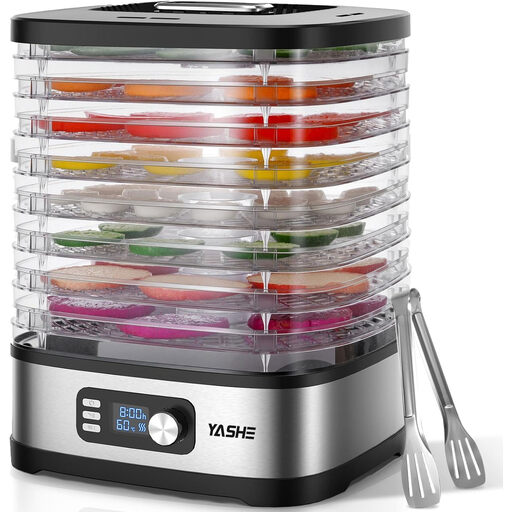
YASHE GGJ-261C food dehydrator
The eight trays provide multiple drying layers; check the dimensions before estimating how many slices will fit.
Eight trays; the product name lists 72 H time and temperature control, mesh screens, a fruit roll tray and stainless steel tongs.
Joybuy
 No image available
YASHE FD-1019 food dehydrator
May suit you if you’re looking for stainless steel trays and adjustable controls; check that the rack surface is right for your batch.
Five stainless steel trays; adjustable timer and temperature; 400 W.
Joybuy
 No image available
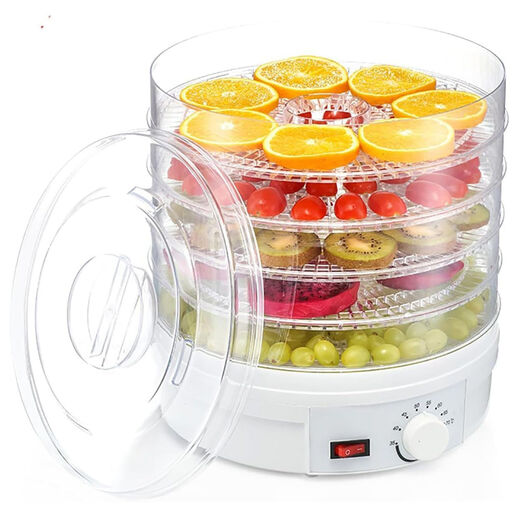
Food dehydrator with five tiers, 35–70 °C
An option if you want to use multiple tiers; check the dimensions before estimating its capacity for citrus slices.
Five tiers; temperature range of 35–70 °C; 350 W.
Joybuy
Frequently asked questions about drying citrus slices
How should I arrange and check citrus slices while they dry?
Arrange the slices in a single layer so air can flow between them. Use any stated time as a guide at most, and let a test slice cool before deciding whether it’s dry enough. Utah State University Extension’s general fruit advice doesn’t give a set drying time for every citrus variety, slice thickness and appliance combination.
How should I store slices that are ready before the festive meal?
Let the slices cool completely, then pack them in clean, dry conditions. For fruit being stored for longer, the National Center for Home Food Preservation recommends a period of 7–10 days to allow the moisture to distribute evenly. If you see condensation, dry the fruit further; discard any mouldy fruit. This is a storage guideline, not a statutory shelf-life for citrus.
Should I wash citrus if the peel will stay on an edible slice?
Wash fruit you’re serving with the peel on under running water. The Netherlands Nutrition Centre notes that washing removes dirt and some, but not all, pesticide residues. Washing therefore doesn’t guarantee that all residues are gone.
What are my rights if the product is faulty or I buy it online in the Netherlands?
If a product is faulty, contact the seller about your statutory guarantee; according to the Dutch Government, there is no fixed general two-year guarantee period in the Netherlands. For an ordinary online consumer purchase, you generally have a 14-day cooling-off period after delivery, subject to exceptions listed by ACM ConsuWijzer.
What rules apply to an electric dehydrator and racks that come into contact with food?
Electrical appliances sold in the Netherlands must meet the applicable electrical safety and CE requirements. The Netherlands Food and Consumer Product Safety Authority sets out the rules for materials that come into contact with food. Check the information for the exact model; a BPA-free claim or a CE image on a product listing alone doesn’t amount to a full check of the item you receive.


