
Host catering for a large group
You want to prepare plenty of citrus slices ahead of a single serving time. Compare the usable tray area with the space the appliance takes up to work out whether one drying cycle will be enough.


Start by checking the tray size and how many slices you can fit in a single layer per drying cycle; Utah State University Extension recommends arranging fruit in a single layer. Then compare the timer, temperature settings and external dimensions. But don’t take the set time as proof that the slices are dry enough: drying time also depends on slice thickness and moisture content, so check the slices yourself once they’ve cooled.
You want to prepare plenty of citrus slices ahead of a single serving time. Compare the usable tray area with the space the appliance takes up to work out whether one drying cycle will be enough.
You want to plan your drying cycles, while leaving enough time to check the slices yourself once they’ve cooled. The time needed varies depending on factors such as slice thickness and the fruit’s moisture content.
You could plan several drying cycles if a smaller appliance is a better fit on your worktop or in your cupboard. Compare the external dimensions separately from the number of trays or the stated drying area.
Choose this if: you want to prepare plenty of slices for the same serving time and have room for a larger appliance. Rommelsbacher lists seven trays and 0.5 m² of drying area for the DA 650.
Bear in mind: a stated area doesn’t tell you how many slices will fit or whether they’ll dry evenly at the same time. Compare the dimensions with the quantities you plan to prepare.
Choose this if: you want to plan your preparation around a set mealtime and consider time and temperature settings important. DOMO lists six stainless steel trays and digital controls for the DO353VD; Steba lists five racks and a 1–36-hour timer for the ED 5.
Bear in mind: a timer sets the running time, but it can’t tell you whether the citrus is dry enough.
Choose this if: you have limited kitchen or cupboard space and can plan several cycles if needed. Tristar lists external dimensions of 25 × 23,4 × 27,1 cm for the PD-9064; WMF positions the KITCHENminis 415250011 as a space-saving model.
Bear in mind: external dimensions don’t tell you how many citrus slices will fit on the trays. Check the usable space and cleaning instructions.
| Buying concern | What to check | Who this matters to |
|---|---|---|
| Batch size per drying cycle | Compare the usable tray size with the diameter of the slices. Utah State University Extension recommends arranging fruit in a single layer. | If I want to prepare plenty of slices for the same community meal, I want to know how many will fit side by side in each cycle. Around 36% of consumers prioritise capacity per drying cycle. |
| Preparation and storage | Check the cleaning instructions and let a test slice cool before assessing how dry it is; Utah State University Extension warns that warm fruit feels softer and less dry. | If I’m preparing slices for others and want to store them, I need to be able to check them carefully and clean the trays according to the instructions. Around 29% of consumers prioritise this concern. |
| Planning around mealtime | Compare the timer and temperature settings, and allow time to check the slices once they’ve cooled. University of Minnesota Extension notes that drying time also depends on slice thickness and moisture content. | When the serving time is fixed, I want to be able to plan the drying cycle in advance without assuming the timer confirms the slices are dry. Around 21% of consumers prioritise this kind of planning. |
| Kitchen space and power | Measure the available space and compare it with the external dimensions. Wattage alone doesn’t tell you how much electricity a full drying cycle will use. | If my kitchen has limited space, I want to choose an appliance that fits and make sense of the stated power information. Around 14% of consumers start by considering space and usage information. |
Trays can vary in size. Slices need to fit side by side without overlapping, so the number of levels alone doesn’t tell you how much you can dry in each cycle.
Compare the usable tray dimensions or stated drying area with the quantities you plan to prepare and the diameter of the slices.
Less available drying space may mean you need more drying cycles and extra preparation time.
Drying time varies with factors such as the thickness and moisture content of the fruit. Warm fruit also feels softer and less dry than it does once cooled.
If possible, plan a test cycle and check the slices once they’ve cooled before packing or serving them. Utah State University Extension recommends drying moist pieces for longer.
Rommelsbacher lists seven trays and a total drying area of 0,5 m² for the DA 650. This information can help when comparing appliances for larger batches.
DOMO describes the DO353VD as a food dehydrator with six stainless steel trays and digital time and temperature controls.
Steba’s ED 5 has five racks, each listed by the manufacturer as 32 × 25 cm.
WMF positions the KITCHENminis 415250011 as a space-saving food dehydrator with five levels.
The PD-9064 is a five-tier stackable model for which Tristar lists external dimensions of 25 × 23,4 × 27,1 cm.
This selection of Joybuy products focuses on multiple trays and adjustable drying cycles for preparing citrus slices.
 No image available
The five height-adjustable trays provide multiple levels for a drying cycle; check how many slices will fit without overlapping.
Temperature setting: 35–70 °C; timer up to 72 hours; power: 240 W.
 No image available
With five adjustable trays, you can use multiple levels; compare the usable space with the number of slices you plan to prepare.
Temperature setting: 35–70 °C; power: 240 W.
 No image available
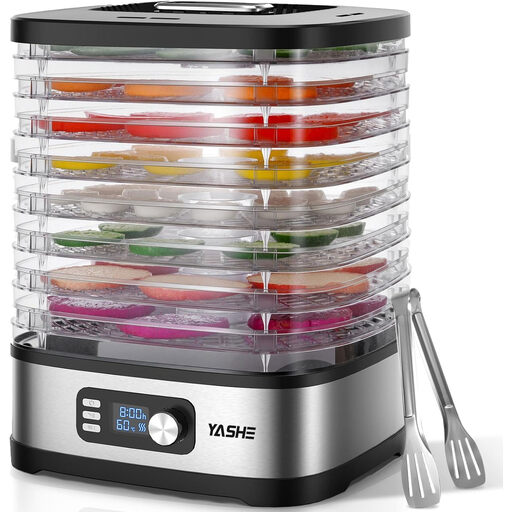
The eight trays provide multiple levels; also check whether the included accessories suit what you want to prepare.
The product name lists a timer of up to 72 hours, mesh screens, a fruit leather tray and stainless steel tongs.
 No image available
The five stainless steel trays provide several levels for a drying cycle; check how much space the citrus slices will take up.
The product name lists an adjustable timer and temperature, 360° airflow and a power rating of 400 W.
 No image available
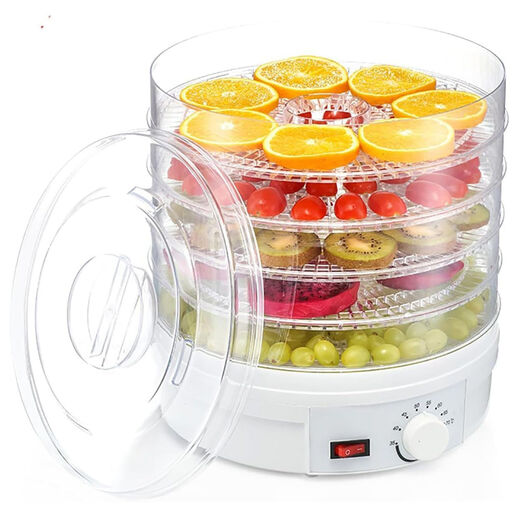
The five tiers provide multiple tray levels; compare the usable size with the number of slices you want to dry.
Temperature setting: 35–70 °C; power: 350 W.
Let a test slice cool before assessing how dry it is: Utah State University Extension notes that warm fruit feels softer and less dry. Also check for moisture returning during storage; the same organisation recommends drying any moist pieces for longer. A timer alert alone doesn’t confirm that the slices are dry.
Not necessarily: the Netherlands Nutrition Centre also describes drying thinly sliced fruit using other kitchen appliances, such as an oven or air fryer. Don’t assume recipe timings will work for citrus slices in a food dehydrator; first compare the appliances and space available, as well as the preparation time you have.
If you buy as a consumer in the Netherlands, you have statutory consumer rights in addition to any manufacturer’s warranty. ACM ConsuWijzer explains that a product must meet the expectations you were entitled to have; if there’s a problem, the seller must offer an appropriate solution. A stated manufacturer’s warranty period doesn’t automatically represent the full duration of your statutory rights.
For food sold at markets and events in the Netherlands, the NVWA requires hygienic preparation and storage. If you prepare and sell food repeatedly, several times a year, you may also need an HACCP food safety plan. For the sale or supply of unpackaged food, the NVWA explains how customers must be informed about allergens present. Those rules don’t make clear whether they apply to a one-off community meal where food is given away free; don’t assume the two situations are legally the same.
No. That label alone doesn’t confirm that all applicable requirements for materials that come into contact with food have been met. The NVWA explains that broader requirements apply in the Netherlands and the EU, so don’t assess product information solely on the basis of a BPA-free claim.