What should you look for when choosing?
Food dehydrator with multiple trays
Suitable when: you want several participants to lay out slices at the same time and can allow several hours for a drying cycle.
Bear in mind: the worktop and storage space required. A timer ends the set period, but it won’t tell you whether every slice is dry.
An existing oven or air fryer
Suitable when: you’re making a small batch for a demonstration and don’t want to buy a separate appliance.
Bear in mind: the Voedingscentrum’s oven and air fryer method involves turning the slices regularly. Follow a recipe for the appliance you’re using rather than assuming drying times are the same across different methods.
The main decision is whether you mainly want to demonstrate the process during the session or also have a batch ready in time for tasting. For its own recipe using 1/4-inch slices in a single layer, Excalibur Dehydrator Recipes recommends 135 °F for 6–10 hours, until the slices have a leathery texture. This isn’t a guaranteed time for a different appliance or load.
| What to consider |
What to look for |
Who this matters to |
| Tasting session |
Allow enough time for your chosen method and take slice thickness and load size into account. |
If I want participants to taste the slices during the same session, I’d rather prepare a separate batch in advance. Around 33% of consumers put the tasting session first. |
| Tray space |
Compare both the number of trays and their dimensions with your batch size; the slices need to sit side by side. |
If several participants are slicing at once, I want to know how many slices will fit without overlapping. Around 27% of consumers prioritise space for a group-sized batch. |
| Cleaning |
Check which parts can be removed and which cleaning method the manufacturer recommends for each part. |
If I’m using it repeatedly, I want to be able to clean the parts that come into contact with food thoroughly. Around 20% of consumers make cleaning their top priority. |
| Extra appliance |
First, work out the batch size and whether you have an oven or air fryer available. |
For a small, occasional demonstration, I want to weigh up whether I really need another appliance. Around 20% of consumers prioritise avoiding a separate purchase. |
Food dehydrators at Joybuy
These food dehydrators are suited to spreading fruit across multiple trays for a workshop.
 No image available
YASHE GGJ-261A food dehydrator, 5 trays
The five adjustable trays provide several levels for spreading out the slices.
240 W; temperature setting of 35–70 °C; BPA-free.
View at Joybuy
 No image available
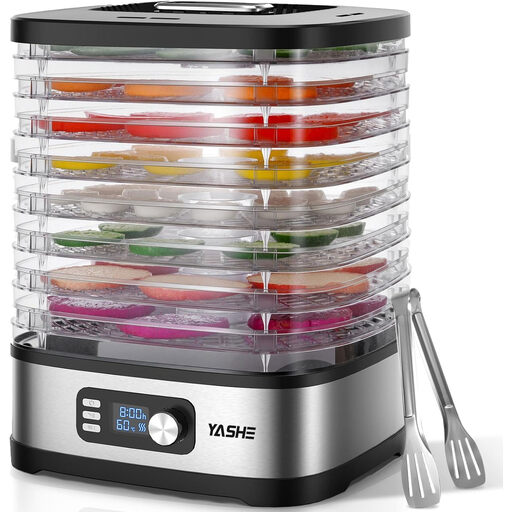
YASHE GGJ-261C food dehydrator, 8 trays
With eight trays, you can spread the fruit across several levels; check that the total capacity suits your workshop batch.
Timer from 1–72 hours; temperature setting of 35–70 °C; includes mesh screens and a fruit leather tray.
View at Joybuy
 No image available
YASHE FD-1019 food dehydrator, 5 stainless steel trays
The five trays provide several levels for a workshop batch; compare the tray space with the number of slices you want to dry.
Timer from 1–48 hours; temperature setting of 35–70 °C; 400 W; BPA-free.
View at Joybuy
 No image available
Food dehydrator, 5 tiers
The five tiers are designed to spread fruit across several levels; check the tray space for your planned batch.
Temperature setting of 35–70 °C; 350 W; BPA-free.
View at Joybuy
 No image available
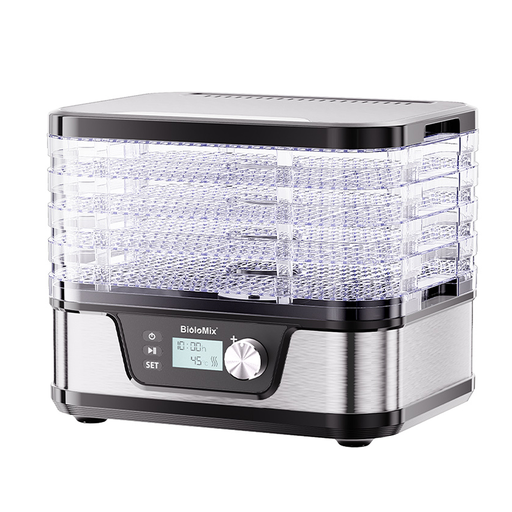
BioloMix BFD1300 food dehydrator, 5 trays
The five trays and adjustable timer are useful if you want to set a drying cycle in advance; check the available space on each tray for your batch.
24-hour timer; temperature setting of 35–75 °C; 10 L capacity.
View at Joybuy
Frequently asked questions
Will freshly sliced bananas be dry by the end of a short workshop?
Don’t count on it. A recipe from Excalibur Dehydrator Recipes gives a drying time of 6–10 hours for its specific method, until the slices have a leathery texture. If you’ve planned a tasting session, dry a separate batch in advance and assess the slices according to the instructions for the appliance you’re using.
How should I arrange the slices on the trays?
Arrange the slices side by side in a single layer, without overlapping them. This follows the drying instructions from Excalibur Dehydrator Recipes. The time required will still depend on factors including slice thickness, moisture content and preparation method.
What should I look for when it comes to cleaning and energy use?
For each model, check which trays can be removed and what cleaning instructions the manufacturer gives for each part. The stated power in watts isn’t a measured figure for a full drying cycle; you’ll also need to know the actual running time and your electricity tariff, among other things.
Do I need to register a workshop business and provide allergen information?
If you operate a food business supplying food directly to consumers, the Netherlands Food and Consumer Product Safety Authority (NVWA) says you must register. Ondernemersplein explains that businesses preparing or processing food must work safely with food, using an HACCP plan or an approved hygiene code. If you sell or supply unpackaged products to customers, the NVWA says you must be able to provide information about any allergens present. Whether these business rules apply to a particular private or occasional workshop depends on how it is organised and how food is supplied.


