
Host preparing a large batch
You want to dry plenty of evenly sliced bananas before the family visit, without crowding the trays. Your main priorities are drying space and the ability to plan ahead.


For a small, one-off batch, an oven or air fryer may do the job. If you’re preparing a larger batch or drying fruit regularly, a food dehydrator is worth considering, provided the slices fit on the trays without overlapping. So compare usable space, temperature settings and how you can plan the drying process, rather than looking only at the number of trays. Penn State Extension recommends 60 °C for drying bananas in a food dehydrator, but drying time also depends on slice thickness and the method used. Check the slices when they’re done and let them cool completely before packing them away, as advised by the National Center for Home Food Preservation.
You want to dry plenty of evenly sliced bananas before the family visit, without crowding the trays. Your main priorities are drying space and the ability to plan ahead.
You want to schedule the drying session in advance and are looking for temperature controls, a timer and the chance to check the results afterwards. Setting a time doesn’t guarantee that every slice will be dry.
You may only be making one small batch and want to consider whether your existing oven or air fryer will do the job. The Voedingscentrum explains how to dry fruit using both appliances.
| What to consider | What should you check? | Who is this most important for? |
|---|---|---|
| Space for your batch | Compare the tray dimensions and the space available for slices to sit without overlapping. The stated drying area isn’t a measured banana capacity. | For a family-sized batch, I want to fit as many slices as possible into each drying session without stacking them; around 33% of consumers prioritise having enough space for their batch. |
| Planning ahead | Check whether you can set the temperature and time, and allow time to inspect the results. Drying time depends on factors including slice thickness and the method used. | If I want to prepare the slices before the visit, being able to plan a session is useful, but I still want to check how dry they are myself; around 27% of consumers prioritise predictable preparation. |
| Whether an extra appliance is worthwhile | Decide whether you’re likely to dry fruit again and whether your oven can be set to suit the method you choose. | For one small batch, I’d rather consider using my oven or air fryer first than make room for another appliance; around 20% of consumers say occasional use is their main consideration. |
| Drying and storage | Check the temperature settings and the tray-cleaning instructions. Let the slices cool and check them before packing them away. | If I’m preparing a batch in advance to serve later, I want to prevent moisture problems during storage; around 20% of consumers prioritise drying results and storage. |
The number of trays doesn’t tell you how many of your sliced bananas will fit. The slices need to sit side by side, so you may need an extra drying session for a large batch.
Compare the dimensions of each tray too, and, if possible, try a batch before the visit.
An extra drying session may mean more preparation time.
The Voedingscentrum describes a method using an oven or air fryer with fruit, including bananas. This isn’t the same as a method for drying and storing fruit for longer.
Decide in advance whether you want to serve the slices soon or store them for longer, and follow the relevant preparation and storage instructions.
The moisture content can vary from slice to slice. Moisture left behind or absorbed again during storage can cause spoilage.
Check the slices, let them cool completely and inspect stored batches for moisture or mould.
The DA 650 is worth comparing if you’re looking for plenty of drying space and an adjustable timer.
The ED 5 has five trays and electronic temperature and time settings.
The DH 2025 is a stackable model for anyone who wants to adjust the tray layout.
The 112380 is an option if you want to see how much is in its stack of transparent layers.
These models are food dehydrators with stackable trays for fruit. Compare their listed settings and tray configurations with the amount you want to dry for the family visit.
 No image available
Worth comparing if you’re looking for an adjustable temperature and timer to plan your drying session.
The product name lists five height-adjustable trays, 35–70 °C, a 72-hour timer and 240 W.
 No image available
Compare this model if five adjustable trays suit the amount you need to dry and the layout you’re looking for.
The product name lists five adjustable trays, 35–70 °C and 240 W.
 No image available
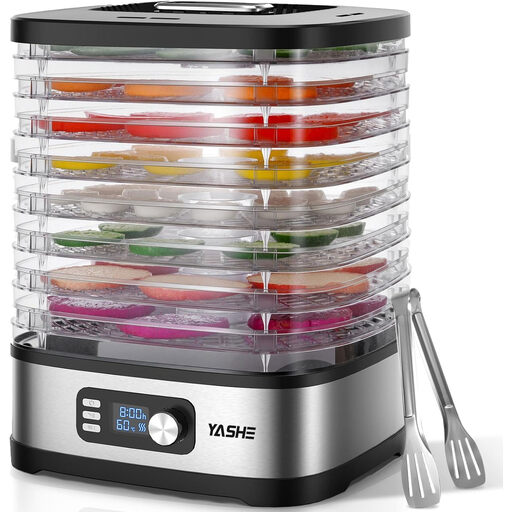
The eight-tray version is worth comparing if you’re looking for a larger tray configuration.
The product name lists 72-hour time and temperature control, mesh screens, a fruit roll tray and stainless steel tongs.
 No image available
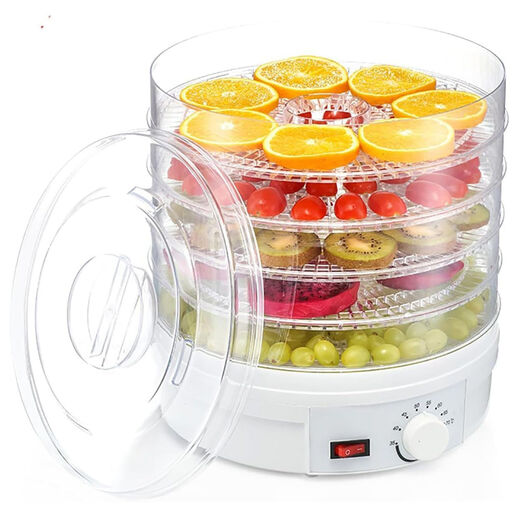
Compare this model if you’re looking for five trays and adjustable time and temperature settings for a planned session.
The product name lists five stainless steel trays, an adjustable timer and temperature, 360° airflow and 400 W.
 No image available
A five-tier version to compare if this layout suits the batch you want to prepare.
The product name lists 35–70 °C and 350 W.
Slice the bananas evenly and allow time to check them after drying. Penn State Extension recommends 140 °F (60 °C) for 8–10 hours as a guide for drying bananas in a food dehydrator; the actual time depends on factors including slice thickness and the method used. Don’t assume that setting the timer will automatically give you slices that are ready to serve.
Not necessarily. The National Center for Home Food Preservation says that some commercial banana chips are treated to make them crisp, a result that can’t be replicated at home.
Let the slices cool completely before putting them in a clean, dry, airtight container. Check stored batches for moisture or mould. The National Center for Home Food Preservation also describes a conditioning step for fruit that will be stored for longer, to distribute moisture between the pieces.
Check the information for the exact appliance. The European Commission states that materials intended to come into contact with food must comply with Regulation (EC) No 1935/2004 when placed on the EU market. According to EU information, electrical and electronic equipment falls into product categories covered by CE rules. The CE marking is a declaration by the manufacturer, not a centrally issued quality certificate.
According to ACM ConsuWijzer, the seller is responsible under the legal guarantee if the product doesn’t do what you could reasonably expect when used normally. Online purchases generally come with a 14-day cooling-off period from the day of delivery; exceptions may apply, so check the relevant terms.