
Cooking for a large platter
You want to make plenty of banana slices for the same neighbourhood meal and, above all, find out how many will fit on the trays with enough space between them in each batch.


When choosing a food dehydrator for banana slices, first check how much room the trays offer when the slices are spaced apart. If that isn’t enough, plan to dry them in several batches before the meal. A timer can help with planning, but it doesn’t guarantee a particular drying time. Removable trays that are easy to clean can make tidying up afterwards simpler.
You want to make plenty of banana slices for the same neighbourhood meal and, above all, find out how many will fit on the trays with enough space between them in each batch.
You want to fit drying in around other preparations and are looking for control over the temperature and end time, without treating a timer as a guarantee of drying time.
You expect to use the dehydrator again after this meal, so you’re looking at removable trays, ease of cleaning and whether parts can be replaced.
First work out how many slices you can dry at once with space between them; then consider planning and cleaning.
| What to consider | What should you look for? | Who is this important for? |
|---|---|---|
| Drying space per batch | Compare the tray dimensions or the stated drying area. Leave space between the slices for air to circulate; the number of trays alone doesn’t tell you how many portions will fit. | If I’m drying for a shared platter, I want to know how many slices will fit on the trays with space between them. Around 42% of consumers prioritise having enough drying space when choosing for this neighbourhood meal. |
| Planning around serving time | Check whether the temperature and time can be set, and allow for a trial batch or several batches. Utah State University Extension gives a typical drying time of 8–10 hours for bananas, but stresses that drying times vary between appliances. | If I want to serve the slices on time, I need to be able to fit the drying in around my other preparations. Around 33% of consumers put serving time and planning first. |
| Cleaning and reuse | Check which parts are removable and listed by the manufacturer as dishwasher-safe. If parts can be replaced, check that they fit the exact model. | If I want to use the dehydrator again later, I look for trays that are easy to clean or replace. Around 25% of consumers prioritise cleaning and reuse. |
The usable capacity also depends on the tray dimensions and the space between the slices. Utah State University Extension recommends leaving space for air to circulate during drying.
Compare the usable tray area and plan to dry several batches if needed. A trial batch using the slice thickness you intend to serve will help you plan accordingly.
Extra batches may mean more preparation time.
Setting an end time is an appliance function, not confirmation that the bananas are completely dry in your dehydrator. Utah State University Extension notes that drying times vary between appliances.
Check the result and follow the appliance manual. Let the slices cool completely before packing them; the National Center for Home Food Preservation warns that packing food while it’s warm can cause condensation.
Fritel describes the DH 2025 as a stackable model with five trays measuring 24,5 × 31,5 cm and adjustable temperature.
According to the product specifications, the Princess 112398 has six stainless steel trays, a timer and a drying sheet with a fine-mesh mat.
Steba says the ED 5 has five trays measuring 32 × 25 cm, temperature control and a timer that runs from 1 to 36 hours.
Rommelsbacher says the DA 650 has seven trays and a stated drying area of 0,5 m².
Severin describes the OD 2940 as suitable for banana chips and lists a replaceable stacking tray.
These food dehydrators offer options for spreading out and planning drying batches. Before use, check that any materials that come into contact with food comply with the applicable Dutch and European requirements; a product listing alone doesn’t show that a particular model complies.
 No image available
The five height-adjustable trays and timer give you options for organising and planning drying batches; they don’t guarantee a particular yield or drying time for bananas.
Temperature setting: 35–70 °C. Timer: up to 72 hours. Stated power: 240 W.
 No image available
The five adjustable trays can help you spread fruit across several levels; the product information doesn’t state a yield per batch for banana slices.
Temperature setting: 35–70 °C. Stated power: 240 W. The product information lists dishwasher-safe parts.
 No image available
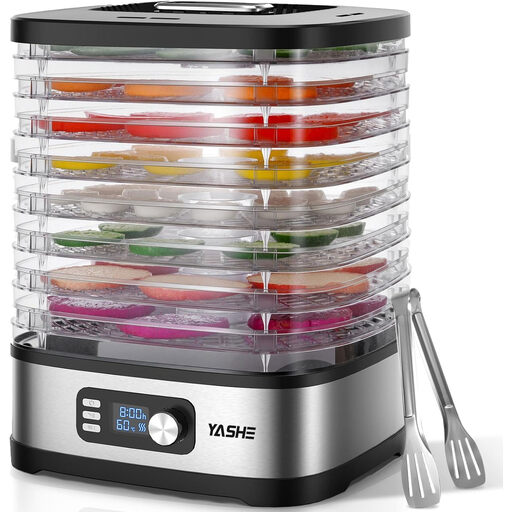
The eight trays and timer can help you plan several drying batches; the settings don’t guarantee a specific drying time for bananas.
Temperature setting: 35–70 °C. Timer: 1–72 hours. The product name lists mesh screens, a fruit roll tray and stainless steel tongs.
 No image available
The five trays and adjustable timer give you options for planning drying batches; they don’t determine how long your banana slices will need.
The product name lists five stainless steel trays and a stated power of 400 W. Temperature setting: 35–70 °C. Timer: 1–48 hours.
 No image available
The five removable trays offer a way to spread fruit across several levels; check that the slices have enough space between them.
Temperature setting: 35–70 °C. Stated power: 350 W. The product information lists dishwasher-safe trays.
Utah State University Extension recommends slices about ¼–⅜ inch thick and gives a typical drying time of 8–10 hours. Drying time varies by appliance, so follow the manual too and try a small batch before the meal.
No, let them cool completely first. The National Center for Home Food Preservation warns that packing food while it’s warm can cause condensation. Use clean, dry, airtight containers and check for moisture.
If you want to store them for longer, the National Center for Home Food Preservation describes a 7–10-day period during which you keep the cooled fruit loosely packed in sealed jars, shake them daily and check for condensation. Dry the fruit again if condensation appears; a timer doesn’t replace these checks.
That depends on how the meal is organised. The Netherlands Food and Consumer Product Safety Authority says food safety requirements apply when food is sold at events, including when it’s sold by a private individual. For repeated sales, the authority specifies a food safety plan. If in doubt, check which rules apply to your particular situation.
Yes. The Netherlands Food and Consumer Product Safety Authority lists Dutch and European requirements for articles intended to come into contact with food. A label such as “BPA-free” doesn’t by itself show that all applicable requirements have been met; check this for the specific model.