
Cook with limited cupboard space
You want to dry banana slices, but need to fit the whole appliance into a small cupboard after use. So, compare the model’s external dimensions with the space available in your cupboard.


First, measure your cupboard and the space the dehydrator will need while in use. Then compare its external dimensions with the usable tray area, as banana slices need space between them for air to circulate, as advised by Utah State University Extension. For the occasional small batch, the Voedingscentrum also describes a method using an oven or air fryer. If you want to dry more at once, weigh up drying space against storage space.
You want to dry banana slices, but need to fit the whole appliance into a small cupboard after use. So, compare the model’s external dimensions with the space available in your cupboard.
You make banana slices often and want adjustable drying settings, with enough room to space the slices out. Utah State University Extension stresses that air needs to circulate around the food and between the trays.
You want to dry several batches at once and are weighing up the tray area against the extra cupboard space the appliance will take up. The number of trays alone won’t tell you how many slices will fit without overlapping.
| What to consider | What should you check? | Who is this important for? |
|---|---|---|
| Fitting and storage | Measure the cupboard’s width, depth and height; also check how the separate trays can be stored. | If I need to put the appliance in a small cupboard after use, I want to know whether all the parts will fit too. Around 36% of consumers put cupboard space and storage first. |
| Even drying | Check the temperature settings and whether the slices will fit on the trays with space between them. | I want to be able to arrange banana slices in a single layer and adjust the drying settings to suit. Around 29% of consumers prioritise drying control and air circulation. |
| Batch size | Compare the tray dimensions or stated drying area, as well as the external dimensions. | If I want to make several batches at once, I look for enough room to lay out the slices without overlapping. Around 21% of consumers prioritise the amount they can dry in one go. |
| Cleaning and electricity | Read the cleaning instructions for the trays; compare electricity costs only using consumption in kWh per batch and the same tariff. | I want to know in advance how much cleaning the trays will need and how to compare electricity consumption. Around 14% of consumers prioritise practical considerations such as cleaning and running costs. |
Models also differ in width and depth, and you need space both for storage and for air to circulate while the appliance is in use.
Measure the entire storage space and check the placement instructions for the model you’re considering.
The number of levels doesn’t tell you how many banana slices will fit without overlapping. Utah State University Extension advises leaving space for air to circulate around the food and between the trays.
Compare the tray dimensions and plan to space the slices out.
According to University of Minnesota Extension, drying time depends on factors including the thickness of the slices and their moisture content. Drying and storage are also separate steps.
Check the results after each batch and only pack the slices once they’re sufficiently dry and have cooled.
The Tristar PD-9064 is a model worth comparing if you have limited cupboard space.
The Princess 112380 has stackable levels; compare its footprint with the cupboard where you plan to store it.
WMF describes the KITCHENminis 415250011 Snack to-go as a space-saving dehydrator with takeaway containers and a timer.
The Rommelsbacher DA 650 is a cabinet-style dehydrator worth comparing if both tray area and cupboard space matter.
This selection includes multi-tier food dehydrators for fruit, including stackable models and the Rommelsbacher DA 650. Compare the stated external dimensions with your cupboard, and the tray area with the number of slices you want to dry at once.
 No image available
The stackable trays are worth considering if you want to adjust the drying settings and put the parts away after use.
Five height-adjustable trays; temperature control from 35–70 °C; 72-hour timer; 240 W.
 No image available
The stated external dimensions make this model worth comparing if you want to measure your cupboard space before buying.
31 × 29 × 24,5 cm; five adjustable trays; temperature control from 35–70 °C; 240 W.
 No image available
This model is worth comparing if you’re looking for adjustable drying times and stainless steel trays.
Five stainless steel trays; temperature control from 35–70 °C; 1–48-hour timer; 400 W.
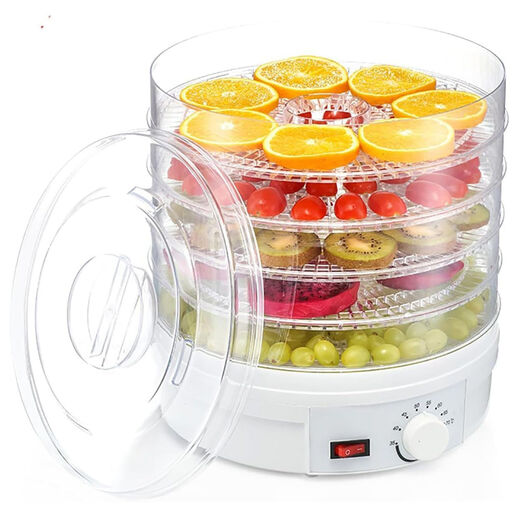 No image available
The five levels give you several trays to compare; check the dimensions before deciding whether the appliance will fit in your cupboard.
Five levels; temperature control from 35–70 °C; 350 W; trays are listed as dishwasher-safe in the product description.
 No image available
This model is worth considering if a larger stated drying area is important; check in advance that the depth of 43 cm will fit in your cupboard.
Seven trays; stated drying area of 0.5 m²; external dimensions of 29 × 43 × 27,5 cm; temperature control from 35–75 °C; 99-hour timer.
Not necessarily: the Voedingscentrum suggests banana as a possible variation on a recipe for thin fruit slices made in an oven or air fryer. Follow the instructions and storage period in that recipe; don’t automatically apply them to a food dehydrator.
Arrange the slices so air can circulate around them and between the trays, as advised by Utah State University Extension. University of Minnesota Extension recommends storing thoroughly dried food in cool, dark conditions in moisture-proof packaging; check that the slices are dry enough before putting them away for longer-term storage.
No. To compare electricity costs, you need the actual consumption per drying batch in kWh and the same rate per kWh. A model’s stated wattage alone doesn’t tell you how much it will cost to run.
No. ACM ConsuWijzer explains that statutory rights under Dutch law apply alongside a seller’s or manufacturer’s warranty. If a product is faulty, the seller is your point of contact; what you can reasonably expect from the product is what matters, not just the length of a commercial warranty.