
Cook with limited worktop space
Wants to dry banana slices without letting the appliance take over a small kitchen. Compare its external dimensions with both the space available and the room needed to lay the slices out separately.


Start by choosing a food dehydrator based on how much space it takes up and whether you can arrange banana slices in a single layer with space between them. Then compare the number of trays, temperature settings, timer and cleaning requirements with how often you plan to use it. More trays can help you spread out larger batches, but they don’t automatically make a dehydrator more suitable for a small kitchen.
Wants to dry banana slices without letting the appliance take over a small kitchen. Compare its external dimensions with both the space available and the room needed to lay the slices out separately.
Often makes larger batches and focuses on usable drying space, temperature control and a timer that suits how they monitor the drying cycle.
Wants to know how much effort is involved in operating and cleaning an extra kitchen appliance before making room for it.
First measure the worktop and storage space available, then check whether the tray layout and controls suit the batches you want to dry.
The percentages below show how consumers considering a food dehydrator for this purpose are divided by their main buying concern; each consumer is counted under one concern.
| What to consider | What to look for | Who is this important for? |
|---|---|---|
| Worktop and cupboard space | Measure the width, depth and height, then compare them with the appliance’s external dimensions and tray layout. | If I have limited space, I want to know whether the dehydrator will fit and whether there’ll still be enough room to lay the slices out without overlapping them. Around 36% of consumers say space is their main buying concern. |
| Drying control and batch size | Compare the number and dimensions of the trays, the temperature settings and the timer. | If I want to dry more banana slices at once, I look for a layout that leaves space between them and adjustable controls. Around 29% of consumers prioritise batch size and control. |
| Operation and cleaning | Check the cleaning instructions and whether the manufacturer says the parts are dishwasher-safe. | If I want to keep the faff to a minimum after slicing, I look for straightforward controls and trays that are easy to clean. Around 21% of consumers say operation and cleaning are their main concern. |
| Purchase price and electricity use | Compare prices from retailers. Assess electricity use based on measured consumption and the actual running time, not just the stated wattage. | If I want to weigh up the cost of an extra appliance, I consider both the purchase price and the energy used per comparable drying cycle. Around 14% of consumers say cost is their main buying concern. |
More trays don’t necessarily mean you can fit more banana slices in a useful way. Utah State University Extension emphasises that air needs to circulate around the food and between the trays.
Compare the external dimensions and tray layout, and arrange the slices in a single layer with space between them.
The stated wattage doesn’t tell you how much energy a full cycle uses. Running time and the power used during operation also make a difference.
To compare costs, use measured kWh for similar-sized batches rather than relying on the wattage shown on the product label.
The thickness of the slices, how much you load into the dehydrator and the texture you want all affect when they’re ready. Utah State University Extension also points out that pieces don’t always dry evenly.
Check that the slices are dry once they’ve cooled. If you notice moisture when checking them, dry the fruit again rather than relying on a general shelf-life claim.
The KITCHENminis 415250011 is a food dehydrator that WMF positions as space-saving, with temperature control and a timer.
The PD-4910 has five drying trays and stated external dimensions of 30 × 24 × 27 cm.
The 112380 has six stackable trays, allowing you to spread slices across several drying levels.
The ED 5 comes with five trays, each measuring 32 × 25 cm, and an electronic timer.
These food dehydrators are designed for drying fruit, including banana slices. Compare the tray space and controls with your batch size and the room you have for the appliance.
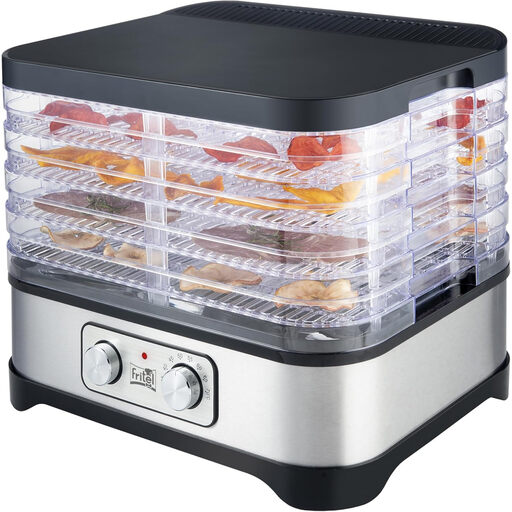 Image unavailable
The five trays let you arrange banana slices in a single layer without overlapping them.
The trays measure 24,5 × 31,5 cm; the stated external dimensions are 371 × 307 × 258 mm.
The temperature can be set from 35–70 °C; the stated power rating is 250 W. According to the product information, the trays are dishwasher-safe.
The casing and interior get hot during use. Keep children away and don’t block the ventilation openings.
 Image unavailable
The five trays provide several levels for spreading fruit out during a drying cycle.
The temperature can be set from 35–70 °C and the timer for up to 24 hours.
 Image unavailable
With seven trays and a stated drying area of 0,5 m², this model is suitable for spreading fruit across several layers; check that the appliance will fit in your kitchen.
The temperature can be set from 35–75 °C. The timer can be set for up to 99 hours and has an automatic shut-off function.
An Excalibur recipe suggests drying ¼-inch slices in a single layer at 135 °F for 6–10 hours, or until leathery. Treat this as a recipe example rather than a set time for every appliance: slice thickness, load size and the texture you want can all vary.
Once the pieces have cooled, check that they’re evenly dry. Utah State University Extension describes conditioning dried fruit to even out its moisture distribution; if you notice moisture during this process, dry the fruit again. A general shelf-life claim isn’t a guarantee for your banana slices.
No, you shouldn’t assume that. The Tristar PD-4910 is listed as having parts that aren’t dishwasher-safe; follow the cleaning instructions for the model you choose.
When you buy online from a business, you’ll usually have a 14-day cooling-off period. In the Netherlands, you’re also entitled to a product that works as it should, and the retailer is your point of contact if there’s a fault. There’s no fixed statutory guarantee period that applies to every product.
No. According to the European Commission, the manufacturer uses the CE marking to declare that the product meets the relevant EU product rules; there’s no central EU body that issues a general CE certificate for this purpose. The marking doesn’t prove how well a dehydrator performs or whether it’ll fit on your worktop.