Who would find a food dehydrator useful?

If you can only get started late

You might not be able to slice the banana until after class, and want to know whether drying it will fit into your evening or require more attention later. The time required depends in part on the thickness of the slices; only assess them once they’ve cooled.

If you make small batches

You usually make a small amount at a time and want to see whether your existing oven or air fryer will do the job before making room for a separate dehydrator.

If you make snacks regularly

You dry fruit more often and want to use several layers, with suitable temperature settings and trays that are easy to clean.

What should you look for when choosing one?

An oven or air fryer you already own

Suitable for: the occasional small batch, if you don’t want another appliance to store.

Bear in mind: the Voedingscentrum’s fruit recipe advises turning the fruit partway through, so the process needs attention.

Stackable food dehydrator

Suitable for: anyone who often dries several layers and wants a separate appliance with an adjustable temperature.

Bear in mind: check the space between the trays and whether you need to swap them around while drying.

Compact cabinet-style dehydrator with a timer

Suitable for: anyone who wants to set a drying time after class and keep the oven free. WMF lists a 0–24-hour timer for the KITCHENminis 415250011.

Bear in mind: the timer doesn’t remove the need to check the fruit once it has cooled.

Larger cabinet-style dehydrator

Suitable for: anyone who regularly dries larger quantities or other ingredients too.

Bear in mind: the extra drying space may be unnecessary for a single banana; the stated power rating isn’t the same as measured energy use per batch.

Consideration What should you look for? Who is this important to?
Drying time and checking Check the timer range and automatic shut-off function; consider whether you’ll have time to test a cooled slice for moisture. If I can only get started after class, I want to be able to set a drying time and still check the result. Around 40% of consumers are chiefly concerned about drying time and checking the result afterwards.
Batch size and space Compare the usable tray area with the appliance’s dimensions, and make sure there’s enough room for it with space for ventilation. For a small batch, I don’t want an appliance with more drying space than I need, and I also need to be able to store it away. Around 30% of consumers are chiefly concerned about finding a suitable batch size and fit.
Buying a new appliance or using one you already own If you’ll only use it occasionally, consider trying an oven or air fryer recipe first; only calculate electricity costs using suitable measured consumption and your own tariff. If I only dry bananas occasionally, I want to know whether a separate dehydrator offers anything my oven or air fryer doesn’t. Around 20% of consumers are chiefly concerned about weighing up the cost of buying one against using existing appliances.
Cleaning and batches Check which removable parts are dishwasher-safe for each model; ingredients with different drying times should be checked separately. If I dry food more often, I want to be able to clean the trays and organise different ingredients clearly. Around 10% of consumers are chiefly concerned about cleaning and organising batches.

Common buying mistakes

  • Confusing a timer with a dryness test

    Drying times vary, and warm fruit feels softer than cooled fruit. So setting a drying time doesn’t prove the slices are dry enough.

    Let a slice cool and check it before packing the batch. You may need to allow time for another check or drying session.

  • Assuming shelf-life advice applies to every homemade banana

    Storage advice depends on how the fruit is prepared and how dry it is. For its specific recipe, the Voedingscentrum recommends storing the fruit in an airtight container for a few days or freezing it; this isn’t a general storage period for every preparation method.

    Don’t store slices that are still moist for a long time, and follow the storage advice that applies to your preparation method.

  • Confusing wattage with energy use per batch

    The stated power rating in watts doesn’t, by itself, tell you how much energy a drying session uses.

    Compare electricity costs only using suitable measured consumption or a well-founded calculation based on the running time and your own electricity tariff.

Brands to consider

Fritel

According to the manufacturer, the Fritel DH 2025 is a stackable food dehydrator with five trays for fruit and other ingredients.

  • Fritel lists an adjustable range of 35–70 °C and trays measuring 24.5 × 31.5 cm for the DH 2025.
  • The manufacturer describes two ways to stack the trays. Before buying, check that the controls and any timer suit the way you plan to use it.

Princess

The models reviewed differ: the 112380 is stackable, while the 112398 has six stainless-steel drawers and digital controls.

  • Princess lists six stackable layers and a temperature range of 40–70 °C for model 112380. For model 112398, the brand specifies a range of 35–75 °C, a timer of up to 48 hours and removable dishwasher-safe parts.
  • These specifications apply to the models named; check the exact model number before choosing a version.

WMF

WMF describes the KITCHENminis 415250011 as a compact drying oven with five levels.

  • WMF lists a 0–24-hour timer, a temperature setting of 30–70 °C and automatic shut-off.
  • The description ‘quiet’ is a claim made by the manufacturer, not the result of an independent noise test.

Rommelsbacher

According to the manufacturer, the DA 650 has seven trays and is a larger option for anyone who makes batches more often.

  • Rommelsbacher lists 0.5 m² of drying area, an adjustable range of 35–75 °C and a timer of up to 99 hours.
  • The extra drying space may be unnecessary for a small batch. The stated power rating doesn’t tell you how much energy a single batch uses.

Wartmann

According to Wartmann, the WM 2206 DH is a cabinet-style model with six racks and horizontal airflow.

  • Wartmann lists an adjustable time of between 30 minutes and 72 hours.
  • The product information gives different temperature ranges. Don’t use a range as a buying criterion without confirming it for the exact model.

Food dehydrators at Joybuy

These Joybuy products are food dehydrators for anyone looking for a separate appliance to dry fruit in several layers. The selection includes models with five trays and a larger model with seven trays; check the label and instructions for the specific appliance.

YASHE GGJ-261B food dehydrator with five adjustable trays

YASHE GGJ-261B food dehydrator

The timer and multiple trays suit anyone who wants to set a drying time after class and dry fruit in layers; remember to check the fruit once it has cooled.

Temperature control: 35–70 °C. Timer: up to 72 hours, with automatic shut-off. Five height-adjustable trays. Power: 240 W.

View at Joybuy

YASHE GGJ-261A food dehydrator with five adjustable trays

YASHE GGJ-261A food dehydrator

An option for drying fruit in several layers, with an adjustable temperature.

Temperature setting: 35–70 °C. Five adjustable trays. Power: 240 W. BPA-free.

View at Joybuy

YASHE FD-1019 food dehydrator with five stainless-steel trays

YASHE FD-1019 food dehydrator

The adjustable timer may suit anyone who wants to set a drying time in advance after class; check the fruit once it has cooled.

Five stainless-steel trays. Temperature setting: 35–70 °C. Timer: 1–48 hours. Power: 400 W. The trays are listed as dishwasher-safe.

View at Joybuy
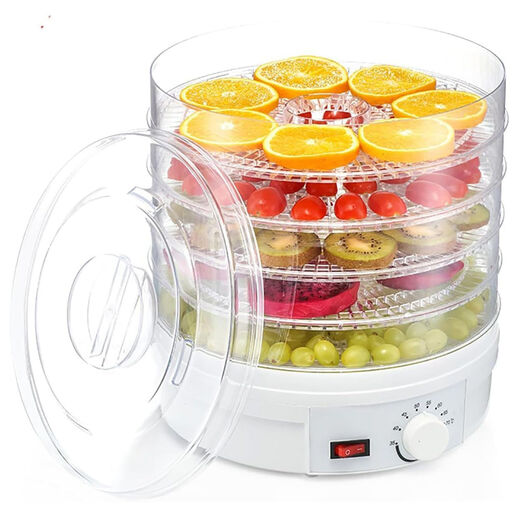
Food dehydrator with five levels and a temperature setting of 35–70 °C

Food dehydrator with five levels

A multi-level model for anyone who wants to dry fruit in a separate appliance.

Five levels. Temperature setting: 35–70 °C. Power: 350 W. The trays are listed as dishwasher-safe.

View at Joybuy

Rommelsbacher DA 650 food dehydrator with seven trays

Rommelsbacher DA 650

The larger drying space may suit anyone who regularly makes bigger batches, but it could be unnecessary for a single banana.

Seven trays and 0.5 m² of drying area. Temperature setting: 35–75 °C. Timer: up to 99 hours, with automatic shut-off. Power: 600 W.

View at Joybuy

Frequently asked questions

How can you tell if banana slices are dry enough?

Let a slice cool first, then check its texture and whether any moisture remains. Utah State University recommends checking that dried fruit has a leathery texture; drying times vary.

How do you make and store a small batch of dried banana?

Arrange the slices in a single layer and let them cool after drying. For the Voedingscentrum’s specific recipe, store the fruit in an airtight container for a few days or freeze portions. Don’t automatically apply this storage period to a different preparation method.

Can a timer run a food dehydrator after an evening class without supervision?

A timer ends the set running time, but doesn’t confirm that the fruit is dry enough. Keep the ventilation openings clear, follow the instructions and check the result once it has cooled. The Brandweer advises allowing electrical appliances to release their heat.

What are your rights when you buy a food dehydrator online?

According to ACM ConsuWijzer, online purchases generally come with a cooling-off period of up to 14 days after delivery, subject to legal exceptions. The seller is also responsible for the statutory guarantee if a product doesn’t meet what you could reasonably expect under normal use; this isn’t the same as a fixed manufacturer’s warranty period.

What safety requirement applies to a mains-powered food dehydrator in the Netherlands?

The Netherlands Food and Consumer Product Safety Authority states that electrical equipment within the applicable voltage limits must meet safety requirements and carry a CE marking. Check the marking and instructions for the specific model; this doesn’t tell you how long bananas need to dry.
