
Host with lots of apple slices to prepare
Wants to dry plenty of slices before the gathering, in as few batches as possible. So, they compare usable drying area with the space the appliance takes up.


For a family-sized batch of apple slices, start by looking at the usable tray space. This helps you work out how many slices you can lay out without overlapping them. Then consider the temperature controls, timer and space the appliance will take up. Some cabinet-style models offer more stated drying area, while stackable models provide a different layout. None of these specifications tells you how quickly your whole batch will dry, so allow time to check the slices and dry them for longer if needed.
Wants to dry plenty of slices before the gathering, in as few batches as possible. So, they compare usable drying area with the space the appliance takes up.
Wants to start drying in good time and may want to store the slices until the gathering. Looks for easy-to-use controls, and plans to let the slices cool completely before packing them carefully.
Would rather make several smaller batches than permanently make room for a large appliance.
Suitable for: anyone who wants to spread out lots of slices for several guests and has room for a larger appliance. According to Steba, the Steba ED 6 has six racks measuring 37 × 30 cm; Rommelsbacher states that the Rommelsbacher DA 650 has seven trays and 0.5 m² of drying area.
Keep in mind: stated tray space is not a measured capacity in apples, nor a guarantee of a particular drying time.
Suitable for: anyone who wants to stack the trays and, if needed, dry several batches one after another. The Fritel DH 2025 has five trays measuring 24,5 × 31,5 cm; the Princess 112380 has six stackable layers.
Keep in mind: the number of layers alone doesn’t tell you how many apple slices will fit in one batch. Check the usable tray space and controls on the specific model too.
Suitable for: anyone who values worktop space more than drying one large batch. A compact dehydrator such as the WMF KITCHENminis has five drying layers; an existing oven may be an alternative if it can be set to a sufficiently low temperature and allows moisture to escape.
Keep in mind: University of Minnesota Extension says that oven drying takes longer than using a food dehydrator. The time needed also depends on how thickly the apples are sliced and their moisture content.
| What to consider | What to look for | Who should pay particular attention? |
|---|---|---|
| Drying space | Compare tray dimensions and usable area; plan to dry several batches if needed. | If I want to dry lots of slices for the family at once, I look at how much space I can use without overlapping them; around 36% of consumers prioritise enough drying space for a family-sized batch. |
| Planning and controls | Compare the temperature settings, timer and automatic shut-off on the exact model. | I want to be able to plan the drying time around the gathering and check the slices as they dry; around 29% of consumers prioritise controls that let them plan ahead. |
| Worktop space | Measure the space available and compare it with the appliance’s external dimensions. | If I have limited worktop space, I’d rather make smaller batches one after another than set up a large appliance; around 14% of consumers prioritise making the most of limited kitchen space. |
| Cleaning and storage | Check the cleaning instructions and let the slices cool completely before packing them. | I want to be able to clean the trays after use and store the slices properly until the gathering; around 21% of consumers prioritise maintenance and storage. |
Trays vary in size and usable area. How many slices will fit also depends on how you arrange them; the number of layers doesn’t tell you the capacity in apples.
Compare the usable tray space on the exact model and arrange the slices without overlapping them. Plan an extra batch if everything won’t fit.
A smaller usable area may mean extra preparation time and another drying batch.
The slices may still contain different amounts of moisture when you take them out. The end time you set doesn’t, by itself, tell you whether every piece is sufficiently dry.
Check the slices as they dry and let them cool completely. Pack them in clean, dry conditions; discard any food that has gone mouldy.
University of Minnesota Extension says that oven drying takes longer than using a food dehydrator. Your oven and the drying method can affect how long preparation takes.
Before planning the gathering around one drying batch, check that your oven can be set to a sufficiently low temperature and allows moisture to escape.
Oven drying can take longer; energy use depends on the oven and the drying time.
The features below apply to the product ranges and models named; they are not recommendations for each brand’s entire range.
According to Fritel, the DH 2025 is a stackable food dehydrator with five trays measuring 24,5 × 31,5 cm.
The Princess 112380 is a stackable model with six layers.
According to WMF, the KITCHENminis 415250011 is designed for a compact set-up and has five drying layers.
According to Rommelsbacher, the DA 650 has seven trays and 0.5 m² of stated drying area.
According to Steba, the ED 6 is a cabinet-style model with six racks, each measuring 37 × 30 cm.
These food dehydrators are options for drying fruit and apple slices. Before buying, check that the model on offer has CE marking, and allow time to check the slices and dry them for longer if needed.
 No image available
The adjustable trays are a good option if you want to spread apple slices across several levels.
Five adjustable trays; temperature range of 35–70 °C; timer up to 72 hours and automatic shut-off; 240 W.
 No image available
The adjustable temperature is useful if you want to choose the heat for your drying batch.
Five adjustable trays; temperature range of 35–70 °C; 240 W.
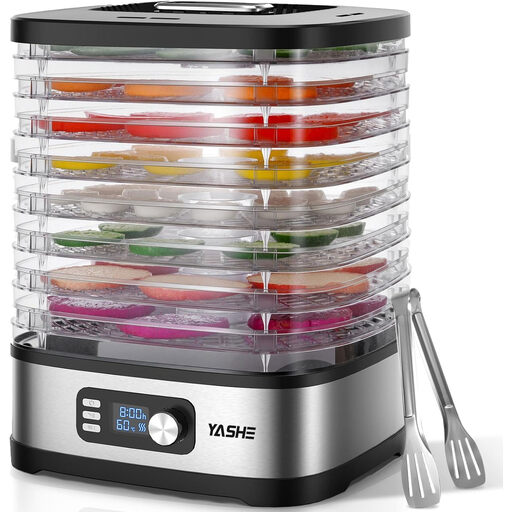 No image available
With eight trays, this model lets you spread apple slices across several layers; the number of trays doesn’t tell you the capacity or drying time.
Eight trays; temperature control from 35–70 °C; adjustable timer up to 72 hours. Includes mesh screens, a fruit leather tray and stainless steel tongs.
 No image available
The stackable trays are a good choice if you want to dry fruit in several layers and set a timer.
Five stainless steel trays; adjustable temperature and timer from 1–48 hours; automatic shut-off; 360° airflow; 400 W.
 No image available
The five layers let you spread apple slices across several levels.
Five layers; adjustable temperature from 35–70 °C; 350 W.
Cut the apples into slices of an even thickness and spread them across the trays. Penn State Extension recommends slices between ⅛–½ inch thick and notes that thinly sliced apples can dry to a crisp. Follow your dehydrator’s instructions too, and check the slices as they dry.
Let the slices cool completely before putting them in a clean, dry, airtight container. For longer storage, the National Center for Home Food Preservation recommends leaving dried fruit loosely packed for 7–10 days and shaking it daily; dry it again if condensation forms. Store it somewhere cool, dry and dark.
No. The Government of the Netherlands says there is no fixed statutory guarantee period in the Netherlands. You are entitled to a product that works as it should, and the retailer is your point of contact if something goes wrong; any manufacturer’s guarantee is separate.
Check that the specific food dehydrator on offer carries CE marking. The Netherlands Food and Consumer Product Safety Authority describes CE marking as mandatory for electrical consumer products, including kitchen appliances. The marking doesn’t tell you how quickly or evenly the appliance will dry apples.
Only if your oven can be set to a suitably low temperature and allows moisture to escape. University of Minnesota Extension says that oven drying takes longer than using a food dehydrator. Check your oven’s manual and allow extra time.